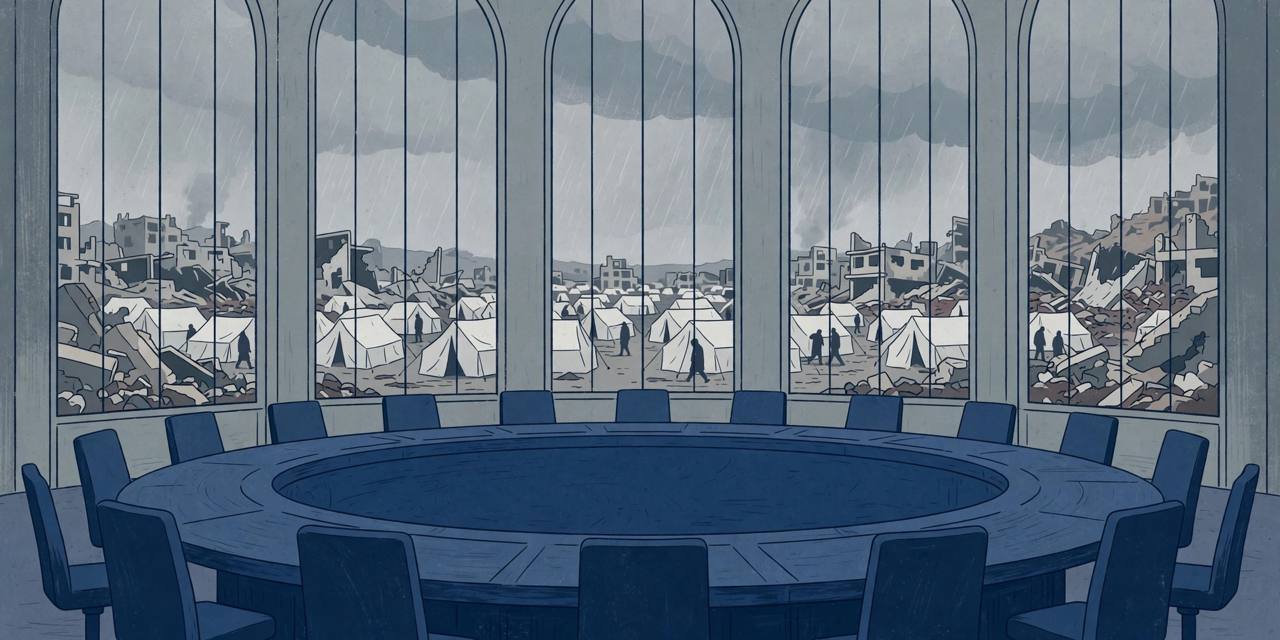
The Board of Peace, the body overseeing the US-brokered ceasefire in Gaza, delivered a bleak first annual report to the United Nations Security Council on Tuesday, warning diplomats that the fragile agreement could collapse if steps are not taken to implement it in full, the Associated Press reported.
Source: Associated Press
“The distance between what has been agreed and what is happening on the ground nonetheless remains the principal risk to the process,” the report says in its conclusion, according to a copy obtained by the AP. It calls on both Israel and Hamas to uphold the commitments made last year and urges the Security Council — the UN's most powerful body — to lend its full support to carrying the agreement out.
“A ceasefire that delivers nothing visible cannot be sustained indefinitely,” the report said. “Should it collapse, there would be no road map to return to, no administration to deploy and no enabling environment to rebuild.”
Administration still locked out, stabilisation force delayed
The report says continued Israeli strikes in Gaza and Hamas military activity have stalled the road map, and laments that the technocratic civil administration the board created to run Gaza on an interim basis has still not been allowed by Israel to take up its job inside the territory. That delay, in turn, has held up deployment of an international stabilisation force — which the report describes as key to Israel withdrawing its troops from Gaza, the disarmament of Hamas and the start of reconstruction.
“Neither party may treat the other's delay as license for its own inaction, and together these obligations are the only route to Israeli withdrawal and reconstruction at scale,” the report said, adding that the end result “must lead to the credible pathway to Palestinian self-determination and statehood … and no unilateral step should be allowed to foreclose it.”
One year on, aid workers call the board a failure
The Security Council gave the Board of Peace its mandate on November 17 last year to manage the ceasefire that took effect on October 10, 2025, and to oversee reconstruction. A year later, aid workers interviewed by The New Humanitarian said there is a near-unanimous consensus among the diplomats and politicians they deal with that the board has been a failure: the Palestinian technocratic committee meant to govern Gaza has not entered the Strip, the international stabilisation force has not arrived, and Israeli restrictions on aid and reconstruction material continue, with COGAT — the Israeli military unit that coordinates with humanitarians — saying no reconstruction equipment will be allowed in until Hamas has been fully and verifiably disarmed.
Source: The New Humanitarian
The human cost of the stalemate is rising with the winter. Gaza health authorities say at least 1,600 Palestinians have been killed since the ceasefire took effect, while five Israeli soldiers have been killed, Reuters reported earlier on Tuesday; the UN migration agency, IOM, separately warned on Tuesday of further deaths from hypothermia after a nine-month-old baby living in a tent died from suspected hypothermia last week, saying displaced families face “another winter in tents and rubble” — the same phrase the board's report uses.
The IOM's winter warning for Gaza's tent encampments was reported earlier on Tuesday. Read: UN agency warns of Gaza hypothermia deaths without more supplies
What is solid
- The Board of Peace delivered its first annual assessment to the UN Security Council on Tuesday, Nov 17, 2026 (AP, from a copy of the report).
- The quoted warnings — including that a ceasefire delivering nothing visible “cannot be sustained indefinitely” — are the report's own words as obtained by the AP.
- The Security Council mandated the Board of Peace on Nov 17, 2025, and the ceasefire took effect on Oct 10, 2025 (The New Humanitarian).
What is only claimed
- Aid workers told The New Humanitarian that diplomats privately regard the board as a total failure; the board's own report instead blames non-implementation by the parties — the two assessments are not the same.
- Casualty figures since the ceasefire come from Gaza health authorities and Israeli tallies and are not independently verified.
What happens next rests with the Security Council, which the board has asked to put its full weight behind the agreement it endorsed last year, and with Israel and Hamas, which the report urges to stop using each other's delays as a reason for their own inaction.