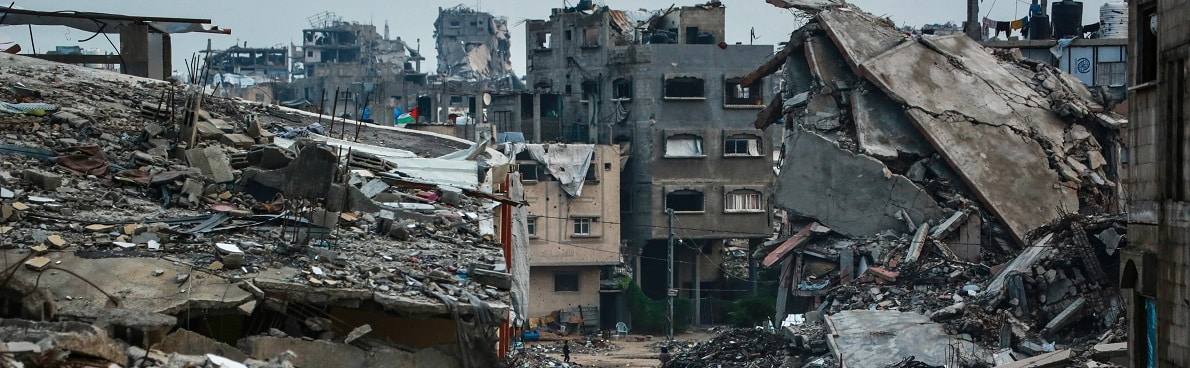
Israel's military assault has turned Gaza into a "toxic wasteland", threatening human survival for decades to come, according to a new report published on Monday by Oxfam and the UK-based Conflict and Environment Observatory (CEOBS).
Source: Oxfam
The report, titled "Environmental War Crimes", says the extensive use of explosive and incendiary weapons has made Gaza's air, soil and water dangerous to Palestinians now and for decades to come, with indicators of toxic contamination across almost the entire Strip.
Its spatial analysis found that the scale and intensity of the assault has affected about 78 per cent of Gaza's land area, and identified indicators of potential contamination across more than 99 per cent of the territory. The contaminants include heavy metals, explosive residues, asbestos from destroyed buildings, dioxins and biological contaminants, along with raw sewage.
Source: Oxfam
Worst-hit areas and poisoned water
The highest levels of potential contamination are concentrated in Gaza City, Khan Younis, Rafah, Jabalia and along the Salah al-Din Road, the report says, reflecting the combined impact of bombardment, widespread destruction and multiple sources of contamination.
The damage to water systems is severe. Only 19 per cent of Gaza's sewage pumping stations are still working, raw sewage is pouring into the sea and leaking into the ground, and faecal coliforms were found in nearly 20 per cent of all drinking water wells — compared with just 2 per cent before 7 October 2023.
61 million tonnes of debris
The UN Environment Programme (UNEP) estimates that Israel's military operations have generated more than 61 million tonnes of debris across the territory, turning destroyed homes, neighbourhoods and infrastructure into a vast reservoir of potentially hazardous materials. The Palestinian Environment Quality Authority puts the figure at between 61 million and 68 million tonnes.
Source: The Guardian
The report's author, Lama Abdul Samad, a global water and sanitation specialist at Oxfam, said tackling the environmental damage will be "highly challenging" because contamination is dispersed across urban rubble, farmland, water systems and soils, while unexploded ordnance continues to restrict safe access to most areas.
The war began on 7 October 2023, when Hamas-led militants attacked southern Israel, killing about 1,200 people and abducting 251. Since then, Gaza's Health Ministry — part of the Hamas-run government, which does not distinguish between civilians and militants — has reported more than 74,000 Palestinians killed and at least 175,000 wounded, with thousands more still unaccounted for under the rubble. A ceasefire that took effect in October 2025 has largely halted major fighting, but Israeli strikes have continued, and the ministry says more than 1,570 Palestinians have been killed since the truce began.
Oxfam's demands — and what happens next
Oxfam is calling for a full, independent, field-based Post-Conflict Environmental Assessment to establish what contaminants are present, where they are found and at what concentrations. The report says the absence of such an assessment is a direct consequence of Israel's continued refusal of independent access to Gaza.
Oxfam International's executive director, Amitabh Behar, said: "Israel's ongoing genocide in Gaza includes military assaults on its environment, which are environmental war crimes threatening life now and for generations to come." The report says the destruction and contamination raise serious concerns under international humanitarian law, international human rights law and occupation law — findings and characterisations that are Oxfam's and CEOBS's, based on satellite imagery, remote sensing, scientific analysis and open-source data, since field testing inside Gaza has not been possible.
With attention turning increasingly to Gaza's reconstruction, Oxfam says environmental recovery must not be treated as an afterthought but as a vital undertaking in parallel — owned and led by Palestinians themselves, rights-based and reparations-oriented. It is urging Israel to allow unrestricted access for aid, environmental assessment teams and essential equipment.
What is solid
- Oxfam and CEOBS published the 'Environmental War Crimes' report on 23 November 2026
- The report's spatial analysis found contamination indicators across more than 99% of Gaza and effects on about 78% of its land area
- UNEP estimates more than 61 million tonnes of debris in Gaza
What is only claimed
- Oxfam calls the assault 'genocide' and 'environmental war crimes' — these are Oxfam's characterisations
- The figure of more than 74,000 killed comes from Gaza's Health Ministry, which does not distinguish civilians from militants