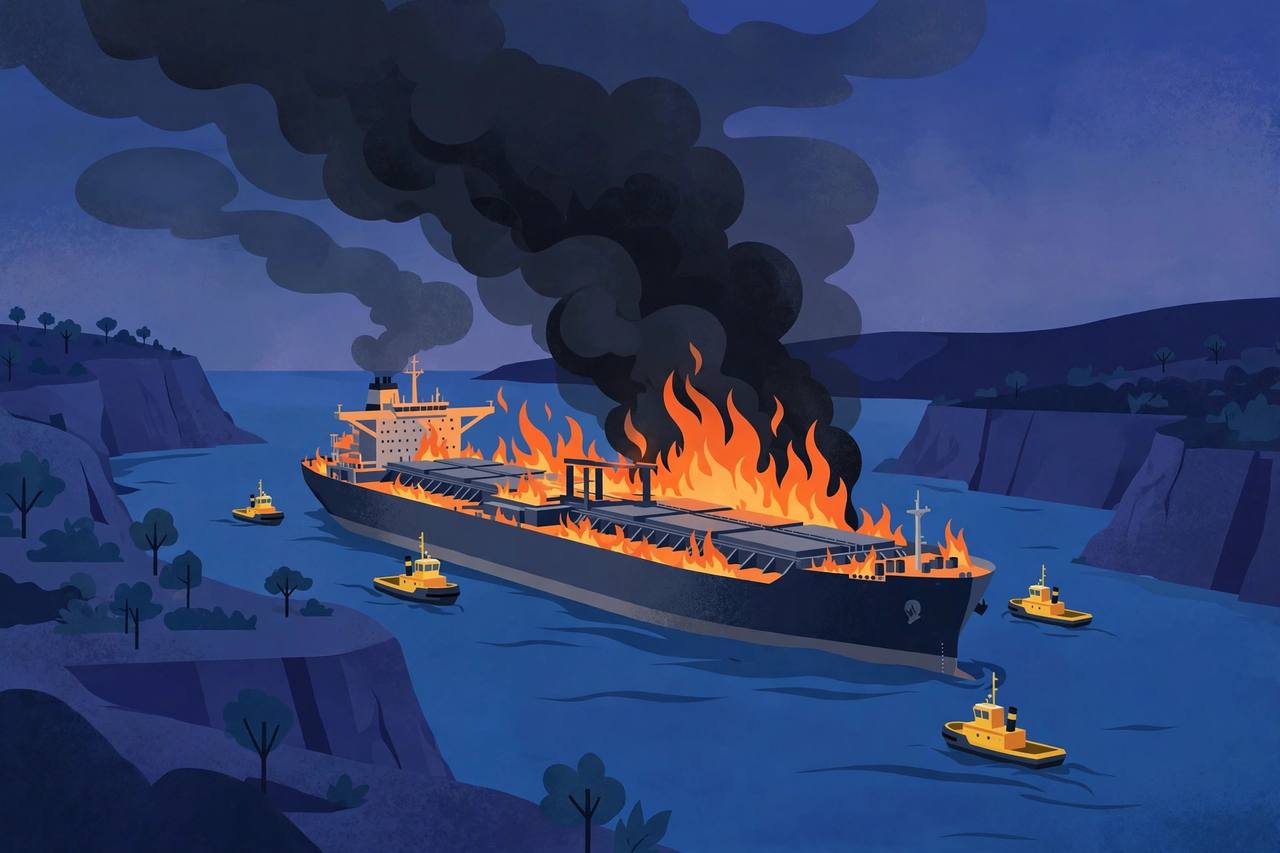
Two oil supertankers exploded and caught fire after striking naval mines in the Strait of Hormuz on Sunday, Iran's navy and the Islamic Revolutionary Guard Corps (IRGC) said, in the latest attack on shipping through the world's most important oil chokepoint.
Source: IRGC Navy via Sepah News
The IRGC Navy said the two vessels were sailing through "unauthorized" routes and had not complied with instructions issued by Iranian naval forces. It said the tankers were brought to a halt north of Oman's Al Ghanam Island and east of the Strait of Hormuz after the explosions.
Iran's Army Navy separately announced on Sunday that two "violating" oil tankers caught fire in the morning after colliding with naval mines east of the strait. It said the vessels had switched off their identification and navigation systems and entered a prohibited zone.
Source: Mehr News Agency
In the same round of Sunday statements, the IRGC also said its air defences had downed a US MQ-1 Predator drone east of the strait — a claim already covered in our earlier report today. Read the MQ-1 drone report
The tankers' names, flags and owners were not given, and the extent of the damage and any environmental impact remained unclear. No casualty figures were given in the Iranian statements.
No independent confirmation yet
No independent source had confirmed by Sunday night that the two tankers actually struck mines. Neither the ships' operators nor the British maritime agency had confirmed the mine strikes, and it was unclear whether a separate incident report filed with the UK Maritime Trade Operations agency — a tanker incident involving military forces in the Gulf of Oman on Sunday — involved the same vessels.
Source: euronews
A strait under daily attack
The United States and Israel launched their joint war on Iran on February 28, and Iran has since tightened its grip on the strait, barring safe passage for vessels belonging to or affiliated with Israel and the United States. Shipping through the chokepoint, which carries about a quarter of the world's seaborne oil trade, has been hit almost daily since.
On Saturday, three tankers were damaged in or near the strait — two struck by unknown projectiles near Oman's Khasab port, according to UKMTO, while Iran's navy said a third hit a naval mine east of the strait. On Friday evening, Qatar's Nakilat shipping company said its LNG carrier Al Mayeda was struck by unidentified objects in the Gulf, with no crew injured and no environmental impact.
Source: Associated Press
Saturday's attacks off Khasab were the latest in a run of strikes on tankers in the strait this month. Read Saturday's report
For the lakhs of Punjabi and Indian workers living in the Gulf, the shipping war is not distant news: the strait is the lifeline for fuel, food and remittances across the region, and every new strike raises the risk to seafarers and to the flights and jobs that depend on Gulf stability. Pakistan secured an emergency oil credit line from Oman on Sunday as fuel supplies are disrupted by the fighting.
What is solid
- Iran's navy and the IRGC say two supertankers hit naval mines east of the Strait of Hormuz on Sunday and caught fire
- UKMTO confirmed it received a report of a tanker incident involving military forces in the Gulf of Oman on Sunday
- The tankers' names, flags and owners were not released
What is only claimed
- Whether the vessels actually struck Iranian mines — no independent source has confirmed the mine claim
- Whether the incident reported to UKMTO involved the same two tankers Iran described
Watch for any statement from the tankers' operators or insurers, for UKMTO's next incident report, and for oil prices when Asian markets open — each new mine claim has pushed traders to price in more risk on Gulf shipping.
The Pentagon has not formally commented on Sunday's tanker claims, and US Central Command has rejected claims that the Iranian attacks were successful, according to reports.
Source: The Independent via Archynewsy