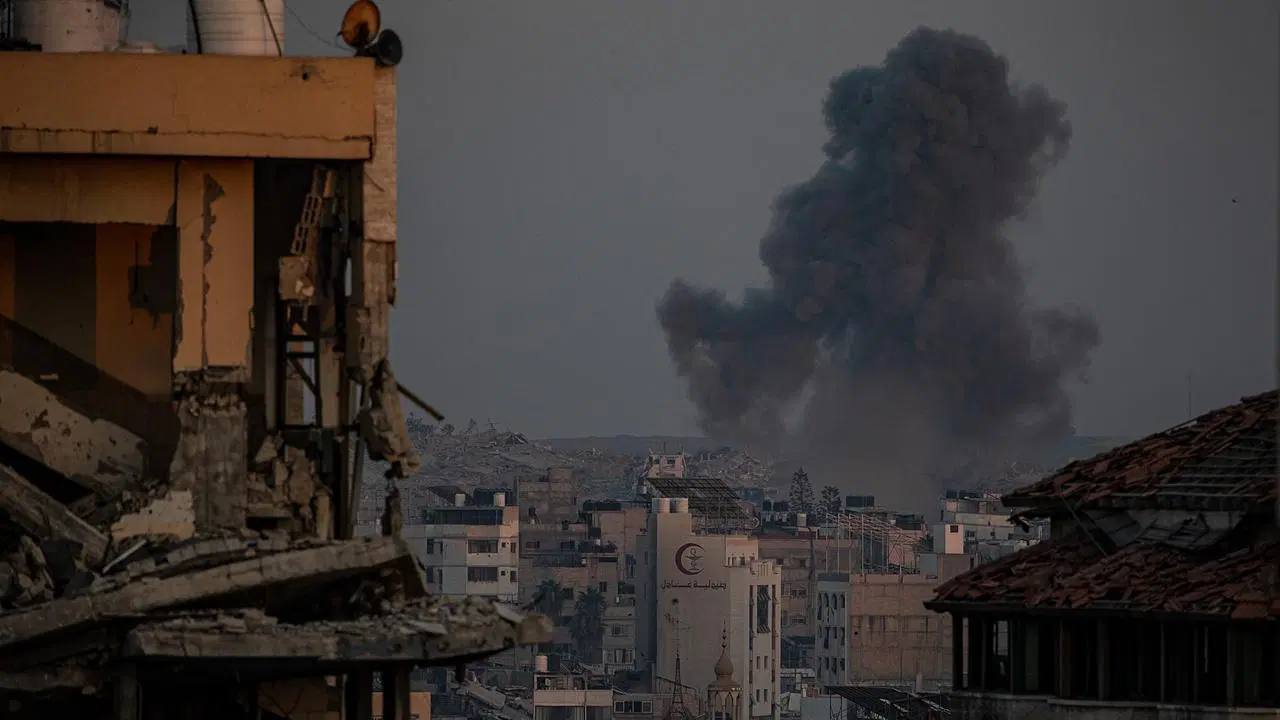
Hamas said on Thursday it is weighing its response after a fresh round of Israeli strikes killed 10 people in Gaza, including a senior Hamas official, raising fears that the year-old ceasefire could unravel further.
Source: Reuters
Khalil al-Hayya, who has led Hamas since July, said the group “cannot accept” continued killings and the blockade under the ceasefire agreement, and would consult other Palestinian factions on how to respond. “The equation of killing and blockade cannot be accepted under the agreement,” Hayya said, without giving details of what a response might look like.
Source: Reuters
The strikes that triggered the warning killed Khaled Abu Nada, a senior Hamas official who also served as a top figure in Gaza’s education administration, hospital officials said. The Israeli military said it had struck several militants in the southern city of Khan Younis and one Hamas militant in northern Gaza. Abu Nada is the third senior Hamas figure killed in three days — internal security chief Naeem Abu Nahel was killed on Tuesday, November 24, and northern Gaza security chief Muhammad Abu al-Ouf a day later.
Source: Reuters / BBC
Katz threatens to move a million Gazans
On the same day, Defence Minister Israel Katz threatened to displace one million Palestinians in Gaza unless Hamas gives up its weapons. Writing on X, Katz said Hamas must disarm voluntarily under US President Donald Trump’s plan, or Israeli forces will do it — including by moving a million residents south. Trump announced in July that the group had agreed to disarm, a claim Hamas has not accepted.
Source: France24 via QuietBrief
Hamas called the continued strikes a violation of the ceasefire agreement and international law, and blamed the US-backed Board of Peace — the body set up under Trump’s plan — for failing to stop the attacks and for providing cover that encouraged further killings. “Palestinian blood is precious and a policy of silence regarding the occupation’s crimes is unacceptable from the Board of Peace and the guarantors,” Hayya said.
Source: World Today Journal / Al-Monitor
Thursday’s strikes themselves — including the killing of Abu Nada — were reported earlier. This story follows Hamas’s response and Israel’s new displacement threat. Read the earlier story: Israeli strikes kill eight in Gaza, including Abu Nada
A ceasefire under strain
The ceasefire that took effect in October 2025 has largely halted major fighting, but near-daily Israeli strikes have continued. More than 1,600 Palestinians and five Israeli soldiers have been killed since the truce began, according to tallies cited by Al-Monitor, bringing the overall death toll from the war to more than 74,500. The war began when Hamas-led militants attacked southern Israel on October 7, 2023, killing around 1,200 people and abducting 251.
Source: Al-Monitor / BBC
Meanwhile, mediators from the United States, Qatar and Egypt are holding talks in Cairo aimed at a broader Gaza deal, including hostage releases and Israeli withdrawal terms. Whether those talks can absorb the shock of the latest targeted killings — and whatever response Hamas and its allied factions announce — is now the open question.
Source: Archynetys
What happens next
Hamas faces a difficult calculation: responding militarily risks triggering broader Israeli operations, while restraint may be seen domestically as weakness. Watch for three things — whether Hamas and the other factions announce a concrete response, whether Israel carries out the displacement threat Katz posted, and whether the Cairo mediation produces anything that steadies a ceasefire both sides now accuse the other of breaking.