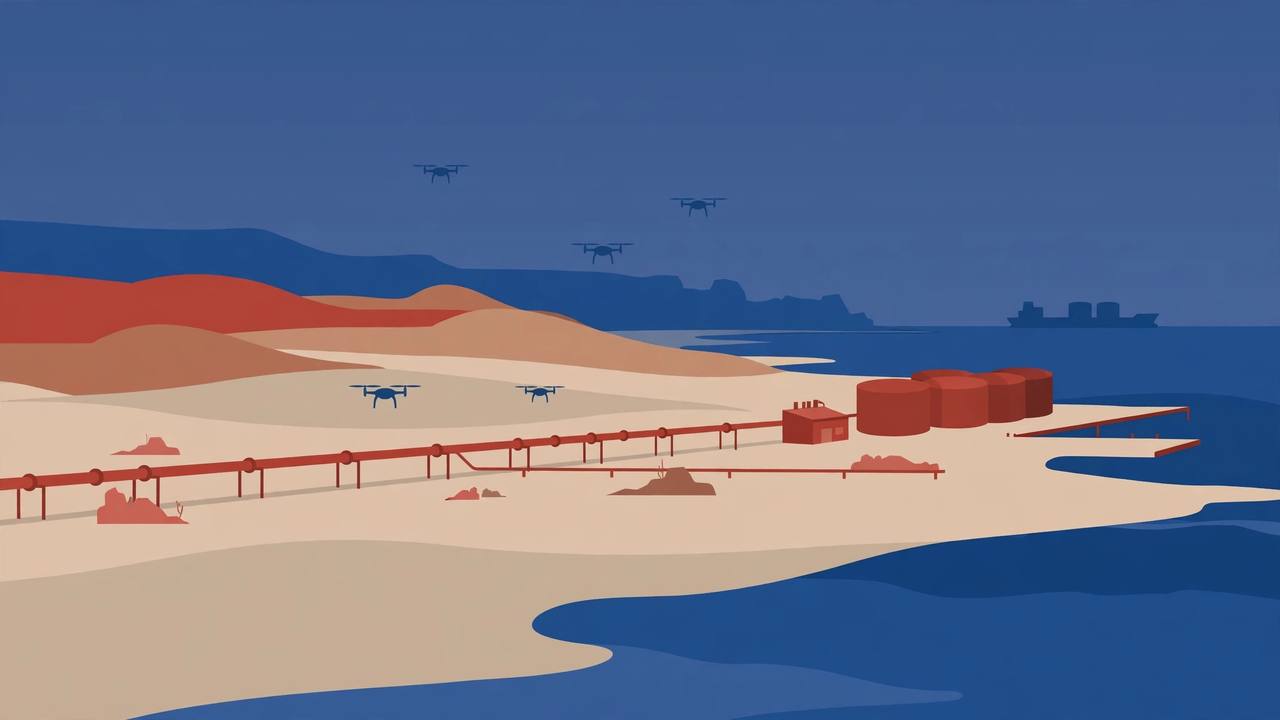
Yemen's Iran-aligned Houthis said on Tuesday, November 17, that they had launched a total of five drones towards two pumping stations along Saudi Arabia's vital East-West pipeline in the Riyadh area, Reuters reported. There was no immediate Saudi confirmation of the claim, and Reuters did not report any confirmed damage to the pipeline.
Source: Reuters via Duke FM
The claim is a new one, made on Tuesday, and is separate from the group's earlier claims this month. Reuters noted that the Houthis have claimed several times this month to have attacked the pipeline, as fighting continues between the group and the Saudi-led coalition backing Yemen's internationally recognised government.
Awaaz Punjab reported the group's earlier claim, aimed at Riyadh airport and a pipeline pumping station, on November 13. Read the November 13 claim
Why this pipeline matters
Since the Middle East conflict disrupted oil flows through the Strait of Hormuz, Riyadh has rerouted about 4 million barrels of crude per day via the East-West pipeline to the Red Sea port of Yanbu — yaani 40 lakh barrels roz — equivalent to about 4% of global supply, Reuters reported. For Saudi Arabia, the world's biggest oil exporter, the pipeline has mitigated the impact of the wartime shutdown of the Strait of Hormuz, which has crippled exports from its neighbours.
Oil markets moved on the day's Gulf tensions. Brent crude futures were up $1.06, or 1.15%, at $93.50 a barrel by 1:48 p.m. EST on Tuesday, and US West Texas Intermediate futures rose 84 cents, or 0.98%, to $86.56, Reuters reported in a separate market dispatch.
Source: Reuters via Euronext Live
The gains were capped by expectations of a supply surplus. The Brent benchmark has still fallen 20% this month and WTI 16%, and on Friday the International Energy Agency said the global oil market will return to surplus in the fourth quarter as Middle East exports recover faster than global demand. Middle East Gulf exporters have increased flows towards levels achieved before the US-Israeli war on Iran began, Reuters said.
"The rhetoric is cranked up," said Bob Yawger, director of energy futures at Mizuho, referring to retaliatory attacks between the US and Iran — but he noted that the prospect of an oversupplied market offset some of the gains. Tamas Varga, an oil analyst at the brokerage PVM, said: "Brent is trading in a range. At the moment there are two opposing forces at work," with some traders expecting Middle East supply to increase while others focus on the risks of war-related disruptions.
The pipeline claim landed on a day of wider Gulf escalation. Iranian drones attacked a US military radar system in Bahrain on Tuesday, and the crew of a ship in the Strait of Hormuz was unaccounted for after the vessel was hit twice, Reuters reported. Iranian media later reported an explosion on Iran's Qeshm Island and cited an Iranian official as saying the US had carried out an attack there without causing damage to infrastructure — a claim attributed to Iranian media and not independently confirmed in the report.
Awaaz Punjab's coverage of Tuesday's Bahrain drone attack and the reported US strike on Qeshm Island is in the Geopolitics section. Bahrain airbase drone attack
What happens next
The next step is a Saudi response: at the time of the Reuters report there was no Saudi confirmation of the drone claim and no report of any disruption to pipeline flows. Traders were also awaiting weekly US inventory data, with American Petroleum Institute figures due at 2030 GMT on Tuesday and Energy Information Administration data on Wednesday; a Reuters poll expected US crude stockpiles to have fallen. US Strategic Petroleum Reserve stocks fell last week to 276.4 million barrels, their lowest level since August 1982, under a US agreement to release 172 million barrels from the facility, Reuters reported.
For the lakhs of Punjabi and Indian workers across Saudi Arabia and the Gulf, the East-West pipeline is the bypass route that has kept Saudi crude exports — and the jobs and remittances tied to the kingdom's oil economy — moving while the Strait of Hormuz remains disrupted. No impact on workers, flights or remittances was reported in connection with Tuesday's claim.
What is solid
- The Houthis said on Tuesday they launched five drones towards two East-West pipeline pumping stations in the Riyadh area (Reuters)
- There was no immediate Saudi confirmation of the claim
- About 4 million barrels a day are being rerouted via the pipeline to Yanbu, about 4% of global supply (Reuters)
- Brent rose 1.15% to $93.50 a barrel on Tuesday (Reuters market dispatch)
What is only claimed
- Whether any drone reached or damaged a pumping station — unconfirmed
- The Houthis' repeated pipeline-attack claims this month remain unverified