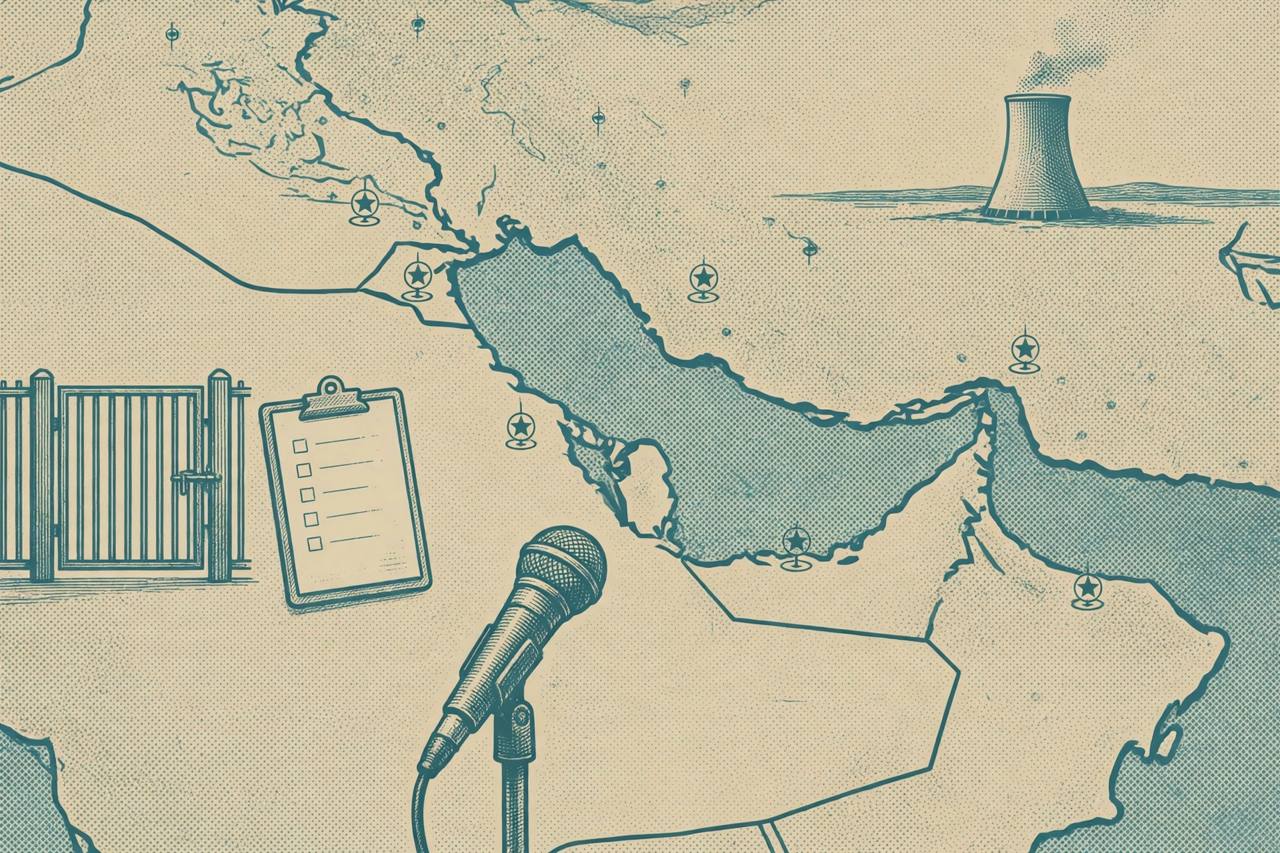
Iran's Foreign Ministry spokesman Esmaeil Baghaei used his weekly press conference in Tehran on Sunday, November 15, to close three doors at once: he said Iran and the United States are not discussing a suspension of uranium enrichment, that the return of International Atomic Energy Agency (IAEA) inspectors to Iran's nuclear facilities is not practical under current circumstances, and that Tehran holds documented evidence of Gulf states helping US attacks on Iran.
Source: TASS via Hatha Alyoum
"We have not been discussing the details of the nuclear issue at all," Baghaei said, according to Russia's TASS news agency — a direct rejection of any suggestion that enrichment, the most sensitive part of Iran's nuclear programme, is on a negotiating table with Washington.
Source: TASS via Hatha Alyoum
IAEA accused of bias; inspectors' return ruled out for now
Baghaei said American and European influence had "severely damaged the credibility" of the IAEA, and described the leaking of the agency's reports to Western media before their official release as a deliberate, structural flaw in the institution's management. Asked about demands from the IAEA and the G7 that Iran resume cooperation and readmit inspectors, he said the agency could not make such a request without considering the broader context, noting that the agency itself had acknowledged that US-Israeli military attacks had created unprecedented conditions that disrupted inspectors' access.
Source: Voice of Emirates
"It must decide whether it wishes to operate as an independent technical body or continue to function under American and European influence," Baghaei told the agency. The remarks come days after an IAEA report on an uninspected enrichment facility at Isfahan deepened the standoff over monitoring of Iran's programme.
"All cases have been documented" — the warning to Gulf states
Baghaei said Tehran had documented evidence of regional countries' involvement in assisting US attacks on Iran, and that Iran had raised the issue directly through diplomatic channels. "All cases indicating the role of countries in the region in helping the US attack Iran have been documented," he said, according to Al Jazeera, adding that Tehran would "follow up on this matter seriously".
Source: Antara via Jawawa, citing Al Jazeera
He said the launch of missiles, drones and aircraft from military bases in those countries, as well as logistical support provided to US forces, demonstrated their involvement, and that "the responsibility of countries in the region for the consequences of the military aggression by the United States and the Zionist regime against Iran is clear". The claim is Iran's allegation; Tehran published no evidence on Sunday, and no Gulf government had responded to this latest statement by Sunday morning.
Baghaei defended Iran's own attacks on neighbouring countries as carried out under Article 51 of the UN Charter, which covers self-defence. "No action has been taken by Iran against the sovereignty of those countries," he said, insisting Tehran's attacks were "purely defensive" and targeted only US bases and military assets used to attack Iran. Gulf governments and the United States have rejected that characterisation in earlier exchanges, pointing to Iranian strikes that they say hit Gulf territory and civilian infrastructure.
"They have to eat eventually" — Tehran answers Rubio
The spokesman also accused the United States of openly threatening to starve Iranians through its economic blockade, responding to a remark by US Secretary of State Marco Rubio — "They have to eat eventually" — about pressure on Tehran. Iran's finance minister separately dismissed US economic threats as ineffective, saying trade and exports continue to grow despite sanctions, according to reports of the same briefing.
Source: Inshorts
Background: a war in its ninth month, and a Gulf on edge
The press conference came the morning after Iran's Revolutionary Guards claimed a six-drone strike on a US air-defence radar at Bahrain's Al-Riffa helicopter base — a claim Bahrain said its air defences had thwarted — and as Parliament Speaker Mohammad Bagher Ghalibaf, Tehran's top negotiator, kept Iran's seven conditions for talks on the table. The war that began with US-Israeli strikes on Iran on February 28 has kept the Strait of Hormuz largely closed to normal shipping and has repeatedly drawn in the Gulf states that host US forces — states where lakhs of Punjabi and Indian workers live and work, and whose safety and remittance routes depend on the waterway staying calm.
What happens next turns on three tests: whether the IAEA's board presses its access demands when it next meets, whether any Gulf government answers Tehran's evidence claim publicly, and whether Washington and Tehran's indirect channels produce the nuclear conversation Baghaei says is not happening. None of the three had moved by Sunday morning in Toronto.