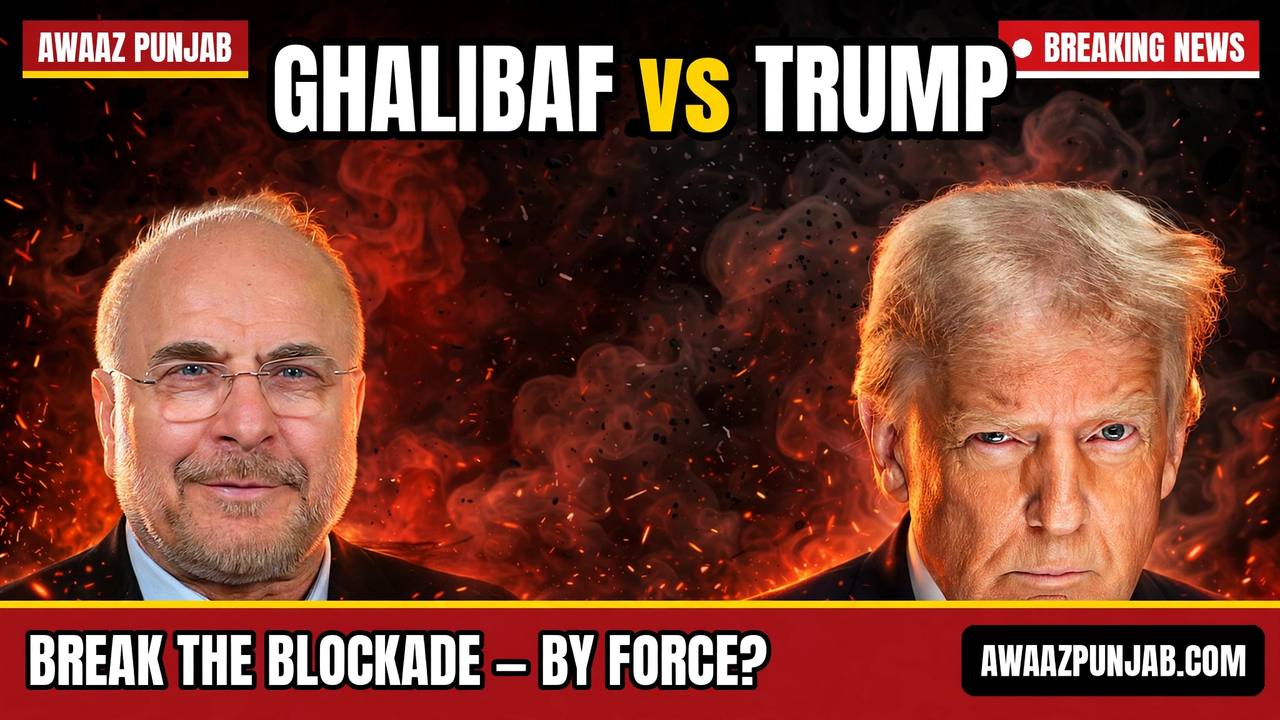
Iran's parliament speaker and top negotiator, Mohammad Bagher Ghalibaf, said on Monday, 23 November, that Tehran has military ways to break the United States' naval blockade of its ports — and will use them in the near future. It was the sharpest warning yet from Iran's leadership that the eight-month standoff with Washington, which both sides describe as a state of "no war, no peace", may be heading toward a new round of fighting.
Three days ago, Iran's deputy foreign minister called the blockade an "act of war" and vowed to break it. Ghalibaf's statement raises that threat to the top of Iran's leadership. Read the earlier report
"The enemy wants to impose a no-war, no-peace situation to drain us," Ghalibaf said in remarks carried by Iranian state media. "The question now is how, by whom, and with what actions should we resolve this situation." He said "sustainable deterrence means strengthening the country", described diplomacy and war as two tools for the same end, and then said there are military ways to break the siege that Iran will pursue in the near future.
Ghalibaf said Iran's supreme leader, Mojtaba Khamenei, had told him that the "no war, no peace situation cannot continue and should be resolved". He added that an agreement is possible only if Washington accepts Iran's seven conditions — including lifting the naval blockade and sanctions, releasing frozen Iranian funds, ending fighting on all fronts, and formally declaring the war over. He said a "carrot and stick" approach from Washington would not work.
Foreign ministry backs the threat — and cites the UN Charter
At the foreign ministry's weekly briefing in Tehran on the same day, spokesman Esmaeil Baghaei said Iran would "use all available means to counter US aggression". He said sanctions, an economic blockade and a naval blockade together amount to "an act of military aggression against Iran", and that under Article 51 of the UN Charter, Iran is entitled to use any means at its disposal to defend itself.
Foreign Minister Abbas Araghchi, meanwhile, called a land blockade of Iran "almost impossible", given the country's vast size and the diversity of its provinces, each with its own routes and capabilities. He said his ministry is still pursuing negotiations and the lifting of sanctions.
Qatar's prime minister in Washington: the region cannot afford escalation
On the same day, Qatar's prime minister and foreign minister, Sheikh Mohammed bin Abdulrahman Al Thani, met US Secretary of State Marco Rubio and Vice President JD Vance in Washington. "The situation in the Middle East cannot afford a new escalation between the US and Iran," he said after the meeting, adding that Doha is working with both governments to revive the negotiations.
In a joint statement on the eighth US-Qatar Strategic Dialogue, released by the State Department, Rubio reaffirmed the United States' commitment to Qatar's security. Both sides reaffirmed their commitment to upholding freedom of navigation through the Strait of Hormuz, and reviewed a $38 billion US-Qatar statement of intent on defence — yaani lagbhag ₹3.34 lakh crore. President Donald Trump, after hosting the Qatari prime minister, said there was "momentum towards the end of this conflict". Rubio, however, has described Iran's demands as "unacceptable".
Fresh US sanctions — and a diplomatic row with Doha
Washington answered on Monday with fresh sanctions on an Iranian banking network, which the US Treasury described as a shadow banking system moving Iranian money through front companies. Treasury Secretary Scott Bessent wrote that "Iran's economy is underwater, and its leaders are panicking". Nobody announced a date for talks.
Tehran also summoned Qatar's chargé d'affaires over a statement Qatar signed with Germany on Saturday, at the end of Emir Tamim bin Hamad Al Thani's visit to Berlin, condemning Iranian attacks on Qatar as a "flagrant violation" of its sovereignty and rejecting any obstruction of shipping in Hormuz. Baghaei called the claims "completely baseless and unacceptable" and said Iran had struck only American bases on Qatari soil.
The wider picture: a war in limbo, and a strait under strain
The United States and Israel struck Iran on 28 February 2026. Large-scale fighting ended in June with a framework agreement, but clashes have flared at intervals since July. The US Navy has blockaded Iranian ports since April, and Iran has kept shipping through the Strait of Hormuz under attack. A preliminary agreement to end the war and reopen the strait, reached in June, collapsed within weeks.
Ghalibaf told Al Jazeera that the Strait of Hormuz will "never return" to its status before the war, and that Iran and Oman have reached an understanding to oversee the waterway as part of Tehran's seven-point proposal. Just five commodity vessels crossed the strait on Saturday, 7 November, against 31 the previous weekend, according to ship-tracking data cited by Reuters. The strait normally carries about a fifth of the world's oil and gas shipments.
Two claims from Monday evening remain unconfirmed by independent sources: the Revolutionary Guards' navy said three tankers had hit mines in the Strait of Hormuz, causing "explosions and massive fires", and the Iranian army said it had shot down a US drone east of the strait. The Institute for the Study of War also reported that Iran recently targeted US Patriot air defence radars in Bahrain, likely to degrade American air defences if major combat resumes.
What it means for Gulf workers — and what happens next
For the lakhs of Punjabi and Indian workers living in the Gulf, the stakes are direct: Qatar hosts the largest American base in the region, and any new round of fighting would put flights, jobs, remittances and safety across the Gulf at risk. Brent crude, the global oil benchmark, was trading near $88.71 a barrel on Tuesday — close to a three-month low — as markets weighed rising supply against the shipping threat in Hormuz.
No date has been set for talks, and none of the three Iranian officials named a date for any move against the blockade. Trump has said he leans toward new strikes after 1 January if there is no deal, and warned that ships trying to run the blockade would end up "at the bottom of the sea". What to watch: an Iranian tanker or warship heading for the Gulf of Oman under escort, a new Qatari visit to Tehran, or a reply from Washington to Iran's seven conditions.