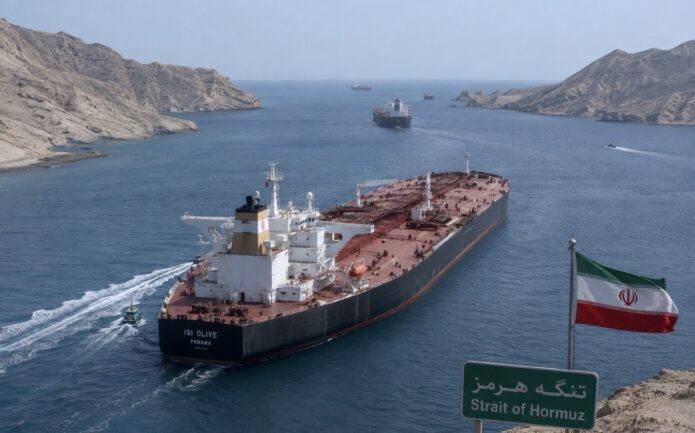
Iran has called the United States' economic blockade an 'act of war' and vowed to take all necessary measures to break it, Deputy Foreign Minister Kazem Gharibabadi said on Saturday, as Qatar pressed on with mediation and Tehran kept its two-day plan to reopen the Strait of Hormuz on the table.
Source: IANS
Days earlier, Iran readied a convoy of tankers at Kharg Island to test the American naval blockade. This statement is the sharpest warning yet that Tehran intends to challenge it. Read the earlier report
What Gharibabadi said
Speaking to reporters in Tehran on Saturday, Gharibabadi — the deputy foreign minister for legal and international affairs — said Iran would not accept economic pressure as a means of imposing political demands, and would respond to the blockade 'through appropriate measures', according to IANS, which cited local media.
"We consider the economic siege a hostile act, and we will take any necessary measures to break this economic siege," Gharibabadi said, according to Iran's Tasnim news agency. Xinhua also reported his remarks, confirming that Tehran regards the blockade as an 'act of war'.
Qatar's mediators in Tehran
Gharibabadi confirmed that a Qatari delegation visited Tehran on Friday night and held about two hours of discussions before returning to Doha. He thanked Qatar for its diplomatic efforts and for facilitating communications between the two sides, Iran's state-run IRNA news agency reported.
Tehran remains in contact with mediators, including Qatar, to examine whether diplomacy can be given another chance — through in-person meetings and virtual exchanges, he said.
The two-day plan stays on the table
Gharibabadi said Iran's two-day proposal — presented by Foreign Minister Abbas Araghchi to the Sultan of Oman — remained on the table as Tehran's only formally submitted plan. Under it, Washington would meet Iran's conditions and Tehran would reopen the Strait of Hormuz. Progress, he said, depends on Washington meeting the requirements for implementing the proposal.
"Whenever the United States meets the requirements for implementing the plan, we can move forward with confidence," Gharibabadi told reporters, according to Xinhua.
Dirty-bomb claims dismissed
Addressing recent American allegations about the possibility of Iran using chemical weapons or a dirty bomb in Washington, Gharibabadi dismissed them as politically motivated claims intended to advance Washington's political and military objectives. US media have reported American intelligence assessments that Iran could be plotting such an attack; Tehran denies it.
He said the allegations followed the same pattern as previous claims about Iran's nuclear programme, and that 'not a single gram' of Iran's nuclear material had been diverted to military purposes, IANS reported.
On the nuclear programme itself, Gharibabadi said no negotiations had yet begun, and repeated Tehran's position that its enriched uranium must not be transferred outside the country.
The war behind the warning
The blockade is the economic front of a war that began on February 28, when Israel and the United States launched joint attacks on Tehran and other Iranian cities. Iran answered with waves of missile and drone attacks on Israel and American bases in the region, and tightened its grip on the Strait of Hormuz, the narrow waterway that carries a large share of the world's seaborne oil.
The same Saturday brought fresh strikes in Bahrain, where Iran said it hit American air-defence radars and Bahrain reported a fire at a civilian industrial facility. Read the Bahrain report
The squeeze at home
The blockade is biting inside Iran. President Masoud Pezeshkian warned on Saturday that the country is engaged in a 'silent economic war', and Iran will begin rationing electricity from Sunday, November 22, after strikes damaged its energy infrastructure. Authorities have also begun 'purchase management' for bread in some areas.
Iran begins rolling power cuts on Sunday as war damage deepens its energy crisis. Read the earlier report
Why it matters for the Gulf — and its workers
Lakhs of Punjabi and Indian workers live and work across the Gulf, and the blockade and the fighting around Hormuz bear directly on their safety, their jobs, and the flights and remittances their families depend on. A tanker convoy challenging the blockade — or a new round of strikes — would put Gulf shipping, oil prices and those workers' daily lives at the centre of the next escalation.
What happens next
Mediators in Qatar, Oman and Pakistan are expected to keep carrying proposals between the two sides, and Gharibabadi said the two-day plan remains Tehran's offer. Washington has not yet publicly responded to Saturday's warning. US President Donald Trump told an Israeli outlet he is not rushing decisions on Iran and may not decide until 2027 — even as his administration weighs further action alongside Israel.
If the Kharg convoy sails, the United States will have to choose between letting it through — collapsing the blockade — or stopping it by force, a dilemma the Washington-based Institute for the Study of War has warned would strain American ties with its Gulf allies. For now, Tehran says the diplomacy must be given a chance — and the blockade, in its words, must be lifted 'rationally'.
What is solid
- Gharibabadi said on Saturday that Iran considers the US economic blockade an 'act of war' and will take all necessary measures to break it (IANS, Xinhua).
- A Qatari delegation visited Tehran on Friday night and held about two hours of talks (IANS, IRNA).
- Iran's two-day plan to end hostilities and reopen the Strait of Hormuz remains its only formally submitted proposal (IANS, Xinhua).
- Gharibabadi said no negotiations on the nuclear programme have yet begun (IANS).
What is only claimed
- The American allegation that Iran could use chemical weapons or a dirty bomb in Washington — reported by US media from intelligence assessments, dismissed by Tehran as politically motivated.
- The Revolutionary Guard Corps' claim that its strikes hit two American Patriot radars in Bahrain — Bahrain reported a fire at a civilian industrial facility and no injuries.