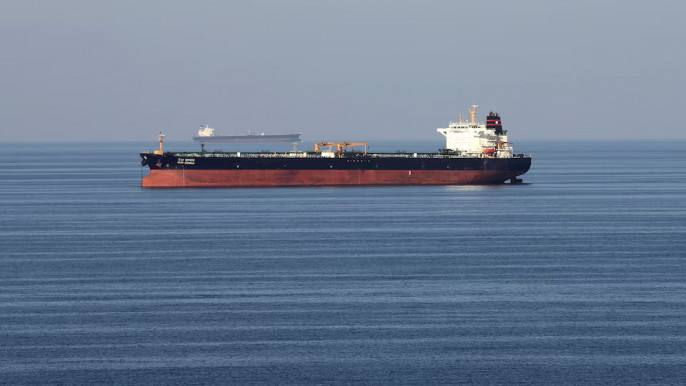
Iran's navy says its forces have recovered two Iranian oil tankers that the United States military had seized, with naval commander Rear Admiral Shahram Irani claiming his commandos boarded the vessels while their crews were asleep and brought them back under Iranian control. The claim was made on Friday at Friday prayers in Tehran and carried by the semi-official Fars news agency.
Source: Anadolu Agency
“US military stole two Iranian oil tankers, but our forces boarded the ships while their crews were asleep and managed to recover them,” Irani was quoted as saying. He said the commandos also apprehended the security personnel assigned to guard the vessels, and that the tankers were recovered along with their equipment.
Tehran has not named the two tankers, identified their owners or flag states, or said when the alleged American seizure took place or when the recovery happened. It has published no photographs, tracking data or other evidence that would let anyone independently establish that the vessels were taken by US forces and then retaken. Al Jazeera noted that the timing of the alleged seizure and recovery remained unclear, and Washington has not commented on the claim. Until independent confirmation emerges, the recovery must be treated as an Iranian military assertion, not an established fact.
Two days earlier, Iran said two oil tankers hit naval mines and caught fire in the Strait of Hormuz near Ghavam Island. That is a separate incident from this claim, and no link between the two has been established. Read the Ghavam mine story
In the same remarks, Irani made a second major claim: that Iranian forces struck the US aircraft carrier USS Abraham Lincoln with a missile on the first day of the war, February 28, 2026. That claim is likewise unverified, with no independent confirmation and no comment from Washington. Irani also alleged that the US military charges shipowners money for safe passage through the Strait of Hormuz and refuses to accept responsibility when vessels come under attack.
Source: Press TV
The war at sea so far
Today is day 273 of the US-Iran war, which began on February 28, 2026, and no ceasefire is in effect. The Strait of Hormuz remains effectively closed to normal traffic: the seven-day average stands at 3 percent of pre-war transits — 2.7 vessels a day against 97 before the war — with tankers at just 1 percent. Iran's strait authority has added 26 more tugs and offshore support vessels to its non-compliance list, which now covers 266 ships.
Source: HELIOS Global Watch / Reuters
The claim comes a day after a drone attack in Kuwait killed two Italian technicians servicing Skyguard radars for Rheinmetall Italia and wounded two others. Kuwaiti authorities attributed the attack to Iran; Tehran denies it. Iran also said on Friday that its air defences fired warning shots at a US F-16 fighter jet near Hengam Island in the Gulf, a claim Washington has not confirmed.
On Thanksgiving, US President Donald Trump told American troops that victory over Iran was “at hand” and would come “whenever I want it to be,” while still offering Tehran a chance to reach a deal. He said Washington is adding an aircraft carrier to the Middle East and named Pickaxe Mountain — the suspected underground nuclear site near Natanz — as the target if US strikes resume. Israel's military spokesman said Israel is ready to strike Iran “at any moment,” even without US forces.
Oil markets have felt the shipping war all week. Reuters said Brent crude settled on Thursday at its highest since November 6, pushed up by the attacks on Hormuz shipping and on Saudi energy sites, with both Brent and WTI headed for their first weekly gain in four weeks. A Houthi projectile struck Saudi Arabia's 400,000-barrel-a-day Jazan refinery on Thursday, starting a fire that halted some operations and killed a Nepalese worker.
For the Gulf's Indian and Punjabi workers, the stakes are direct. Thousands of Indian seafarers crew the tankers and cargo ships that move through the Gulf, and the strait's near-closure has kept shipping disrupted for months. Every new claim of a boarding, a mine strike or a seizure adds to the risk faced by crews and to the worry of their families back home — even when, as with today's claim, the facts themselves remain unverified.
What happens next
Three things will settle whether today's claim is real. First, whether Washington responds at all — a denial, a confirmation or continued silence each point in a different direction. Second, whether Tehran names the vessels or produces any evidence: ship names, dates, positions or imagery would let independent trackers check the story. Third, the wider military picture: the extra US carrier's arrival date, and Sunday's OPEC meeting, where Iraq is seeking a higher quota, will shape how far this shipping war escalates or eases.
What is solid
- Rear Admiral Shahram Irani made the claim on Friday at Friday prayers in Tehran; it was carried by Fars and reported by Anadolu Agency.
- Tehran has named no ships, given no dates and offered no evidence for the recovery.
- Washington has not commented on the claim.
- The Strait of Hormuz remains effectively closed, with transits at 3 percent of pre-war levels.
What is only claimed
- Whether Iranian forces retook two oil tankers seized by US forces.
- Whether Iran struck the USS Abraham Lincoln with a missile on February 28, 2026.
- Whether the US military charges shipowners for safe passage through the strait.