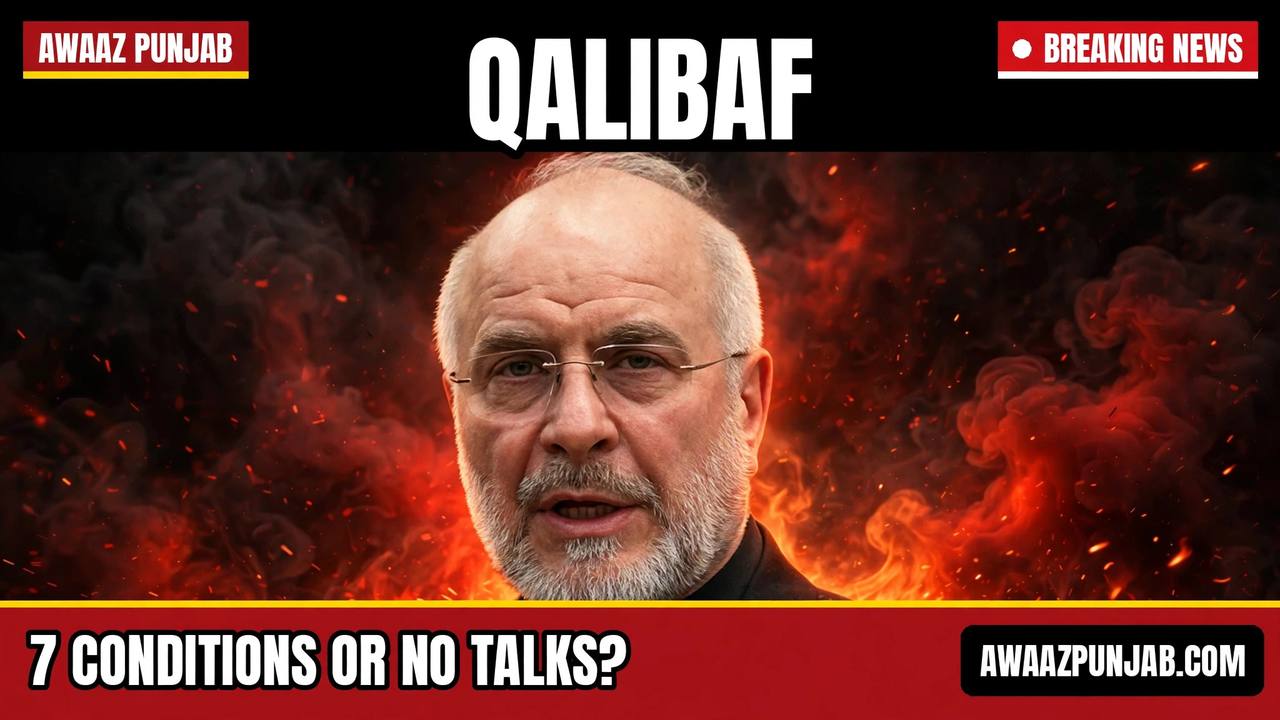
Iran will hold no negotiations with the United States to end the war until Tehran's seven conditions are met, the country's parliament speaker and chief negotiator, Mohammad Bagher Qalibaf, said on Tuesday, according to Iranian state television.
Source: Associated Press
Iranian authorities have not publicly spelled out what the seven conditions are. But Iranian state media have said they include the lifting of sanctions, the ending of the US naval blockade of Iranian ports and the release of seized Iranian assets.
Source: Associated Press
Qalibaf also warned that Iran would "shift the geographical scope of the conflict should the enemy make a mistake," a signal that Tehran is prepared to widen the war beyond its current fronts if it judges Washington has crossed a line.
Source: The Independent via Khabr
The statement came a day after Iran's Revolutionary Guard navy said three oil tankers had struck naval mines in the Strait of Hormuz and caught fire. Read the earlier report on the tanker fires
The naval arm of Iran's Revolutionary Guard said in a post on Telegram on Monday that the three tankers struck the mines because they were "in violation of regulations" regarding passage through the strait, and that the vessels were "engulfed in flames" despite being under US aerial escort. It warned that the strait "is not a place to test unauthorized routes or to disregard maritime warnings."
Source: Associated Press
The Guard's account has been disputed by Western bodies, and no independent confirmation of the cause of the fires, the identities of the tankers, or any casualties has been published. The Guard gave no details on casualties, cargo or the nationalities of the crews and ships.
Source: Trends MENA
Qatar mediation, Washington's answer
Qatar has stepped up diplomatic efforts to revive negotiations between Washington and Tehran. Prime Minister Sheikh Mohammed bin Abdulrahman bin Jassim Al Thani met US Secretary of State Marco Rubio in Washington on Monday and said the Middle East could not withstand another escalation between the two countries.
Source: Trends MENA
A joint statement after the meeting reaffirmed both countries' commitment to freedom of navigation through the Strait of Hormuz, stressing that safe and unimpeded passage was essential for regional security, reliable energy supplies and global economic stability. Doha said it was working with both sides to restart negotiations.
Source: Trends MENA
But Rubio has rejected Tehran's terms as unacceptable, unreasonable and unrealistic, according to the same report — leaving the two sides far apart even as Qatar keeps talking to both.
Source: Trends MENA
Iranian Foreign Ministry spokesperson Esmaeil Baghaei said security could be restored in the Strait of Hormuz and the wider region within the shortest possible time if Washington fulfilled its commitments and accepted Tehran's conditions.
Source: Trends MENA
Oil market barely moves
Oil prices fell to near three-month lows on Tuesday despite the Hormuz incidents, with Brent crude around $88.62 a barrel and US West Texas Intermediate around $79.53, after October highs of more than $100 a barrel for both benchmarks. Reuters quoted DBS Bank's head of energy research, Suvro Sarkar, as saying supply conditions remain benign despite the continued closure of the strait, and the market is weighing a possible future supply glut against persistent Middle East tensions.
Source: Reuters via OilPrice
What this means for Gulf workers
For the lakhs of Indian and Punjabi workers living in the Gulf, the standoff matters in direct, everyday ways: shipping risk in the Strait of Hormuz can disrupt flights and supply routes, oil-price swings feed into fuel and living costs, and any widening of the conflict would put worker safety in the region's ports, refineries and construction sites back at the centre of the story. No new evacuation or advisory has been announced; families should watch official advisories from the Indian and host governments.
Background
The war between the United States and Iran has run since late February 2026, fought through US strikes on Iranian targets, Iranian retaliation, and a grinding contest over the Strait of Hormuz — the narrow waterway through which a large share of the world's seaborne oil passes. Earlier, Iran's top diplomat Abbas Araghchi said Iranian negotiators were in Qatar for talks on a proposal that could reopen the strait within two days if the US met several conditions; Iran has since rejected a Qatari draft agreement aimed at ending the war, with a senior Iranian official telling Reuters that Tehran could not accept the terms and would not compromise on the nuclear issue.
Source: Associated Press
What happens next
Qatar's mediation continues, but with Rubio rejecting Tehran's terms and Qalibaf ruling out talks until all seven conditions are met, no negotiation is scheduled. The immediate risks are a miscalculation in the strait — where tankers, mines and US air cover are now operating in the same narrow waterway — and Qalibaf's warning that Iran could widen the geographical scope of the conflict. The next signal to watch is whether Doha can bring either side back to the table, and whether shipping through Hormuz keeps moving.