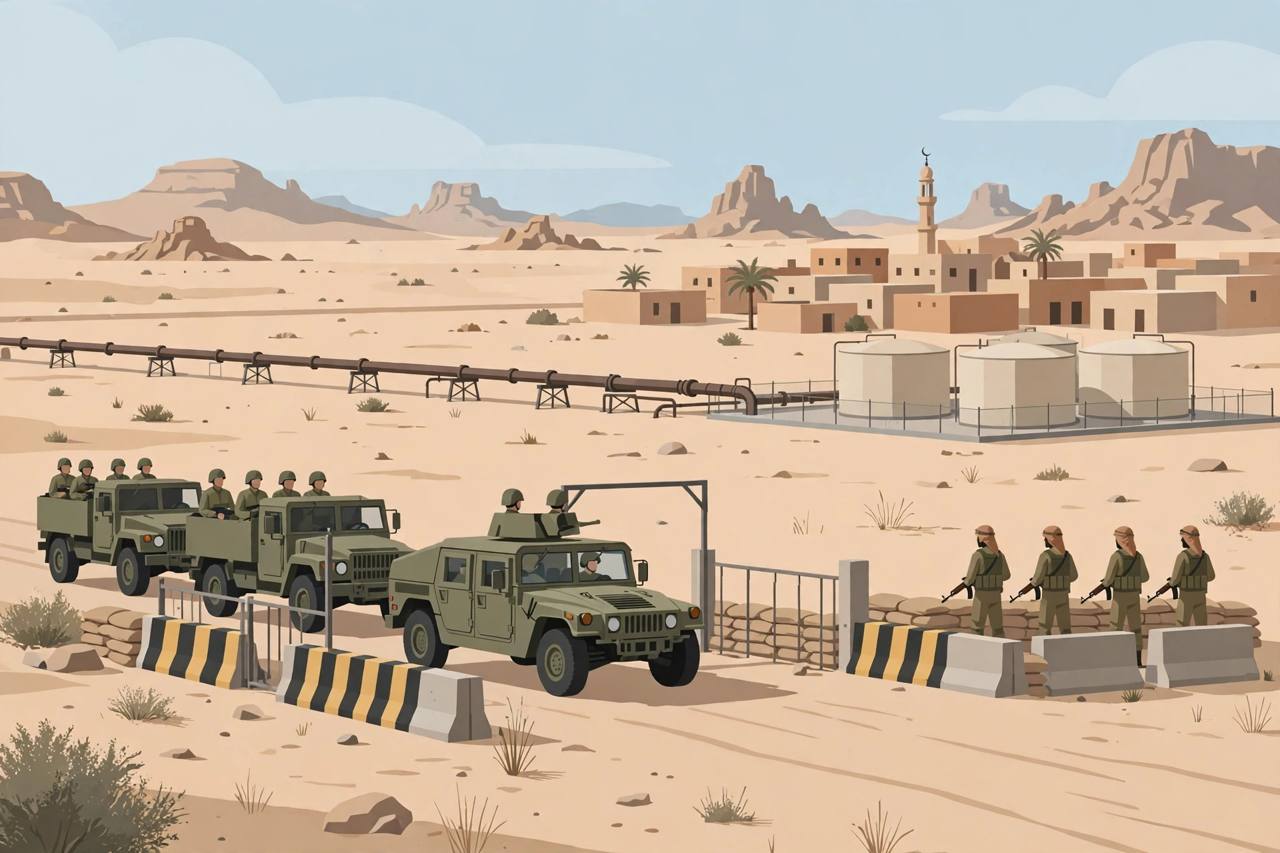
BAGHDAD — Iraq's Prime Minister Ali al-Zaidi on Monday ordered the armed forces to enter Jurf al-Sakher, a stronghold of the powerful Iran-backed armed group Kataib Hezbollah, following accusations of oil smuggling, government spokesman Haidar al-Aboudi told the state news agency INA.
Source: AFP via Arab News
Al-Aboudi said the prime minister “ordered the armed forces to enter” Jurf al-Sakher and that “a deadline has been set for the armed faction to exit the area.” A security source told AFP the deadline was Friday. The town, also known as Jurf al-Nasr, lies about 60 kilometres south-west of Baghdad in Babil province.
Source: AFP via Arab News
This is a major new development in the standoff Awaaz Punjab reported on Sunday, when Kataib Hezbollah rejected the government's oil-smuggling findings as fabricated, leaders of the ruling Shiite Coordination Framework began mediating a gradual pullout, and sources said — without any public confirmation from the prime minister's office — that the group had until the end of the week to hand over security control. Monday's statement is the first public, official confirmation of both the entry order and the deadline.
Source: Awaaz Punjab, Nov 15
On Sunday the standoff deepened as the group rejected the probe and mediators stepped in. Read the earlier story: Jurf al-Sakhr standoff, mediation and the looming deadline
Reports differ on whether troops have already gone in
A senior government official told foreign media on Monday that a range of military units were moving toward the area and that the Iraqi Air Force was ready to support ground troops once the Friday deadline expires, The National reported. A Spanish wire report carried by Democrata said an army operation in Jurf al-Sakher began at 10.00 on Monday, lasted about six and a half hours, and confirmed that pipelines were being tampered with to divert crude for smuggling, as the government spokesman indicated to INA.
Source: The National via Long War Journal; Democrata
The AFP account, however, reported no confirmed entry by government forces or any fighting as of Monday morning United States time. Awaaz Punjab is therefore reporting the order and the Friday deadline as confirmed, and the reported verification operation as attributed — whether federal forces have physically entered and held the town had not been independently confirmed when this story was filed.
How the confrontation built up
The crisis began with an investigation published by Al-Hurra on November 9 into alleged oil smuggling in Jurf al-Sakhar. On Saturday, November 14, a government investigation committee confirmed the allegations, said illegal oil refineries had been uncovered in the area, and al-Zaidi dismissed nine senior security and administrative officials and ordered those accused of involvement to be referred to the judiciary. The government's statement did not name Kataib Hezbollah directly.
Source: Al Jazeera and AFP, via Awaaz Punjab Nov 14-15
On Sunday the group accused al-Zaidi's administration of fabricating the allegations to pressure it into surrendering its weapons, said a technical committee it cited had found no illegal interference with oil pipelines, and insisted that Jurf al-Nasr and the issue of what it called 'resistance weapons' must remain outside political disputes. Coordination Framework leaders Nouri al-Maliki, Hadi al-Amiri and Humam Hamoudi began mediating for a gradual pullout, while Iraq's parliament moved to question the interior and defence ministers and the Federal Integrity Commission said it had recorded 228 suspected oil-smuggling cases and reports between 2024 and 2026.
Source: Shafaq News via Hatha Alyoum; Kurdistan24
Background: a closed town and a $30 million-a-month allegation
Jurf al-Sakher was retaken from the Islamic State group in October 2014 and has since been held by Kataib Hezbollah, which renamed it Jurf al-Nasr; its residents have not been allowed to return and state institutions have had no routine presence there for more than a decade. Analysts and officials told Shafaq News that more than 100,000 people remain unable to return to the town and surrounding communities. Reporting cited by Al Jazeera has put the possible value of the alleged smuggling network at up to $30 million a month — yaani about 3 crore dollars every month. Kataib Hezbollah has brigades inside the state-funded Popular Mobilization Forces and is designated a terrorist organisation by the United States. Baghdad has set a goal of placing the militias' weapons under state control by June 2027.
Source: Shafaq News; Al Jazeera; Long War Journal
What happens next
The test now is Friday: whether Kataib Hezbollah withdraws under the mediated deal its allies in the Coordination Framework have been seeking, or whether federal forces — with the Counter Terrorism Service option the prime minister was reported on Sunday to be holding in reserve — move in and hold the town. For Punjabi and Indian workers across the Gulf and Iraq's oil economy, the stakes are wider than one district: a confrontation between Baghdad and an Iran-aligned faction would land in a region already strained by the US-Iran war, and any disruption around Iraq's pipelines feeds directly into the oil prices that drive fuel costs and remittances back home.