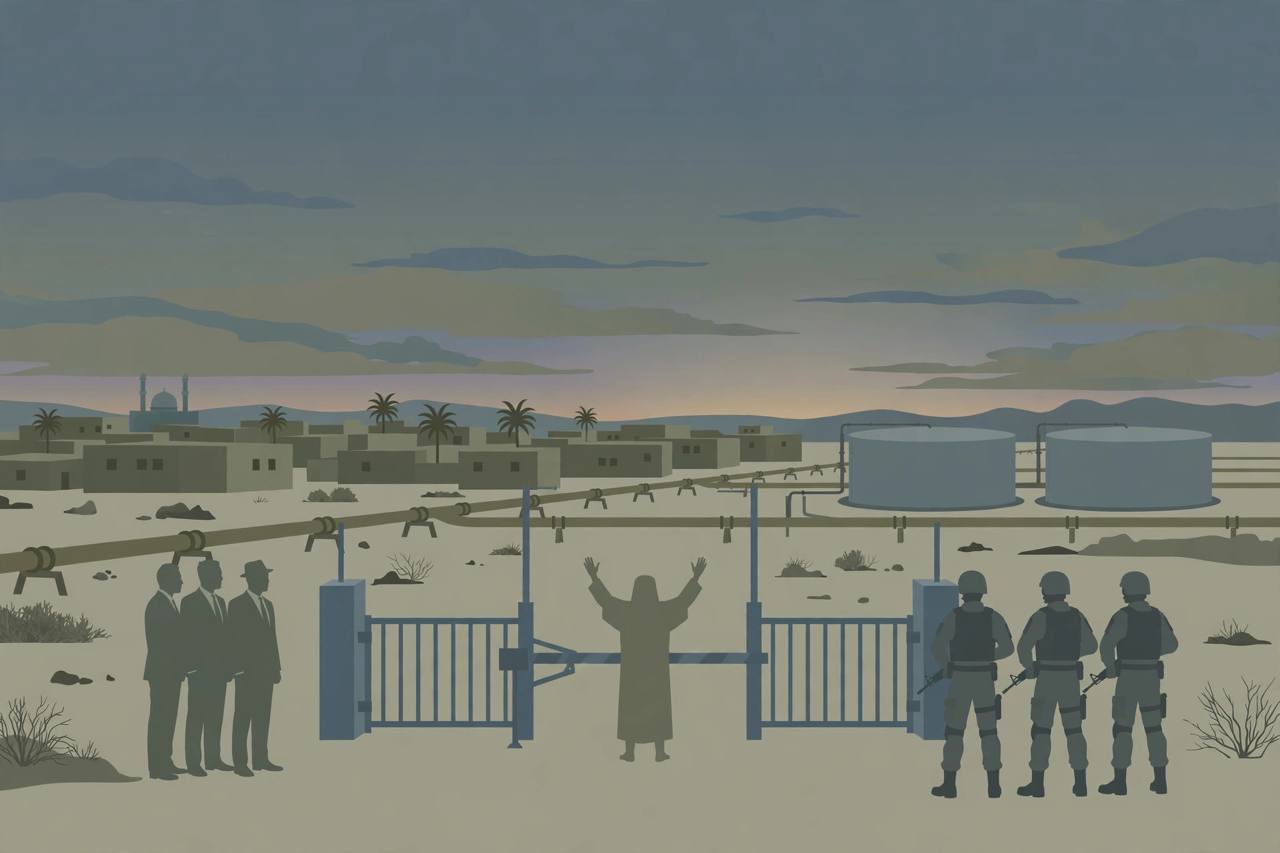
BAGHDAD — Iraq's standoff over Jurf al-Sakhr deepened sharply on Sunday, November 15, as the Iran-aligned armed group Kataib Hezbollah publicly rejected the findings of a government oil-smuggling investigation, leaders of the ruling Shiite Coordination Framework began mediating between the group and Prime Minister Ali al-Zaidi, and informed government and political sources told Shafaq News that the prime minister has given the group until the end of this week to hand full security control of the area to government forces — warning of possible military intervention if it refuses.
Source: Shafaq News via Hatha Alyoum
The escalation follows Saturday's announcement, reported by Al Jazeera and AFP, that a government investigation committee had confirmed oil-smuggling allegations in Jurf al-Sakhr — also known as Jurf al-Nasr — in northern Babil province, uncovered illegal oil refineries there, and that al-Zaidi had dismissed nine senior security and administrative officials and ordered everyone accused of involvement in the alleged smuggling to be referred to the judiciary. The government's statement did not name Kataib Hezbollah directly.
This is a follow-up to Saturday's dismissals, when the prime minister removed nine officials after the committee confirmed the smuggling allegations. Read the earlier story: Iraq PM dismisses nine officials over Jurf oil smuggling
The group rejects the findings
In a statement on Sunday, Kataib Hezbollah accused al-Zaidi's administration of fabricating the allegations to pressure the group into surrendering its weapons. The group said the accusations came despite its participation in negotiations over weapons regulation and the signing of a sovereignty agreement with members of the ruling Coordination Framework and the government, and it insisted that Jurf al-Nasr and the issue of what it called 'resistance weapons' must remain outside political disputes. It also accused the United Arab Emirates, Saudi Arabia and the United States of exerting pressure through al-Zaidi's government — an accusation those governments have not commented on in the reporting available on Sunday.
Source: Shafaq News via Hatha Alyoum
According to the group, a technical committee that inspected the area found 'no illegal interference' with oil pipelines, contradicting the government's account. Kataib Hezbollah said inspectors had documented fuel storage tanks and a small processing facility used to improve fuel quality and supply military vehicles, heavy equipment and diesel generators during shortages, supporting a military sector extending from northern Babil province to Al-Qaim on the Iraqi-Syrian border. The group said the facility was openly accessible and located more than five kilometres from the nearest oil pipeline, accused media outlets of circulating fabricated images attributed to the investigation committee, called on the judiciary to review the penalties imposed on officials, and demanded separate inquiries into alleged corruption involving military food supplies, the public food ration system and a partnership agreement with the Abu Dhabi National Oil Company (ADNOC). The rejection was also reported independently by Rudaw and The New Region.
Mediation — and a deadline, sources say
A source familiar with the matter told Shafaq News on Sunday that Coordination Framework leaders have started mediating to calm tensions and reach a deal for the armed faction's full withdrawal from Jurf al-Sakhr. The mediators named by the source are State of Law Coalition leader Nouri al-Maliki, Badr Organization secretary-general Hadi al-Amiri and Islamic Supreme Council leader Humam Hamoudi. 'The mediators hope to reach a deal within two days that would put a mix of security forces and Popular Mobilization Forces (PMF) units into the area. Under that arrangement, Kataib Hezbollah would pull out gradually, and the new forces would take over full security control,' the source said. These details come from Shafaq's unnamed sources and have not been announced officially.
Source: Shafaq News via Hatha Alyoum
Informed government and political sources also told Shafaq News that al-Zaidi — who is also commander-in-chief of the armed forces — conveyed the end-of-week deadline to mediators from the PMF and the Framework, and that he intends to assign special forces from the Counter Terrorism Service (CTS) to establish full security and military control over the subdistrict in the coming days if mediation fails. Shafaq had earlier reported that al-Zaidi warned mediators that any party obstructing government measures would face action under the law, including the Anti-Terrorism Law, and that mediators are trying to persuade him to abandon the military option, fearing a confrontation could escalate beyond control. The prime minister's office had not publicly confirmed a deadline in the reporting available on Sunday.
Parliament steps in; 228 smuggling cases on record
The dispute widened further on Sunday. Kurdistan24 reported that Iraq's parliament is to question the interior and defence ministers over oil smuggling. Separately, Iraq's Federal Integrity Commission said on Sunday that it had recorded 228 criminal cases and reports involving suspected oil smuggling between 2024 and 2026 — 152 criminal cases and 76 reports — of which 53 criminal cases remain under investigation, 11 have been referred to the relevant court, and 37 of the 76 reports remain under preliminary examination, Shafaq News and Rudaw reported.
Source: Kurdistan24 via Hatha Alyoum
Background: a closed town and a $30 million-a-month allegation
Jurf al-Sakhr, southwest of Baghdad, was retaken from the Islamic State group in October 2014 and has since been held by Kataib Hezbollah, which renamed it Jurf al-Nasr; its residents have not been allowed to return and state institutions have had no routine presence there for more than a decade. Analysts and officials told Shafaq News that more than 100,000 people remain unable to return to Jurf al-Sakhr and surrounding communities, while earlier Ministry of Migration and Displaced Persons figures put the number of families still displaced at around 6,000. Reporting cited by Al Jazeera has put the possible value of the alleged smuggling network at up to $30 million a month — yaani about 3 crore dollars every month — a revenue stream that successive governments had been reluctant to confront. The nine officials dismissed on Saturday included the Babil police chief, the North Babil police director, senior intelligence, counterterrorism and national security officials in the province, the Babil commander of the Popular Mobilisation Forces, the commander of the Interior Ministry's Sixth Energy Police Brigade and the director of the Oil Pipelines Company at the Ministry of Oil; Babil governor Ali Turki al-Jamali, who had denied the allegations, resigned on Thursday.
What happens next
The next two days are now the test: the mediators say they hope for a deal that would see Kataib Hezbollah pull out gradually as mixed security and PMF forces take over, while the sources cited by Shafaq say the prime minister's end-of-week deadline — and the option of sending in the Counter Terrorism Service — stands if mediation fails. Kataib Hezbollah, one of Iraq's most heavily armed factions and part of the state-funded PMF, has so far rejected the investigation outright. For Punjabi and Indian workers across the Gulf and Iraq's oil economy, the stakes are wider than one district: a confrontation between Baghdad and an Iran-aligned faction would land in a region already strained by the US-Iran war, and any disruption around Iraq's pipelines feeds directly into the oil prices that drive fuel costs and remittances back home.