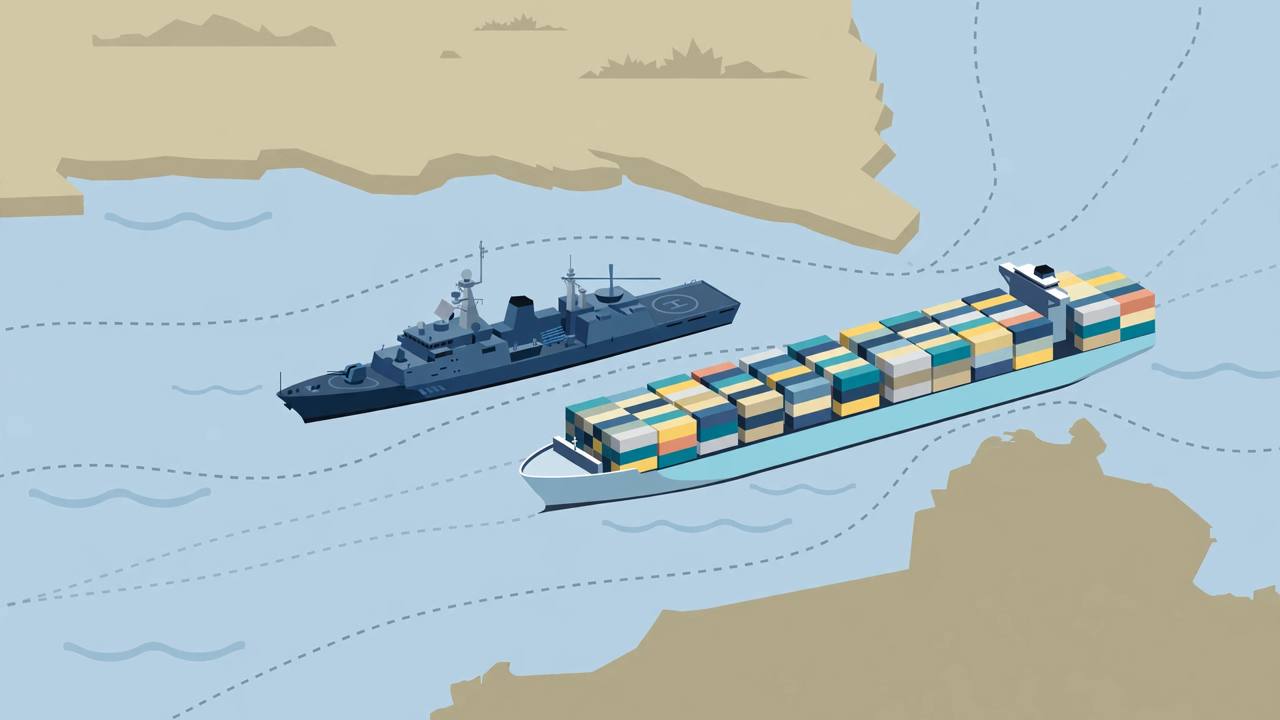
ROME — European nations have taken no concrete steps to strengthen shipping protection in the Red Sea, Italy's defence minister said on Tuesday, adding that governments have failed to respond to his calls to bolster the bloc's naval mission in the area, Reuters reported from Rome on November 10.
Source: Reuters (Angelo Amante), Nov 10, 2026
In September, Defence Minister Guido Crosetto urged the European Union to bolster its Aspides mission, launched in 2024 to protect commercial shipping from attacks by Yemen's Iran-aligned Houthis that have escalated as part of the Middle East conflict. 'I have yet to see anything concrete,' Crosetto told Reuters on Tuesday, although he said EU foreign policy chief Kaja Kallas had 'fully understood' the importance of Italy's request.
Source: Reuters, Nov 10, 2026
'Far larger countries contribute much, much less'
'About one third of European operations depend on Italy's contribution. Other countries, far larger than us, contribute much, much less,' said Crosetto, a senior member of Prime Minister Giorgia Meloni's government, according to Reuters. Following Crosetto's September appeal, Kallas wrote to the bloc's 27 member states urging them to increase their contributions, saying more than 10 warships would be needed for the mission to be truly effective.
Source: Reuters, Nov 10, 2026
Italian daily Il Sole 24 Ore reported that talks among EU states on boosting contributions have so far been inconclusive, partly due to the reluctance of some members with limited resources to deploy assets, Reuters noted. That reporting — an Italian newspaper's account carried inside the Reuters story — is the clearest public explanation so far for the stall, and it has not been contradicted by any member state on the record.
A mission built for this moment, sailing short
Aspides was launched in February 2024 as a defensive EU naval force to accompany merchant ships through the Red Sea, the Gulf of Aden and the northwest Indian Ocean against Houthi attacks. In earlier reporting in September, USNI News described the mission as a rotational task force of up to three ships at a time, with Italy and Greece as the main ship contributors, and quoted Kallas saying commercial ships were literally waiting in a queue for escorts the mission did not have enough frigates to provide. Kallas said then that when Aspides was set up, the indication was that it needed at least 10 ships.
Source: USNI News, Sep 28, 2026 (background reporting)
The Red Sea is not a side route: it carries shipping between Asia and Europe through the Bab el-Mandeb strait and the Suez Canal, and its disruption since the Houthi attacks began has pushed vessels around Africa, raising freight costs that feed into prices in Europe, India and the Gulf alike. That is why a defence minister's complaint about missing frigates is an economic story as much as a military one — and why it lands on the same Tuesday that Sanaa itself was struck again in the Saudi-Houthi exchange and Brent crude's slide below $90 was being read as a signal about the wider Iran war.
What is solid
- Crosetto told Reuters on Tuesday, Nov 10, that EU nations have taken no concrete steps to strengthen Red Sea shipping protection since his September appeal (Reuters).
- Kallas wrote to all 27 EU member states urging bigger contributions and saying more than 10 warships are needed for Aspides to be truly effective (Reuters).
- Aspides was launched in 2024 to protect commercial shipping from Houthi attacks (Reuters; USNI News background).
What is only claimed
- Crosetto's claim that about a third of European operations depend on Italy, and that larger countries contribute 'much, much less', is the minister's own characterisation — Reuters carried it as his statement, without an independent ship-by-ship count.
- Il Sole 24 Ore's explanation for the stall — reluctance by members with limited resources — is reported, not confirmed by the governments concerned.
What happens next: whether any member state answers Kallas's letter with an actual ship before Aspides' next rotation, and whether Italy — which said in September it would not wait indefinitely for Brussels — moves more of its own navy into the strait. No new EU contribution had been announced by Tuesday evening.