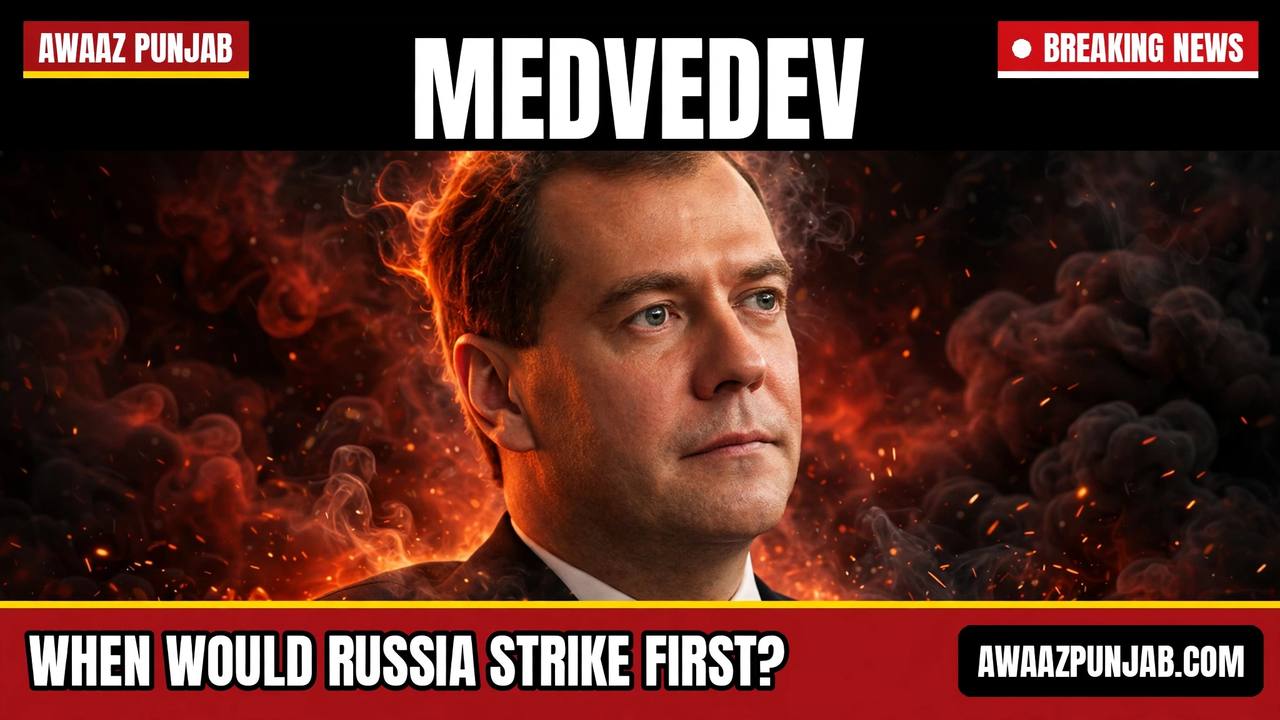
Russia's former president Dmitry Medvedev has said Ukraine and its NATO allies have already created the circumstances in which Moscow weighs launching a nuclear strike, spelling out in a law-journal article the scenarios in which Russia could strike first with nuclear weapons.
Source: ANI
Medvedev, now deputy chairman of Russia's Security Council, wrote in an article titled “State Sovereignty and Nuclear Weapons: International Legal Aspects of Ensuring National Security”, published on Monday in the Moscow Journal of International Law and excerpted by the Russian state news agency TASS.
“Formally, in a number of cases, the parties collectively opposing us (Ukraine, NATO countries, and several Western countries outside the alliance) have already created situations in which Russia considers the possibility of launching a nuclear strike,” he wrote.
The two triggers Medvedev named
The first, he argued, is a massive attack with conventional weapons that causes catastrophic damage. “The massive use of non-nuclear means that cause catastrophes makes a preventive nuclear attack by the Russian Federation possible,” he wrote.
The second is nuclear weapons reaching Ukraine. Medvedev warned that “secret or hidden supplies of nuclear weapons from the West to Kyiv will provoke a legitimate preventive nuclear attack by Russia.”
“The Kiev regime and its sponsors must not harbor any dangerous illusions. Should the abovementioned scenarios unfold, the head of state is not only entitled but also obligated to use nuclear weapons.”
What Russia's doctrine actually says
Medvedev acknowledged that Russia's nuclear doctrine — revised and signed into effect by President Vladimir Putin in November 2024 — does not explicitly authorise preventive nuclear strikes. But he argued that its foundations “effectively provide for a preemptive nuclear strike if the very existence of our state is threatened or our country has sustained unacceptable damage.”
For the legal footing, he leaned on the International Court of Justice's 1996 advisory opinion on nuclear weapons, in which the court found their threat or use would generally run against humanitarian law but could not say definitively whether it would be lawful in an extreme case of self-defence where a state's survival is at stake. From that gap, Medvedev concluded that “international law does not prohibit a nuclear-armed state from using nuclear weapons.”
A note of restraint — and a familiar pattern
Medvedev also stressed that Russia has not used nuclear weapons in Ukraine because, in his words, “so far, the course of events in the Ukrainian crisis has not created a state of direct necessity to use nuclear weapons.” He added that Putin “is always guided by a comprehensive analysis of all factors and the proportionality between the actual damage inflicted and the retaliatory measures.”
Medvedev, who served as Russia's president from 2008 to 2012 and later as prime minister, has raised the spectre of a nuclear strike against Kyiv on several occasions since Russia's full-scale invasion of Ukraine in February 2022 — a war now approaching its fifth year, with NATO military support for Kyiv at its centre.
Why the timing matters
The article landed just days after Trump, Putin and Chinese President Xi Jinping met in Shenzhen on November 19, where the leaders of the world's three largest nuclear powers adopted a joint “Declaration towards Peace”, reaffirming that “a nuclear war cannot be won and must never be fought” and agreeing to pursue dialogue on reducing nuclear risks and preventing proliferation.
There was no immediate response from Kyiv or NATO to Medvedev's article, and nothing in his remarks indicated a decision to use nuclear weapons has been taken. What they do show is Moscow publicly drawing, in legal language, the lines it says would justify the step — even as the three nuclear powers publicly pledged to keep that line uncrossed.
What is solid
- Medvedev's article was published on Monday in the Moscow Journal of International Law and excerpted by TASS.
- The quotes in this story are Medvedev's own words as reported by TASS, ANI and other outlets.
- Trump, Putin and Xi adopted a joint declaration in Shenzhen on November 19 reaffirming that “a nuclear war cannot be won and must never be fought”.
- Russia's revised nuclear doctrine was signed by Putin in November 2024.
What is only claimed
- Whether Ukraine and NATO have actually crossed the thresholds Medvedev describes — that is his claim, not an agreed fact.
- Whether Russia's nuclear doctrine authorises a preventive strike — Medvedev reads it as effectively doing so; the doctrine's text does not say so explicitly.
- Whether the article signals any change in Russian policy — Medvedev himself says no decision to use nuclear weapons has been taken.