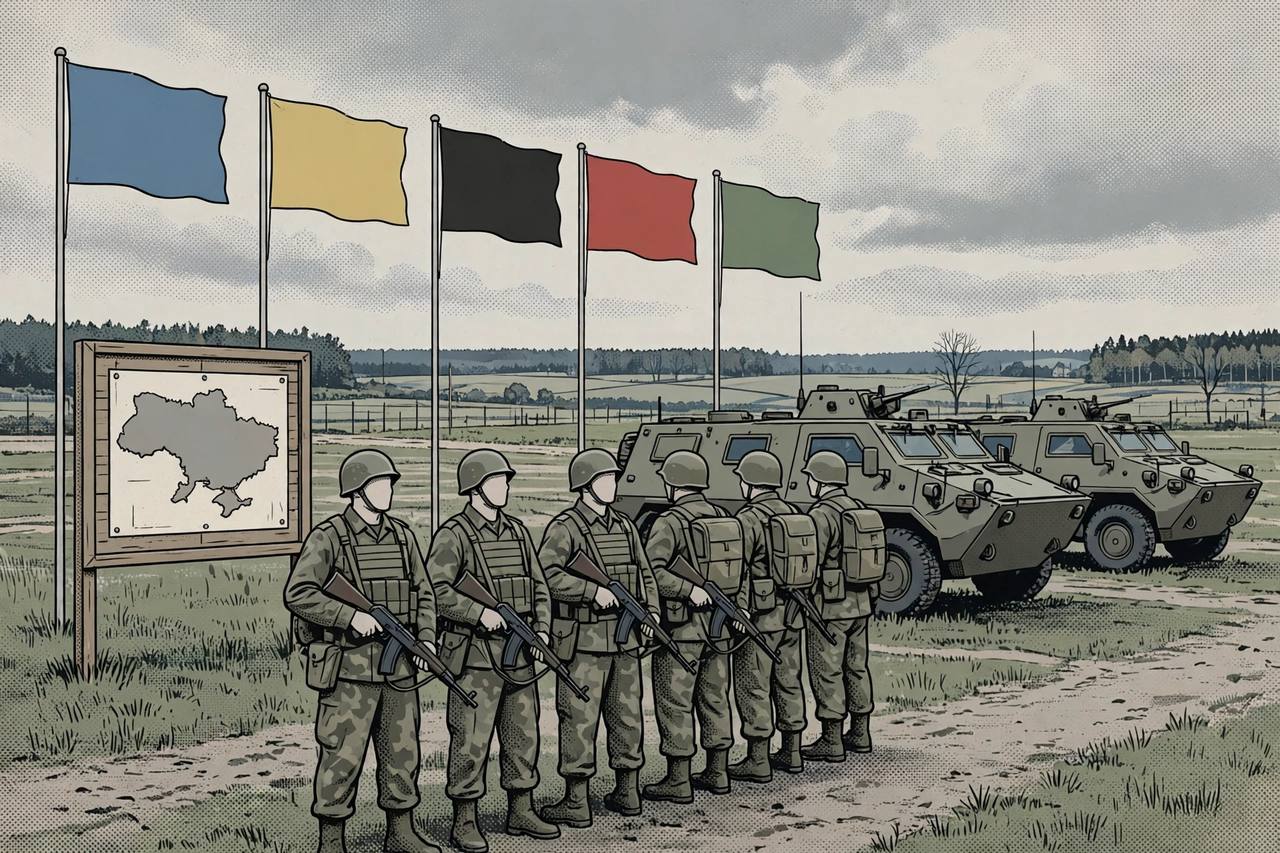
LONDON — British and other European troops who deploy to Ukraine as part of a planned multinational force after a future ceasefire would be allowed to fire back if Russian forces attacked them, Western officials said as Britain and France set out the force's biggest rehearsal yet. The rules of engagement would be defensive only, the officials stressed: 'Clearly we will protect our forces against any aggression,' one official familiar with the plans told The Guardian, emphasising that any engagement would be 'defensive in nature'.
Source: The Guardian, Nov 3, 2026, via EuropeSays (UNITED24 Media summary)
The force — the Multinational Force-Ukraine, or MNF-U — is the military wing of the UK- and France-led 'coalition of the willing', set up in 2025. Its commander, Lieutenant General Tom Bateman, said the participating countries were committed 'to providing robust and binding security guarantees for Ukraine following a cessation of hostilities'. Officials were clear about what the force is not: it is not a NATO mission, it will not do peacekeeping or ceasefire monitoring, and it would enter Ukraine only after the fighting ends and at the invitation of the government in Kyiv, to help rebuild and regenerate Ukraine's armed forces, stationed away from the front line.
Source: Sky News, Nov 3, 2026, via Q Radio
The rehearsal, Exercise Koalicja, runs from November 9 to 22 in Poland, around the town of Nowa Deba, roughly 100 kilometres west of the Ukrainian border. Alongside France and Britain, the other participating nations are Belgium, Estonia, Germany, Lithuania, the Netherlands, Poland, Spain, Sweden and Turkey. The United States will not be present. French General Armel Dirou said the exercise is not intended as a show of force.
Source: Euronews / UK government, via Zevin Insight, Nov 3, 2026
Built to work without Washington
The force is expected to rely almost entirely on European capabilities, including communications systems that do not depend on US technology such as Elon Musk's Starlink. 'We are not dependent on US systems,' one official told The Guardian. That choice follows October restrictions on the Starshield system that disrupted Ukrainian drone operations, including missions by interceptor drones against jet-powered Russian Shahed drones, The Guardian reported. The wider mission could also include fighter patrols to help reopen Ukraine's commercial airports and a Turkish-led effort to clear mines from the Black Sea.
The obstacle has a name: the war has not ended
Every part of the plan is conditional on a peace that does not yet exist. A deployment would require Russia's war in Ukraine to stop first, and President Vladimir Putin has repeatedly opposed troops from NATO member states being stationed in Ukraine — which is why officials describe the deployment itself as hypothetical even as the preparation becomes more concrete. The fire-back rule underlines the stakes: European soldiers on Ukrainian soil, even far behind the front line, could find themselves exchanging fire with Russian forces, for example against drone attacks, and how Moscow would respond to such a clash is an open question.
What happens next: Exercise Koalicja begins on Monday, November 9, and runs for almost two weeks — the largest practical test so far of whether Europe can put a reassurance force into Ukraine on its own when the fighting stops. Whether it ever deploys will be decided by the war, and by the US-brokered talks that are due to bring Ukrainian and Russian delegations together in Abu Dhabi on November 10–11.