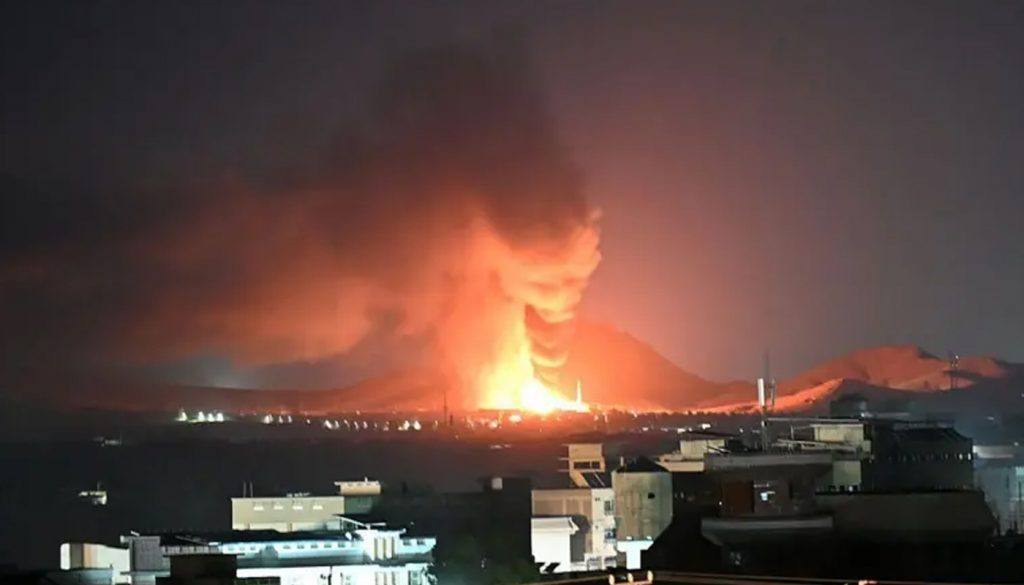
Pakistan launched a new wave of airstrikes inside Afghanistan overnight, killing four civilians, the Taliban government said on Thursday, in the second round of Pakistani bombing on Afghan soil within a week.
Source: Al Jazeera
Pakistan bombed Afghanistan only three days earlier, on Monday, 23 November — that first wave is covered in our earlier report. Read the earlier report
Taliban government spokesman Zabihullah Mujahid said the latest strikes hit three provinces — Kandahar, Paktia and Khost. In a post on X, he accused the Pakistani military of carrying out 'aerial bombardments' against Afghanistan and said: 'Four civilians were martyred in this criminal act of aggression.'
Islamabad gave a different account. Pakistan's information minister said Pakistani forces had struck 10 targets inside Afghanistan that were used to store and launch drones, adding that the strikes were 'strictly limited to identified military objectives'. He did not say where the targets were.
Source: BBC
Pakistan said the strikes were a response to drone attacks launched from Afghan soil a day earlier, on Wednesday. The Taliban denied that, saying no drones had been launched from Afghanistan.
Kandahar, the Taliban's seat of power, among the targets
Sources told the BBC that the strikes hit Kandahar, the southern province that is the seat of Taliban supreme leader Hibatullah Akhundzada. In Paktia, jets bombed the Afghan armed forces' 203 Mansouri Corps base, which is controlled by the Taliban, though no casualty figures were given for that strike. In Khost, houses were damaged but no casualties were reported.
Residents described panic as the jets came in around midnight. One eyewitness in Khost told Reuters that people heard a jet, then a large explosion and a fire. 'People were shouting, and there was panic all around,' he said. Another local, Salamat Khan, told Reuters: 'There is no military base here, nor are there any military personnel... there are only the homes of ordinary civilians.'
The United Nations mission in Afghanistan, UNAMA, confirmed that at least three civilians were killed in one of the attacks. Afghanistan has vowed to respond to the strikes, Al Jazeera reported.
Why this matters
The bombing is the second wave in a week. On Monday, 23 November, Pakistani jets struck the Nurgal district of Kunar province and the Barmal district of Paktika province at around 3 a.m. Pakistan said 28 militants were killed and three targets destroyed; Afghan authorities said three civilians were killed and four wounded, a toll the United Nations confirmed.
The two neighbours have been locked in a dangerous spiral since the autumn. Pakistan accuses the Taliban government of sheltering the Tehreek-e-Taliban Pakistan (TTP), the militant group behind a string of deadly attacks inside Pakistan, including a September attack on a police facility. Kabul denies the charge and says Pakistan is bombing civilians.
The border between the two countries has stayed largely shut, and trade has plunged 74% to $358 million — yaani lagbhag 36 crore dollar. The UN mission said in July that cross-border armed violence between Taliban forces and Pakistani security forces had killed at least 499 civilians between October 2025 and June 2026.
What happens next is unclear. Kabul has promised a response, Islamabad has given no comment on the civilian toll, and with each side blaming the other, the risk of a third round of strikes — or a Taliban retaliation — remains high.