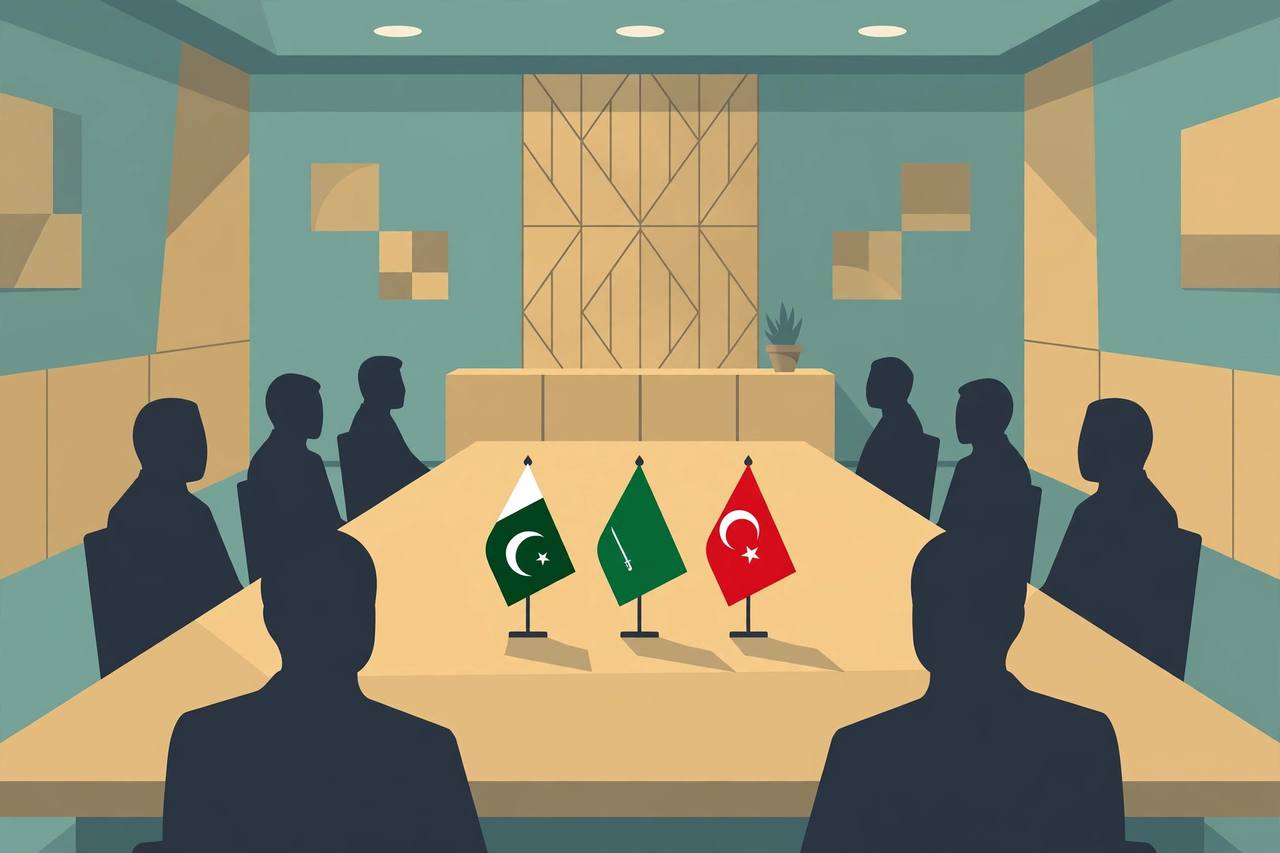
Pakistan and Turkey on Friday pledged to stand by Saudi Arabia against continuing Houthi attacks, as the three countries held high-level defence talks in Islamabad under their trilateral Mecca defence pact, which treats an attack on any one member as an attack on all three.
We reported on November 26 that the three countries were due to meet in Islamabad on November 27–28 for the first ministerial meeting of the pact. Read the earlier story
In a joint statement after more than two hours of talks, the three nations strongly condemned what they called the “persistent and heinous attacks by the Houthi militia targeting civilians and civilian infrastructure in the Kingdom of Saudi Arabia”, and pledged to “continue exerting and accelerating efforts to support the Kingdom in safeguarding its security, in accordance with the collective defence provisions” of the Makkah Joint Defence Agreement.
Pakistani Foreign Minister Ishaq Dar, speaking in televised remarks after the meeting, said the three countries had reaffirmed their support for the kingdom “in safeguarding its security, sovereignty, and territorial integrity” under the pact. Prime Minister Shehbaz Sharif received the Saudi delegation, led by Defence Minister Prince Khalid bin Salman, while Dar met the Turkish delegation led by Foreign Minister Hakan Fidan. Pakistan’s Defence Minister Khawaja Muhammad Asif and army chief Field Marshal Asim Munir also attended, along with Turkish Defence Minister Yasar Guler and military chief General Selcuk Bayraktaroglu.
Turkey completes ratification of the pact
The Islamabad meeting coincided with Turkey formally completing its ratification of the agreement: President Recep Tayyip Erdogan approved the pact on Friday, and it was published in Turkey’s Official Gazette. Turkey’s parliament had approved the deal on November 5 by 279 votes to 119. The agreement, signed in August in the Saudi holy city of Mecca by Sharif, Crown Prince Mohammed bin Salman and Erdogan, binds the three countries for 10 years, after which any member must give three months’ notice to withdraw.
Both Pakistan and Turkey stressed that the pact is purely defensive and is not directed against any country, including Iran. Turkish officials have said Ankara is considering sending military assistance to Saudi Arabia, but insist no Turkish troops would be deployed to fight in Yemen or attack the Houthis. Pakistan’s Asif has said Pakistan will use “whatever means are available” to defend Saudi Arabia against Houthi attacks.
Why now: attacks on Saudi Arabia continue
The pledge comes as Houthi attacks on Saudi Arabia have intensified. On Thursday, an aerial projectile struck the Saudi Aramco refinery at Jazan, killing one Nepali worker and injuring several others, and forcing a temporary halt to some operations at the plant; the Saudi-led coalition blamed the Houthis. Missiles were also intercepted over the Saudi capital, Riyadh, around midnight. Houthi media said a Saudi strike killed 11 civilians in Taiz, Yemen — a claim that has not been independently verified.
The fighting has pushed oil prices higher: Brent crude settled at $96.57 a barrel on Thursday, up $1.96, while US West Texas Intermediate crude stood at $84.84, as traders priced in the risk of further supply disruption in the Gulf.
The attacks matter far beyond the battlefield. Lakhs of Indian and Pakistani workers live and work in Saudi Arabia and across the Gulf, and strikes on refineries, ports and civilian infrastructure put their safety, jobs and remittances at risk — the Nepali worker killed at Jazan is a reminder that foreign workers are among those caught in the firing line.
The committee also discussed the wider war: the meeting stressed resolving the conflict involving the United States, Israel and Iran through diplomatic means, and the need to protect maritime security and freedom of navigation in the Bab el-Mandeb strait. Pakistan said it is working with countries in the region, including Qatar, to urge the United States and Iran to return to the negotiating table. The three sides also welcomed progress towards setting up the alliance’s secretariat in Saudi Arabia, and agreed to keep consulting on defence industries, joint technology, training and de-escalation. Authorities declared a local holiday in Islamabad on Friday as part of security measures for the talks.
What happens next: the pact’s members say they will keep accelerating the alliance’s institutions and collective-defence planning, while watching whether the Houthi attacks on Saudi Arabia continue — and whether diplomacy can cool a region already shaken by the US–Israeli war on Iran, now in its ninth month.