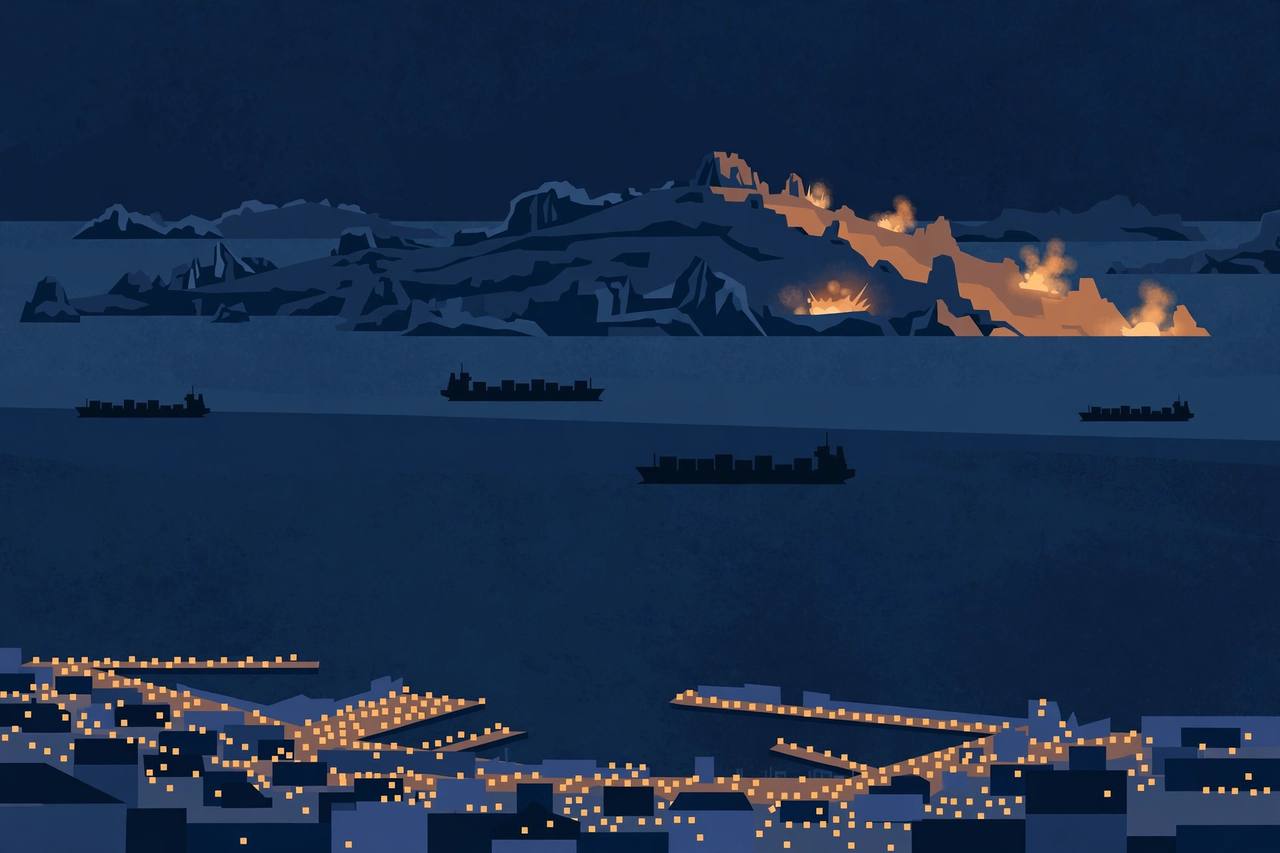
QESHM ISLAND, Iran — Explosions were heard on Qeshm Island on Sunday night, November 8, and Iran's state news agency IRNA reported that some sites on the island appear to have been struck by projectiles, in what would be the third night of reported impacts on the island in a week. The Jerusalem Post, citing IRNA, said four explosions were heard on the island, which sits in the Strait of Hormuz at the mouth of the Gulf. The source and nature of the blasts have not been independently verified, and the US military has not claimed responsibility.
The semi-official Tasnim news agency attributed the impacts to the United States, saying Qeshm was the only place US projectiles hit that night and that nobody was hurt. Tasnim added that explosions heard the same night in Bandar Abbas and Sirik, on the mainland coast across from the island, came from Iran's own military operations in the strait — not from incoming fire. That attribution is an Iranian claim: Al Jazeera Arabic, which carried the Tasnim dispatch on Sunday evening, and live coverage of the night both noted that US involvement, the damage and whether this was a separate incident from Saturday's blasts all remain unverified.
Source: Crust News (Tasnim), Nov 8 2026; The Levant Files live blog, Nov 8 2026 — attribution unverified
Iran also fired from Sirik, state television says
In the same hours, Iranian state television reported that three projectiles were launched from Sirik, on Iran's Hormuz coast, toward vessels it said were violating Iran's navigation restrictions in the strait. Whether any vessel was hit remains unclear, and no shipping casualty was reported in the coverage reviewed here. The reported launch fits the pattern of the weekend in the waterway: Iran's Revolutionary Guards Navy said two oil tankers caught fire after striking mines on what it called unauthorised routes and the Fars agency reported a third tanker fire — claims Reuters said it could not independently verify — while the United Arab Emirates rescued 22 crew members from a burning cargo ship in the Gulf of Oman in an incident no authority has linked to the Iranian reports.
Source: The Levant Files live blog, Nov 8 2026 — Sirik projectiles and the weekend's tanker reports
Not every boom on the coast on Sunday night was an attack, on Iran's own account. Explosions reported in Bandar-e Mahshahr were traced to an electric surge that blew two transformers, and Tasnim itself said the sounds in Sirik and Bandar Abbas came from Iranian forces firing into the strait. The fog is part of the story: on Saturday evening IRNA also reported explosions in Jask, Sirik and Bandar Abbas, the United States did not claim that night either, and Tasnim's early account of two missiles hitting Qeshm was later contradicted by a source the same agency cited.
Source: Crust News, Nov 8 2026 — Mahshahr transformers and Saturday's reports
Sunday night's reported impacts follow the strike President Trump confirmed on Friday, November 6, when he said US forces had hit an Iranian air-defence system on Qeshm in what he called a minor, defensive action, and the US strikes on the island that US officials described as defensive on Monday, November 2. Awaaz Punjab covered the Friday confirmation as it happened. Read the earlier report: Trump confirms US strike on Qeshm air defence
The same day, Trump called new strikes 'highly unlikely'
The Sunday-night reports sit awkwardly beside the day's diplomacy. Hours earlier, President Donald Trump told CNN that fresh US strikes on Iran were 'highly unlikely' if negotiations continued to advance, and that the decision depended on whether Iran signed a strong agreement; he also said the US had identified 38 bridges as potential targets if military action resumed. Iran's Foreign Minister Abbas Araghchi said Tehran's two-day proposal remained on the table and called for an end to the war on all fronts. No agreement was announced on Sunday. Trump also said the new Task Force Iron Gate, created to block Iran's land supply routes, was operating at full capacity alongside the naval blockade, and Reuters reported that Baghdad was still discussing a US request to close all but two of Iraq's border crossings with Iran.
The Gulf's other flashpoint on Sunday night was in Iraqi Kurdistan, where a drone attack halted production at the Khor Mor gas field and cut gas supplies to five power stations, with up to 2,800 MW (yaani 28 lakh kilowatts) of generation expected to fall. Read the companion report: drone attack halts Iraq's Khor Mor gas field
What is solid
- Explosions were heard on Qeshm Island on Sunday night, November 8, and IRNA reported that some sites on the island appear to have been struck by projectiles (IRNA via Jerusalem Post; Crust News; Al Jazeera Arabic).
- Tasnim said nobody was hurt and that explosions heard in Bandar Abbas and Sirik came from Iran's own military operations in the strait (Tasnim via Crust News).
- The US military has not claimed responsibility for Sunday night's reported impacts and had not commented in the reporting reviewed here.
What is only claimed
- Who fired the projectiles that reportedly hit Qeshm: Tasnim attributed them to the United States, but that attribution remains unverified and unconfirmed by Washington.
- Whether any vessel was hit by the three projectiles Iranian state television said were launched from Sirik toward ships in the strait.
- The scale of any damage on Qeshm: no official damage assessment was published in the reports used here.
Why it matters beyond the island
Qeshm guards the northern shore of the Strait of Hormuz, the waterway through which about one-fifth of the world's oil and liquefied natural gas normally moves, so even an unconfirmed night of explosions there is read instantly by oil markets, shipping insurers and the Gulf states. For the lakhs of Punjabi and Indian workers who live and work across the Gulf — in the Emirates, Saudi Arabia, Qatar, Kuwait, Oman and Bahrain — each new night of fire around Hormuz is also a direct safety and livelihood question, because the same waterway carries the region's fuel, food and flight routes. Sunday night's reports, on their own, change none of that: no casualties, no confirmed damage and no confirmed attacker. What they keep alive is the pattern of a war that both capitals say they want to negotiate down and neither has yet stopped fighting at the edges.
What happens next
The first test is confirmation: whether the US military acknowledges any action over Qeshm on Sunday night, as it did after the November 2 and November 6 strikes, or whether the night stays an Iranian-media-only account. The second is Tehran's answer — after Friday's confirmed strike, Iran's response played out in the strait itself, in tanker and mine claims that remain unverified. And over both hangs the negotiation track Trump described on Sunday: if talks advance, he said, new strikes are 'highly unlikely'; Sunday night's explosions, whoever fired them, are exactly the kind of incident that can break that sentence. Oil markets, closed for the weekend when the blasts were reported, will give their own verdict when Asian trading opens on Monday.