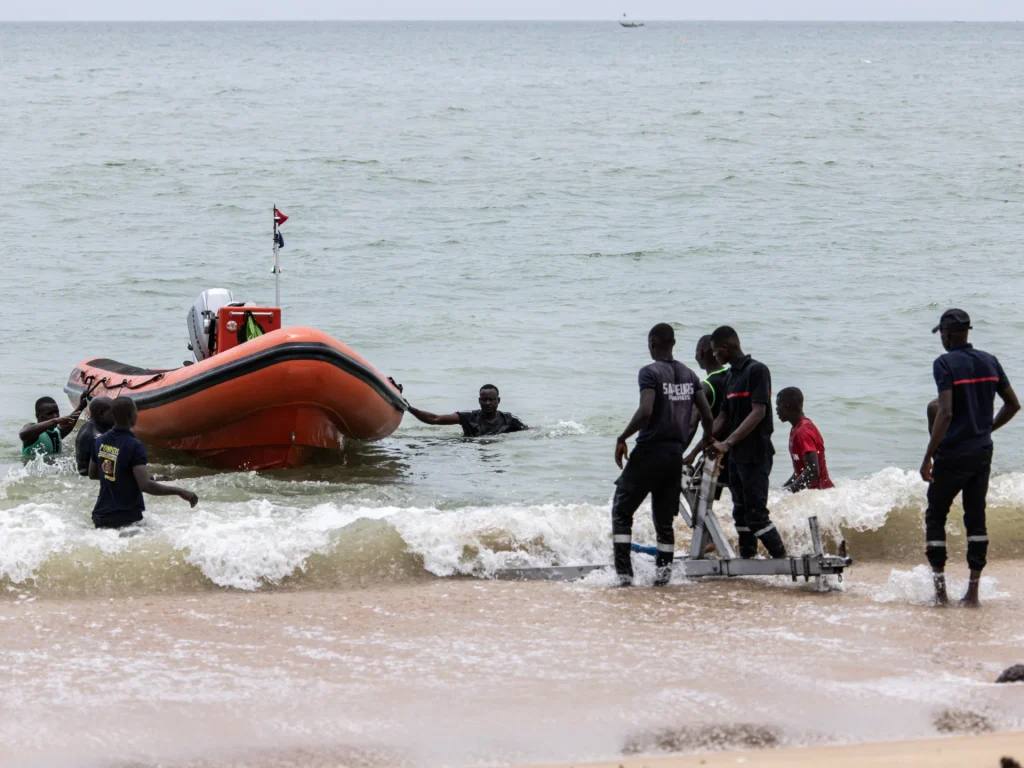
This is the latest toll in the sinking first reported on Sunday, when the confirmed toll stood at 34 and the search was still under way off the Loumpoul dunes. Read the earlier report: toll at 34
DAKAR — The death toll from a migrant boat that capsized off Senegal's north-west coast has risen to 39, the country's emergency services said on Monday, after rescuers recovered more bodies in the continuing search. Only one passenger was pulled from the water alive, and an unknown number of people remain missing, authorities said, in the latest tragedy on the Atlantic route to Spain's Canary Islands — one of the world's deadliest migration routes.
Source: AFP via Le Monde, reported by BobNews24
The small wooden boat — a flat-bottomed pirogue — had set out from Saint-Louis in northern Senegal bound for the Spanish coast and capsized off the town of Kébémer, about 180 kilometres (112 miles) north of the capital, Dakar, the Associated Press said. Reports placed the sinking near the Loumpoul dunes in Kébémer department, between Dakar and Saint-Louis. Accounts differ on the exact day: the AP said the boat overturned on Sunday, accounts cited by Le Monde put the sinking on Saturday, and Saliou Diouf, founder of Boza Fii, Senegal's main migrant aid association, told AFP that 'the sinking occurred on Friday.'
A toll that climbed all weekend
The confirmed toll rose steadily as the search continued. The Interior Ministry initially said on Sunday that at least 21 people had died, cautioning that the figures were provisional. Later that day the official Senegalese Press Agency, APS, put the toll at no fewer than 34 'following the recovery of additional bodies,' with an 'indeterminate number' of people missing. Emergency services raised the count to at least 35 late on Sunday before announcing 39 dead on Monday, Le Monde said, citing AFP. The ministry has not said how many people were aboard, saying only that the passengers were seeking to migrate irregularly. With the missing still uncounted, the final toll may never be fully known.
Diouf said the nationalities of all the victims had not been established 'as the search is ongoing,' but added that the bodies recovered on Saturday were Senegalese. The local group Action for Human Rights and Friendship, known as ADHA, confirmed the earlier 34 figure in a statement to AFP, saying the disaster left 'only one survivor.'
Source: APS and AFP via Bytes Europe
President Faye pledges a crackdown; rights group demands an inquiry
President Bassirou Diomaye Faye extended condolences to the families and pledged to crack down on the networks that organise such voyages. 'All state authorities and resources have been mobilised to locate those who have gone missing, provide care for the survivors and support families,' Faye wrote on Facebook on Sunday. In a statement posted on X, he promised to step up action against the organisers: 'We will relentlessly continue the fight against those who organise these crossings and the work that gives our young people reasons to hope here.' The Interior Ministry underscored 'its determination to combat people smuggling networks, notably through strengthened cooperation with neighbouring countries,' and the interior minister was expected to travel to the area to meet victims' families.
ADHA on Monday called on Senegal's National Assembly to investigate the government's 'migration governance,' Reuters said. 'It is no longer enough to deplore shipwrecks, announce control measures and count interceptions,' the group said. Senegalese authorities also said they had intercepted 142 migrants on Friday aboard another small boat headed for Spain; police said the group included 23 women, two babies and two other children, with passengers from Senegal, Gambia, Guinea-Bissau, Guinea and Nigeria.
One of the world's deadliest routes
The boat was following a heavily travelled route used by thousands of young Senegalese seeking better economic prospects, typically journeying roughly 800 miles across the Atlantic in open wooden canoes to reach Europe, the AP said. The Spanish migrant-rights group Walking Borders recorded 635 deaths on the Atlantic route to the Canary Islands between January and May 2026 — the highest toll among the routes it monitors — and estimated that around 21 people died for every 100 who successfully reached the Canary Islands in that period. Limited job opportunities drive the departures: nearly one in four young people in Senegal was unemployed in the second quarter of 2026, according to the country's statistics agency.
The pressure is being felt at the other end of the route. Authorities on the Canary Island of El Hierro declared an emergency on Saturday after more than 3,300 people had landed aboard about 30 boats since the start of November — arrivals equal to almost a third of the island's population. Fernando Clavijo, president of the Canary Islands regional government, described the situation as 'absolutely unsustainable,' according to Reuters. Senegal, Mauritania and Morocco have intensified maritime patrols near common departure points, pushing smugglers to launch boats farther south, from the coasts of Gambia, Guinea-Bissau and Guinea, which lengthens an already dangerous crossing. What happens next: the search off Kébémer continues, the interior minister is expected in the area, and the toll may rise again as more bodies are recovered.