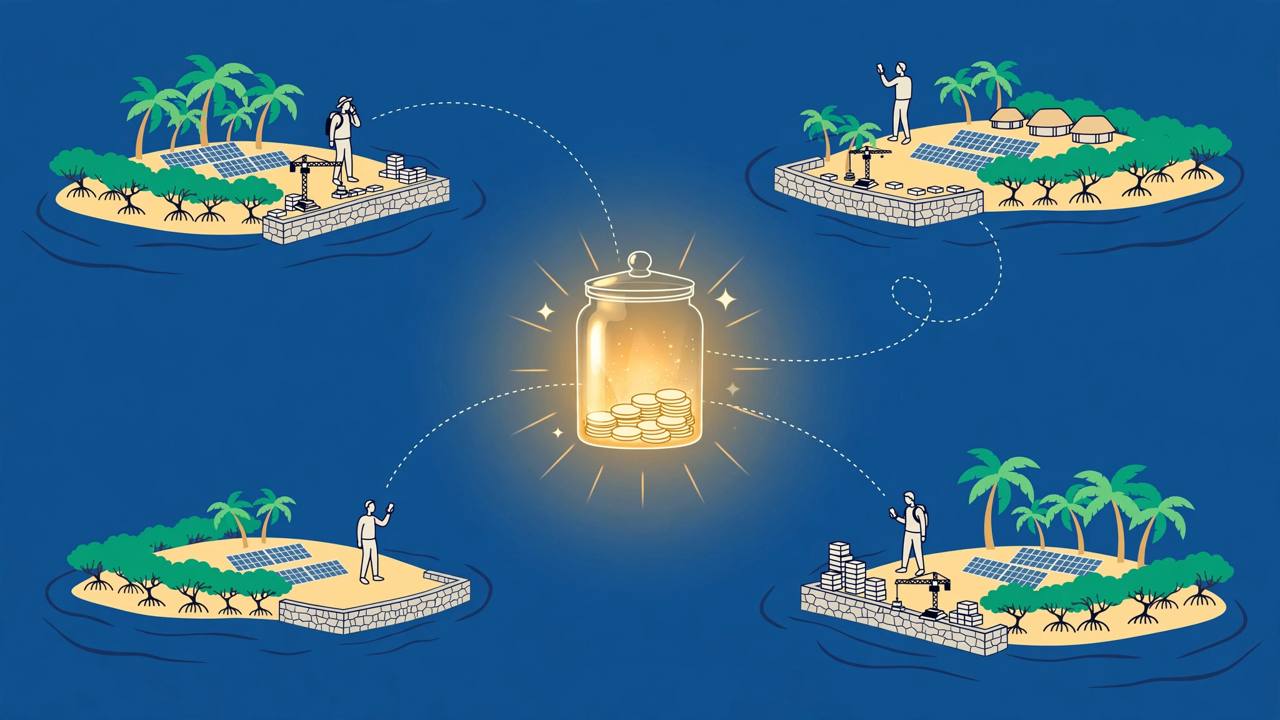
ANTALYA — A group of small island states aims to create a fund backed by a charge on money that islanders receive from abroad, to eventually raise around US$3 billion a year — yaani 300 crore dollars a year — for projects to make their nations less vulnerable to climate change, Reuters reported from the COP31 climate talks in Antalya, Türkiye.
Source: Reuters (Simon Jessop), Nov 13, 2026, carried in PACNEWS Biz Nov 16
That target would exceed the roughly US$2 billion in international public adaptation finance the islands received in 2021-2022, according to a 2025 study by the non-profit research group Climate Policy Initiative. Representatives of Small Island Developing States, or SIDS, have decided they cannot wait for the long-running international debate on financing to deliver more help. "We decided that there had to be a way that we can guarantee more reliable sources of funding for the islands," Antigua and Barbuda's UN Ambassador Walton Webson told Reuters. "We cannot rely solely on development assistance again. What we are now trying to do is create our own."
The plan would create the first platform to use earnings sent by the overseas diaspora rather than international development aid to build a permanent endowment fund for climate resilience. Importantly, the fund would have none of the conditions that can be tied to existing financial support from donors, said Ritu Bharadwaj, a director at the International Institute for Environment and Development, which designed the scheme. "They will have complete control over it," she said.
How the money would flow
Total remittances from the many islanders who have emigrated were around US$22 billion — yaani 2,200 crore dollars — and grew at a compound annual rate of 7 percent between 2010 and 2023, according to numbers provided by the SIDS group. The platform aims to capture about a third of that total by its 10th year of operation. Drafted with the IIED's help, a first phase would draw on remittances to the Dominican Republic, Haiti, Jamaica and Guyana in year one; Fiji, Samoa and Tonga would be included in year two, and Comoros, Cabo Verde and Mauritius in year three.
The platform would charge senders 3 percent per transaction, lower than average costs of around 5 percent to 9 percent across the markets studied. The commercial sector in total charges up to US$1.3 billion a year to cover transfer fees and foreign-exchange margins, the SIDS document seen by Reuters showed — while multilateral climate funds approved just US$202 million for SIDS in 2023. After costs, 2 to 2.5 percentage points of each transaction would enter the fund, be held as an endowment and invested, seeking base-case returns of 6.5 percent. Of the returns, 85 percent would be spent on resilience measures and the rest held as a disaster reserve.
By year 10, the base-case scenario estimates the endowment would have reached US$2.59 billion. Matching grants and other income streams such as tourism levies could take the total to US$5.53 billion and generate US$306 million a year in distributable surplus, and leverage through tools such as guarantees could help mobilise up to US$3.13 billion a year.
Palau's President Surangel Whipps Jr said the small islands that did not create the climate crisis are expected to borrow more money to cope with it than those that did. "This proposal turns that logic around. It takes money that is already ours, already flowing home across the Pacific, the Caribbean and beyond, and puts it to work for our own resilience," he said. The SIDS grouping brings together island nations in the Pacific, the Caribbean and the Atlantic, Indian Ocean and South China Sea regions that are particularly vulnerable to rising sea levels, and many of them carry large national debts that constrain their ability to invest in protection such as measures to halt coastal erosion.
Webson said preliminary discussions had taken place with several development banks, and a broader meeting with them and SIDS leaders was planned for January to try to make progress by COP32 in 2027. Country representatives are meeting in Antalya until the end of next week for COP31, where increasing funding for adaptation to a warming world is one of the central fights.
The fund plan lands in the same summit where Pacific leaders are demanding that climate promises turn into investment and protection for homelands that rising seas are already eroding. Read: Tuvalu's PM tells COP31 his nation will not abandon its homeland
What happens next is the January meeting with development banks and SIDS leaders. If the platform wins backing there, the islands would begin building the first climate fund financed not by donors or debt, but by their own diasporas — a model its designers say other vulnerable regions could copy.