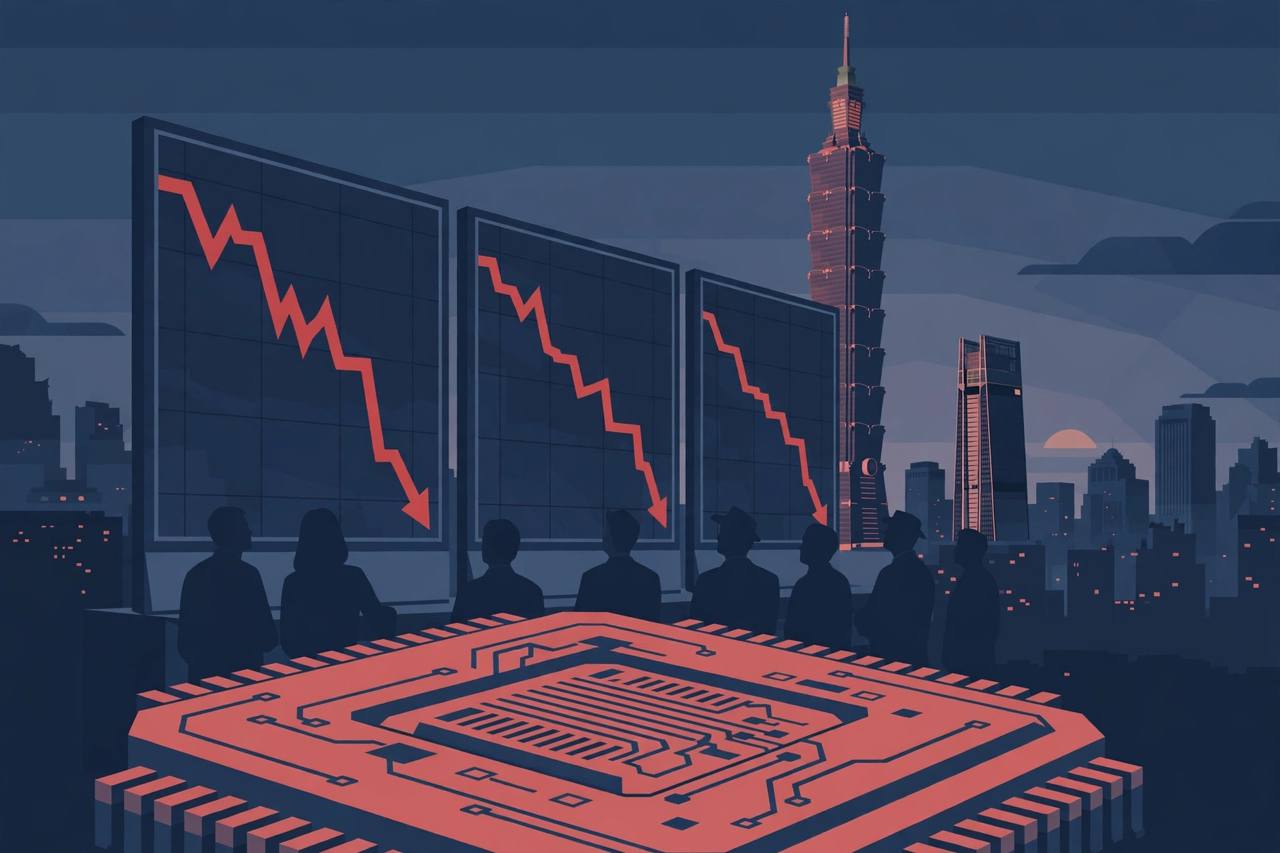
Taiwan's stock market suffered one of the worst days in its history on Monday, November 16, as a selloff in semiconductor shares that began with the turmoil at Nvidia spread across Asia's chip-heavy exchanges.
Source: Taiwan Stock Exchange data via CNA
The benchmark Taiex closed at 41,040.08, down 2,635.04 points, or 6.03 percent, from Friday's close of 43,675.12, according to Taiwan Stock Exchange figures. It was the second-largest single-day points drop in the index's history, and the index closed at its low for the day.
Chipmakers led the fall. TSMC, the world's largest contract chipmaker, closed at NT$2,215, down 5.74 percent from NT$2,350. MediaTek fell 7.89 percent, Hon Hai lost 9.34 percent and Delta Electronics dropped 9.68 percent, according to market data reported by Kabutan. Turnover reached NT$845.1 billion (yaani about 25.7 billion US dollars), and 82 stocks fell by the daily limit.
Seoul and Tokyo fall with Taipei
The selling was regional. South Korea's Kospi finished 3.59 percent lower at 5,100.50, with memory maker SK Hynix dropping 7.89 percent to 1,120,000 won. Japan's Nikkei 225 fell 2.42 percent to 59,662.02, slipping back below 60,000, while the broader TOPIX index fell 1.02 percent to 3,901.37.
Source: Associated Press
Chinese markets diverged: the Shanghai Composite closed down 0.87 percent at 3,602.57, while Hong Kong's Hang Seng was holding a modest gain in late trading.
Why investors are nervous
Investors were already questioning how long US technology companies can sustain the growth in AI spending even before Jensen Huang resigned as Nvidia's chief executive, Zhiwei Zhang of Pinpoint Asset Management told the Associated Press. Nvidia's earnings report on Tuesday will be its first under interim chief executive Colette Kress, and Asian suppliers fear customers may stretch out orders for AI processors, chips and memory.
Taiwan's central bank governor, Yang Jin-long, told the Legislative Yuan on Monday that the bank has ample firepower to stabilise markets, and that the currency market had stayed relatively calm. The New Taiwan dollar closed at 32.886 per US dollar, down 4.8 cents, with turnover of US$1.722 billion on the Taipei foreign-exchange market, CNA reported.
Analysts noted that Taiwan's National Stabilization Fund entered the market last week and had lifted the index about 17 percent from its low, making some profit-taking normal after Friday's sharp intraday rally. Weak economic readings added to the caution: Japan's economy shrank at a 0.1 percent annualised pace in the third quarter, the Cabinet Office said, while China's October retail sales rose just 0.4 percent from a year earlier even as industrial output grew 4.8 percent, according to the National Bureau of Statistics.
All eyes are on Nvidia's earnings on Tuesday — the first under interim CEO Colette Kress. A weak outlook could deepen the rout in Taipei, Seoul and Tokyo; a strong one could trigger a sharp rebound in the same chip stocks that led Monday's fall.