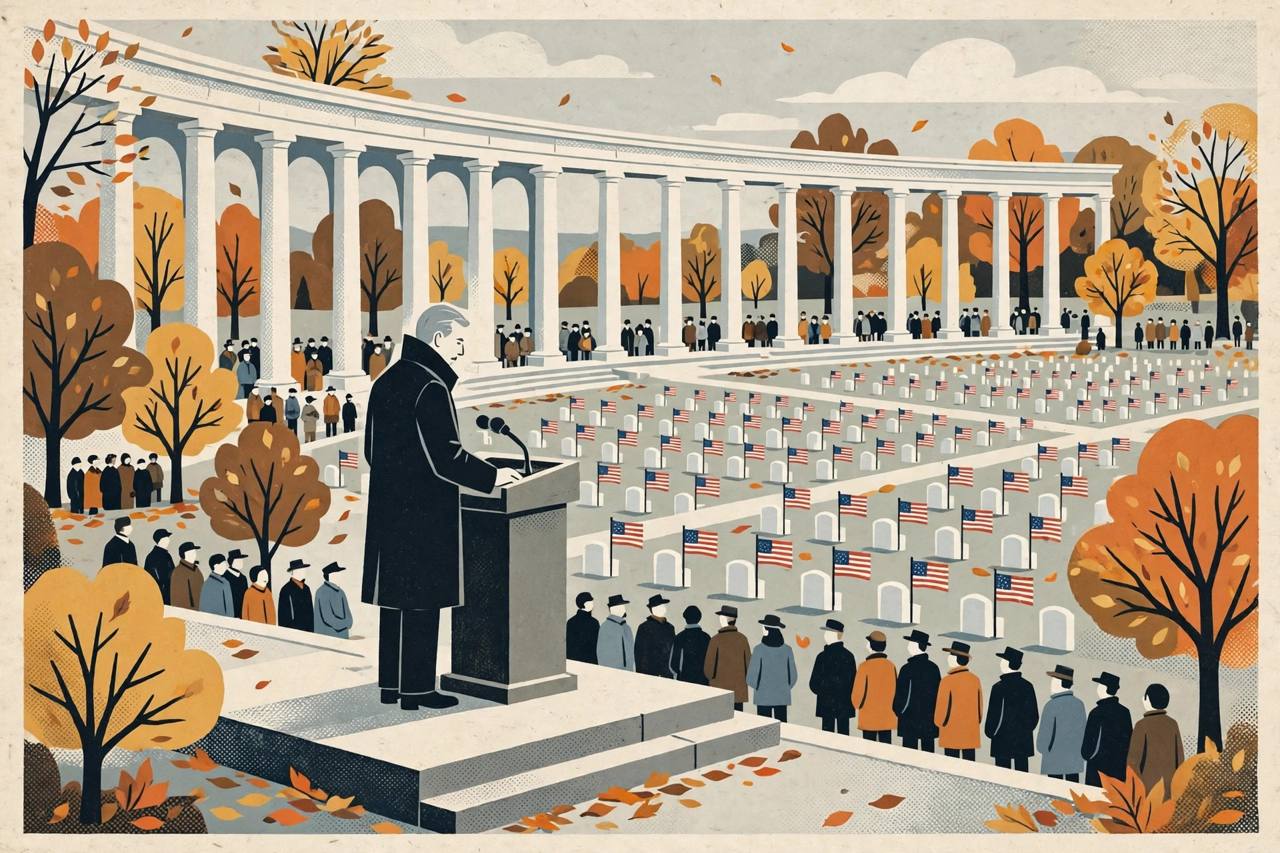
US President Donald Trump used his Veterans Day address at Arlington National Cemetery on Wednesday, November 11, to declare that the United States has already won its war with Iran — but insisted Washington would accept nothing less than a complete result. "We won," Trump said. "We want to make sure we have a total victory, not a 93% victory. It's just a question of when we want to end it."
Source: The Washington Sun
Trump spoke at the Memorial Amphitheater during the 73rd National Veterans Day Observance, after laying a wreath at the Tomb of the Unknown Soldier. He was joined by First Lady Melania Trump, Vice President JD Vance and Defense Secretary Pete Hegseth, and much of the speech praised veterans and thanked American troops for their service.
Source: Clash Report
Turning to Iran, Trump claimed the damage inflicted by the US campaign would take Tehran decades to repair. "It'll take them 25 years to rebuild back what we have destroyed, and hopefully we won't have to destroy any more of that country," he said — a claim about the scale of destruction that he did not support with figures in the speech.
Source: The Washington Sun
The president framed the conflict as one America did not start, saying Iran has been "waging war" on the United States since 1979. He highlighted the 1983 bombing of a Marine barracks in Beirut — for which Iran was found responsible by a US court decades later — and honoured a veteran who was severely injured in that attack.
Source: The Washington Sun
Trump also put the American death toll from the current war at 18 service members. That figure is his own: reporters and official Pentagon tallies have treated the number as disputed, and the White House did not set out a breakdown in the speech.
Source: Times of Israel via Israel.com
Background: a war on hold, a blockade in place
The war began in late February 2026 and has centred on Iranian nuclear and military sites, the Strait of Hormuz and regional energy infrastructure. The United States has since enforced a naval blockade of Iranian ports, while Tehran has effectively closed the Strait of Hormuz to most shipping. On Monday, after meeting Qatar's prime minister at the White House, Trump said the war was militarily "effectively over" and that renewed strikes were unlikely if Tehran moved toward a nuclear agreement and reopened Hormuz.
Source: NPR via KNKX
Trump's Arlington remarks followed his Monday briefing-room comments after the Qatar talks. Read: Trump says Iran war 'effectively over' after Qatar talks
Iran has not issued a direct response to the Arlington speech in the reports available so far. Tehran's standing position is that Washington must accept its conditions — including an end to the naval blockade and the release of frozen Iranian funds — before negotiations move forward. Speaking to NPR on the sidelines of the COP31 climate summit in Antalya, Turkey, Iranian delegation spokesman Hamidreza Gholamzadeh rejected Trump's victory claim, saying the US and Israel had tried to overthrow the Islamic Republic and failed, and that Iran could keep the Strait of Hormuz closed indefinitely.
Source: NPR via KNKX
Tehran has set out its conditions for ending the war in earlier statements by its senior officials. Read: Iran sets seven conditions for Trump on Hormuz
Trump also used the ceremony to promote his proposed triumphal arch near the Lincoln Memorial, saying he would dedicate it to veterans. Reports say the plan for the roughly 250-foot arch was approved by a planning body last week but is currently frozen by a temporary federal court stay and lawsuits.
Source: The Washington Sun
What happens next
Trump gave no date for ending the war, and there has been no formal declaration closing the conflict. Attention now turns to whether Tehran responds to the "total victory" remarks, whether the administration sets a timeline for ending hostilities, and how the incoming Congress — elected in midterms in which the war was a major issue — approaches the conflict when it takes office in January.