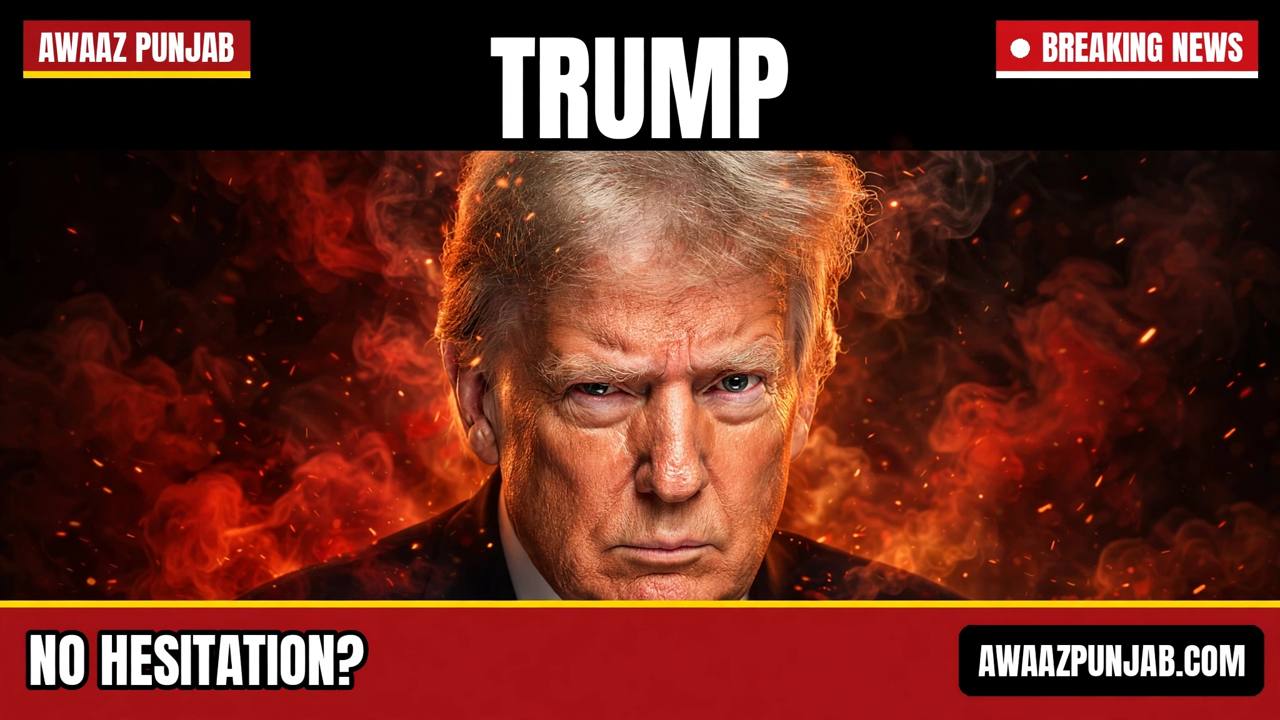
US President Donald Trump said on Thursday, November 12, that he would have "no hesitation" about resuming military strikes on Iran if Tehran threatens American allies or shipping, telling interviewer Hugh Hewitt that a return to strikes was possible "right now" — and warning that if Iran killed a senior American official, "they will not exist very long any longer."
Source: The Hugh Hewitt Show — official transcript, Nov 12, 2026
The remarks, in a 42-minute phone interview on the Salem News Channel's Hugh Hewitt Show released on Thursday, are Trump's most explicit threat yet to restart the eight-month war with Iran, which began on February 28, 2026. They were a conditional warning, not an announcement of a new strike, and no official has been killed.
Source: ANI via Daily Prabhat, Nov 13, 2026
"No hesitation" — and "possible I would do it right now"
Hewitt listed this term's operations — "Midnight Hammer, Rough Rider, Absolute Resolve, Epic Fury, now the blockade" — and asked: "Would you hesitate to use military force to do whatever has to be done to stop Iran from terrorizing our allies and our ships?" Trump replied: "No. No hesitation. We're doing very well with it." He added: "But the answer is if I saw things going the other way, I would do that. And it's possible I would do it right now." Asked later whether he would stick with the blockade even if it took 26 months to collapse the regime, he said: "Oh, yeah."
In the interview's final exchange, Hewitt noted that Treasury Secretary Scott Bessent had moved onto a military base and that Attorney General Todd Blanche was reported to be doing the same, then asked what would happen if the Iranians killed a senior American official. Trump answered: "They will not exist very long any longer." Bessent's move to a military base earlier this week followed alleged Iranian threats against his life.
Source: Jerusalem Post via JBizNews, Nov 12, 2026
Trump also set a personal test for the war's end. Asked whether it would be a defeat if Iran's current leadership — "the Iran crazies", in Hewitt's words — were still in power when he leaves office, Trump said: "Yes, that would be a defeat. Yeah, I would say that would be a defeat. Absolutely."
Hours before the interview aired, Trump posted that the United States does not need a deal with Iran and redirected Vice President JD Vance — until now the lead negotiator — to domestic anti-fraud work. The Hewitt interview is a separate, later development the same day: the threat to resume strikes, in his own words, on the record. Read the earlier story: Trump says US does not need an Iran deal, pulls Vance to domestic focus
Trump's claims: total control of Hormuz, a collapsing regime
Trump claimed the United States now controls the waterway at the centre of the war: "We control the Gulf in terms of the Hormuz Strait. We control it. Totally control it." He said the US was "taking out more oil now than we did before the war started", that the intensive fighting had lasted "three weeks, not seven months", and that "we haven't lost a soldier in five months". These are the president's claims, presented as he made them; they are contested, as the shipping record below shows.
On Iran's condition, Trump claimed: "They are at 301% inflation. Their economy is gone. They're not paying their soldiers. Their military is wiped out. Their navy is gone. Their air force is gone. Their anti-aircraft is gone. And they've lost the Hormuz Strait." He said the regime "is collapsing" and that Iranian statements of defiance were bravado. None of these figures was independently verified in the interview, and Iran disputes this picture.
What the shipping picture actually shows
Despite the claim of total control, the United Kingdom Maritime Trade Operations centre (UKMTO) reported on Thursday that at least two tankers had been struck by projectiles in recent days — one on Wednesday in the Strait of Hormuz, northwest of Ras al-Khaimah, whose crew evacuated safely with no casualties, and another on Tuesday in the Persian Gulf, where several crew members were taken ashore for medical assistance and the rest were reported safe. Oil shipments through the strait have recovered to near pre-war levels, but international tankers still rely on US Navy escorts and attacks on vessels have increased.
Source: Reporter World News, Nov 13, 2026
US Secretary of State Marco Rubio told reporters he had urged his G7 counterparts in Paris to step up efforts to protect shipping from Iranian attacks, while acknowledging the talks had made little progress. The Strait of Hormuz carries roughly a fifth of the world's traded crude oil and natural gas, which is why every threat to it moves energy markets: Brent crude climbed about 1.4% to trade above $94 a barrel on Thursday after Trump's no-deal remarks, erasing an earlier fall.
Source: Bloomberg via The Private Banker, Nov 12, 2026
Iran's side: Tehran says Washington asked Putin to mediate
Iran's chief negotiator and Parliament Speaker, Mohammad Bagher Qalibaf, has claimed — in an Al Jazeera interview — that it was Washington that sought talks, asking Russian President Vladimir Putin during a Moscow visit to press Tehran into direct negotiations, and that Iran's Supreme National Security Council secretary Mohsen Rezaei had briefed Putin on Tehran's demands. Qalibaf said the next move depended on the US response, and that Iran was equally prepared to continue on the path of war. The White House did not directly answer a question on whether the US had asked Putin to facilitate talks. This is Iran's claim, reported as such.
For Punjabi and Indian readers, the stakes are direct, not distant: Indian seafarers crew a large share of Gulf shipping, and earlier this week a Saudi-flagged tanker, the NCC FAJR, with three Indian seafarers aboard was involved in a possible attack in the strait — Shipping Minister Sarbananda Sonowal said all crew were safe. Tens of thousands of Punjabi and Indian workers also live and work across the Gulf states, within range of any wider escalation.
What is solid
- Trump gave the interview to Hugh Hewitt on Thursday, November 12; the quotes in this story are from the programme's own published transcript.
- At least two tankers were struck by projectiles in the Gulf in recent days, per UKMTO reporting on Thursday.
- Trump's warning was conditional — a response if Iran kills a US official or threatens allies and ships — not an announcement that strikes have resumed.
What is only claimed
- Trump's claim that the US "totally controls" the Strait of Hormuz, while tankers are still being hit and still sail under US Navy escort.
- Trump's claims that Iran's inflation is 301%, its military is "wiped out" and its regime is collapsing — asserted by the president, disputed by Tehran, not independently verified here.
- Iran's claim that Washington asked President Putin to mediate talks — not confirmed by the White House.
Watch three things: any Iranian response to the "will not exist" warning; whether tanker attacks in Hormuz increase or stop; and oil prices, which jumped above $94 a barrel on Thursday. Trump's own test — that Iran's leadership still being in power when he leaves office would be "a defeat" — means the pressure for either a deal or renewed strikes now runs on his political clock, even as he says no deal is needed.