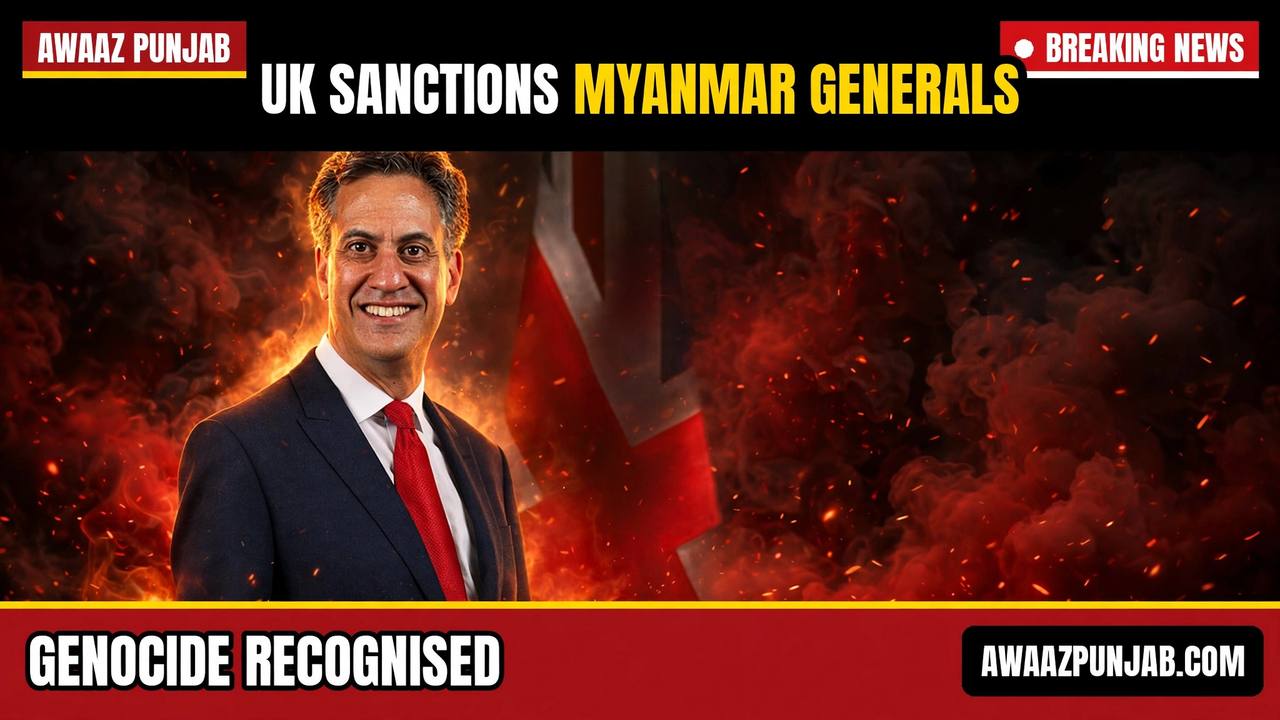
The United Kingdom has formally recognised the genocide committed against the Rohingya people and imposed new sanctions on five senior Myanmar military officers, Foreign Secretary Ed Miliband announced in the House of Commons on Monday, 23 November.
The sanctions — asset freezes, travel bans and director disqualifications — target four Major Generals and a Brigadier General: Myo Htut Hlaing, Myo Min Tun, Myat Thet Oo, Kyaw Soe and Kyaw Swar Oo. The UK government says the officers oversaw troops who carried out egregious civilian killings and repression across Myanmar.
The court ruling behind the decision
The announcement follows the International Court of Justice's landmark judgment on 19 November, when the court found by nine votes to six that Myanmar's military committed genocide against the Rohingya during its 2017 'clearance operations' in Rakhine State. The court found that around 10,000 Rohingya were killed, and more than 700,000 fled to Bangladesh. It was the first time a state has been found responsible for genocide under the 1948 Genocide Convention.
Miliband told MPs: 'The horrific violence and persecution inflicted on the Rohingya cannot go unanswered. Following the landmark judgment by the International Court of Justice, the UK formally recognises the genocide committed against the Rohingya and is taking decisive action.'
Aviation fuel crackdown and new aid
The UK also plans to introduce legislation in the coming months to stop the export and supply of aviation fuel to Myanmar, which the military uses for airstrikes against its own people. Miliband said the government will scrutinise major companies linked to the military regime and take further sanctions action where justified.
Alongside the measures, Britain announced £5 million in additional humanitarian assistance — yaani lagbhag ₹59 crore — for around 350,000 people in Rakhine State, and up to £3 million — yaani lagbhag ₹35 crore — to strengthen justice and accountability for survivors, including doubled support for the UN's Independent Investigative Mechanism for Myanmar.
Last week the UK ordered the expulsion of Myanmar's defence attaché in London. Read our earlier report. Read the earlier story
The UK led a joint statement with 12 other countries — Belgium, Canada, Cyprus, Czech Republic, Estonia, Iceland, Latvia, Luxembourg, New Zealand, Portugal, Spain and The Gambia — and, as the UN Security Council's penholder on Myanmar, will push for a Council meeting on the judgment.
Campaigners welcomed the move. Burma Campaign UK called it the first UK sanctions against the Burmese military in more than two years, but cautioned that sanctions on individuals are largely symbolic, and that the most effective pressure would come from action against the jet-fuel, arms and oil-and-gas networks that fund the regime.
What happens next
The aviation-fuel legislation will be introduced in the coming months, and Miliband said further sanctions are being prepared against companies and individuals linked to the regime. The UK will also press ASEAN governments to push Myanmar to comply with the court's ruling, which requires the regime to stop continuing violations, prevent repetition and provide reparations. Myanmar has rejected the judgment as 'unfair'.