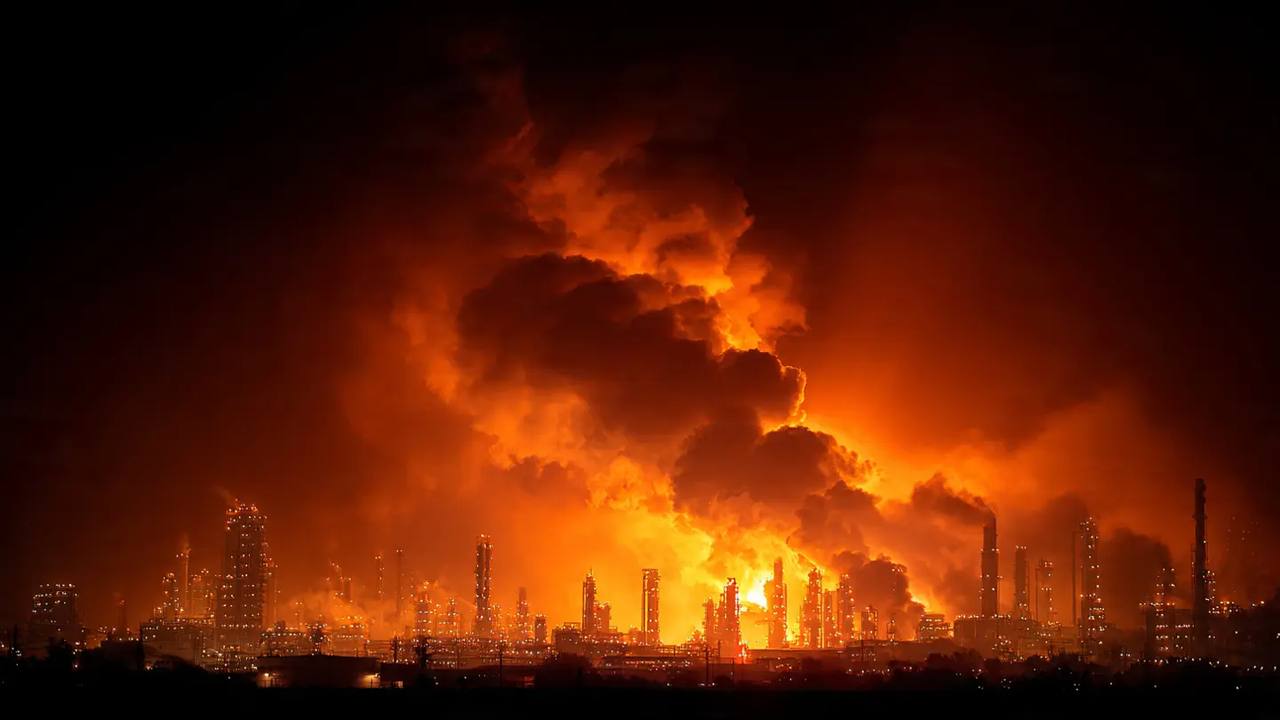
Ukraine has struck 40 Russian oil and military-industrial facilities in just 50 days, The New York Times reported, in a deep-strike campaign that now reaches more than 2,400 kilometres from Ukraine and spans at least five seas. The campaign is aimed at severing the fuel, weapons and money networks that keep Moscow's war machine running — and at turning Russia's immense geographic scale into a liability.
Source: The New York Times, via The Gaze
The targets show how far the campaign has spread: an oil terminal on the Arctic White Sea coast, a rocket-fuel production plant deep in Siberia, a Russian military cargo vessel set ablaze in the Baltic Sea, and damage to the Kerch Bridge, the critical link between Russia and occupied Crimea. Ukrainian forces have also struck Russian vessels far beyond Russia's borders — a military cargo ship in the Gulf of Finland and warships at the Libyan port of Benghazi, more than 1,600 kilometres from Ukraine.
At Benghazi, seven Ukrainian naval drones sank the Russian warship Merkury, one of Moscow's newer naval vessels, along with a military helicopter aboard it, and hit a second cargo ship, the ANGARA, which President Volodymyr Zelenskyy said had been transporting weapons. Days earlier, Ukrainian drones had struck the Russian military cargo ship Sparta II in the Gulf of Finland. Zelenskyy has defended strikes on Russian military targets anywhere in the world as an exercise of Ukraine's sovereign right to self-defence, calling them “our long-term security guarantee”.
Source: h.ua
Oil is the main target
Russia's oil industry has become one of the principal targets. Ukrainian forces have attacked every link in the refinery chain — from pumping stations and pipeline infrastructure to refineries, petrochemical plants and maritime export terminals. According to the International Energy Agency, Russian refinery output is approximately 30% below its level a year ago, with gasoline production down 20% and diesel production falling by nearly 30%.
The tempo keeps rising. Ukraine is firing more than 1,000 drones into Russia on some days, and Russia reported a record 1,441 Ukrainian drone interceptions on November 17. Kyiv has continued hitting Russian refineries, sending production to a two-decade low, despite President Donald Trump's demand to stop. Among the targets hit overnight on November 26 were the Marinovka military airfield in the Volgograd region and a Transneft oil pumping station in Bashkortostan, more than 1,000 kilometres from the Ukrainian border.
The widening war — and the pushback
The campaign's reach beyond Russia has drawn concern from allies. After Prime Minister Giorgia Meloni of Italy said the war “should not and cannot be extended to the Mediterranean,” Zelenskyy said he called her and confirmed that the Benghazi attack “was conducted without prior coordination with our European partners.” Libya has condemned the Benghazi strikes and demanded an explanation from Kyiv, and Germany has warned Ukraine against geographically expanding the war.
Moscow has warned of retaliation. President Vladimir Putin has said Ukraine keeps hitting Russian oil refineries despite Trump's request, and that retaliation is “inevitable” — while Russian strikes on Ukraine's power grid and bridges continue, and November has become the deadliest month of the war for Russian forces, according to Kyiv. Ukraine's top presidential aide Kyrylo Budanov has acknowledged that “long-range strikes alone is not going to win the war.”
What is solid
- The New York Times reported 40 Russian oil and military-industrial facilities struck in 50 days, reaching more than 2,400 km and at least five seas.
- The International Energy Agency put Russian refinery output about 30% below a year ago.
- Ukraine sank the Russian warship Merkury at Benghazi and struck the Sparta II in the Gulf of Finland, as confirmed by President Zelenskyy.
- Zelenskyy said the Benghazi attack was conducted without prior coordination with European partners.
What is only claimed
- The exact damage at each of the 40 sites — Ukraine and Russia give conflicting accounts of how many drones were intercepted and how much damage was done.
- Whether the campaign can force Moscow to negotiate — Kyiv presents it as leverage, while Russia says retaliation is inevitable and the war continues.
This campaign tally is a new assessment of a long-running effort, not a single night's attack. Our earlier reports covered the individual strikes as they happened — including the sinking of the Merkury at Benghazi, the Sparta II attack in the Gulf of Finland, and the repeated strikes on the Kerch Bridge — and the overnight strikes on three Russian oil facilities in Samara, Bashkortostan and Rostov.
Ukraine struck three Russian oil facilities overnight — the Novoshakhtinsk refinery in Rostov, and oil hubs in Samara and Bashkortostan — as the deep-strike campaign continued. Read the earlier story
What happens next will be shaped by winter. Russia is stepping up attacks on Ukraine's energy grid as temperatures fall, Ukraine is pressing its deep-strike campaign despite Washington's pressure to stop, and European leaders remain divided over a €45 billion loan to Kyiv — with formal peace negotiations still stalled and no settlement in sight.