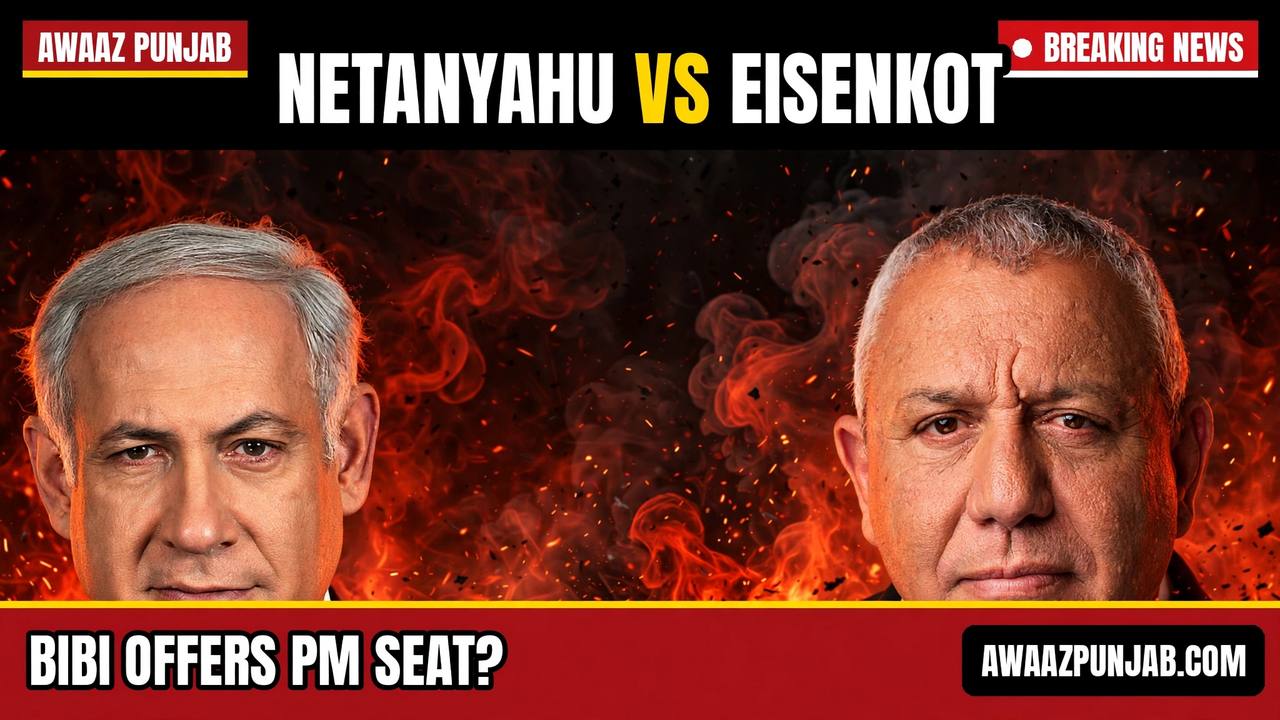
Israeli Prime Minister Benjamin Netanyahu on Saturday evening offered his rival Gadi Eisenkot the first turn as prime minister in a rotating national unity government, saying he would serve as alternate prime minister at the start of the term — the clearest sign yet that Israel's longest-serving leader is contemplating the end of his premiership.
Source: Associated Press
"Naturally, I should lead the unity government, or at least be first in the rotation," Netanyahu wrote in a statement posted on X. "But given the gravity of the existential danger and the possibility that a government will be formed that lacks the ability to confront it, my responsibility as a leader requires me to set everything aside... and agree that Gadi Eisenkot will serve first as prime minister, while I will serve as alternate prime minister at the beginning of the term."
Source: BBC News
Netanyahu, 77, said "unity is the need of the hour" and called for "genuine, sincere, and accelerated negotiations" between his Likud party and Eisenkot's Yashar party. He pointed out that Likud finished as the largest party in the October 27 election, ahead of Yashar by roughly 250,000 votes, and said that would normally entitle him to lead a government or go first in any rotation.
Eisenkot responded within hours, inviting Netanyahu and his team to meet "tonight" for "genuine and accelerated negotiations on basic guidelines and policy issues." He said he was ready to meet within 24 hours — but added that he was also close to agreeing an alternative path to power that would end Netanyahu's premiership without him.
Source: Associated Press
How Israel got here
Israel has been without a settled government since the inconclusive general election on October 27, a month ago. Likud emerged as the largest party in the 120-seat Knesset, but Netanyahu's coalition fell well short of the 61 seats needed for a majority. President Isaac Herzog instead handed the mandate to form a government to Eisenkot, the former military chief of staff, on November 7.
Eisenkot has since sealed coalition agreements with Avigdor Lieberman's right-wing Yisrael Beiteinu and Yair Golan's left-wing Democrats, and he is in talks with the ultra-Orthodox United Torah Judaism party and Naftali Bennett's B'Yachad. His bloc currently counts 48 seats, according to reports — 13 short of a majority. His ally Matan Kahana was elected Knesset Speaker by 66 votes to 52, an early sign of his bloc's organising strength.
Eisenkot's mandate runs until December 6, and he can ask the president for a 14-day extension, to December 20. He has vowed to bring a new government to a parliamentary vote as early as next week — and his camp estimates that, failing a deal with Likud or the ultra-Orthodox parties, it can still put a minority government to a vote while he holds the mandate.
Why Netanyahu says he is offering
Netanyahu framed the offer as a matter of national security. He warned that a government formed without Likud would be unable to confront what he called an existential threat, and he accused "supporters of terrorism" of planning to bring "the terrorists back to the gates of our communities" through policies including the withdrawal of Israeli forces from Gaza, Syria and Lebanon.
Not everyone in Eisenkot's camp is convinced the offer is genuine. Lieberman has cautioned against taking it at face value, suggesting it could be an attempt to run down the clock, delay the formation of an alternative government and force fresh elections. Eisenkot himself accused Likud on Friday of stalling, saying the two sides had held only five meetings in two weeks despite repeated requests for more talks.
Eisenkot has also set conditions of his own, including compromises on judicial reform and a state commission of inquiry into the October 7 attacks — issues on which Likud has so far not engaged seriously, according to his camp.
What happens next
The next hours will tell whether the offer is a breakthrough or a tactic. Eisenkot invited Netanyahu's team to negotiate "tonight", and both sides are expected to meet within a day. If the talks fail, Eisenkot is expected to press ahead with his own coalition and put it to a vote in the Knesset next week — a vote that, if it passes, would end the premiership of Israel's longest-serving leader. If neither side can command a majority, Israel could be heading for yet another election.
Eisenkot has already sealed two coalition deals and is closing in on a government of his own — read how his bloc reached 48 seats. Read the earlier story
What is solid
- Netanyahu offered Eisenkot the first turn as prime minister in a rotating unity government, in a statement posted on X on Saturday evening, November 28.
- Eisenkot invited Netanyahu's team to negotiate 'tonight' and said he was ready to meet within 24 hours.
- Likud was the largest party in the October 27 election; Eisenkot holds the mandate to form a government until December 6.
- Eisenkot's bloc currently counts 48 of the 61 seats needed for a Knesset majority.
What is only claimed
- Whether Netanyahu's offer is a genuine concession or a delaying tactic to force fresh elections — Lieberman has warned it may be the latter.
- Whether a unity government can be agreed before Eisenkot's mandate expires, or whether he will instead put a minority government to a vote.