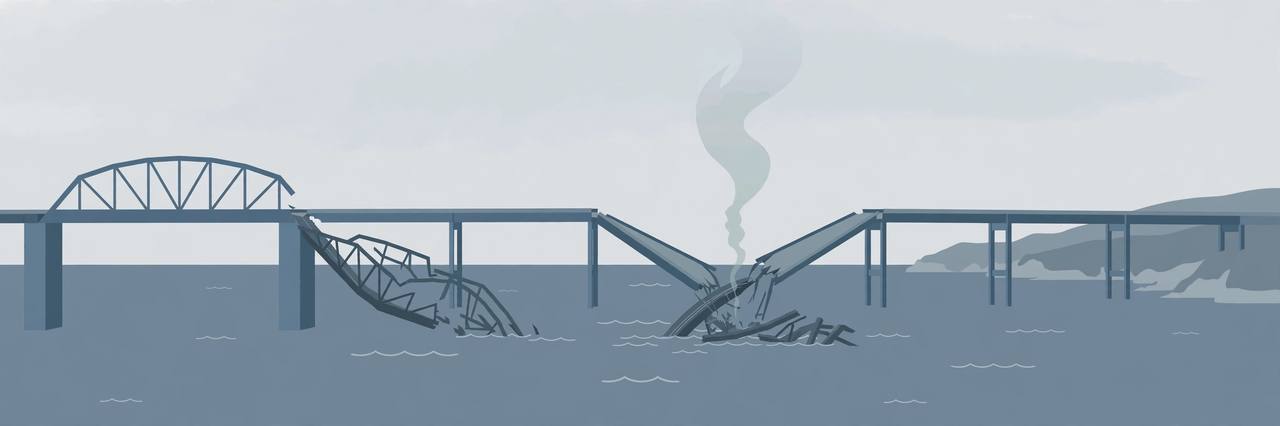
Britain's Defence Intelligence has published satellite images showing the damage to the Kerch Bridge — the road-and-rail link between Russia and occupied Crimea — after Ukrainian forces struck it three times between 16 and 19 November. The images, dated 22 November and taken by Airbus Defence and Space, give the first detailed public look at the bridge's condition since the attacks.
Source: UK Ministry of Defence — Defence Intelligence
Ukrainian forces struck the Kerch Bridge three times between 16 and 19 November. Our earlier report covered the third strike, which damaged the railway track. Read the earlier report
The satellite images show a collapsed road section, a damaged road section and a damaged rail section. British intelligence said the road section was left unusable, while one railway track across the bridge remained in operation. The railway bridge sustained damage near its arch, with scorch marks and damage to fencing.
The images also show two Russian Pantsir-S1 air defence systems — known to NATO as the SA-22 Greyhound — positioned about 2.4 kilometres south of the section of the bridge that collapsed into the sea. British intelligence said that despite significant measures taken to protect the bridge, Russian air defence had failed to prevent the Ukrainian strikes.
What the three strikes did
Russian officials first said the bridge had come under attack on 16 November. On 17 November, President Volodymyr Zelensky confirmed a further strike using Flamingo and Neptune missiles, Palianytsia drones and other Ukrainian weapons. The arch section of the road bridge collapsed in that strike, making vehicle traffic impossible and blocking the maritime passage between the Sea of Azov and the Black Sea. On 19 November, Ukraine's General Staff confirmed a Neptune missile strike that damaged the railway track.
Zelensky has described the operation as a seven-stage campaign run by Ukraine's Security Service and the General Staff, with most of the early stages aimed at air defences, radars and electronic warfare systems around the bridge approaches before the strikes on the bridge itself. Verified video and photos geolocated by NBC News and Reuters show a section of roadway — about 200 to 225 metres, according to BBC Verify and commercial imagery — dragged into the sea.
UK Defence Intelligence said the attacks restricted Russian maritime logistics. Ships in the Sea of Azov likely cannot sail directly into the Black Sea until the waterway under the central arch is cleared, and the port of Azov has reportedly stopped operating. The strait is only 3 to 6 metres deep, and large ships pass through a single narrow channel that runs under the arch where the debris now lies.
The bridge was built by Russia across the Kerch Strait after its 2014 annexation of Crimea and is the only direct land link between the Russian mainland and the occupied peninsula. The road arch is about 227 metres long; the railway arch is still standing but damaged. Occupation authorities introduced fuel restrictions in Crimea on 18 November, and Ukrainian monitoring footage has claimed to show queues at Sevastopol.
Russia has not given a repair timeline. Deputy Prime Minister Marat Khusnullin said on 19 November that a timeline would come within a week. Ukraine says the bridge will not stay standing, and Kyiv has warned Russia is ramping up so-called double-tap strikes elsewhere. The damage assessment published by Britain is its own intelligence reading of the satellite imagery; Russia has not confirmed the extent of the damage.
What is solid
- UK Defence Intelligence published satellite images dated 22 November showing the bridge damage
- Three Ukrainian strikes hit the bridge between 16 and 19 November
- The road section collapsed and is unusable; one railway track remains in operation
What is only claimed
- Whether Russian air defences fired at all during the strikes — one Ukrainian military expert said they fired not a single shot, while the imagery alone cannot prove it
- How long repairs will take — no official Russian timeline has been published