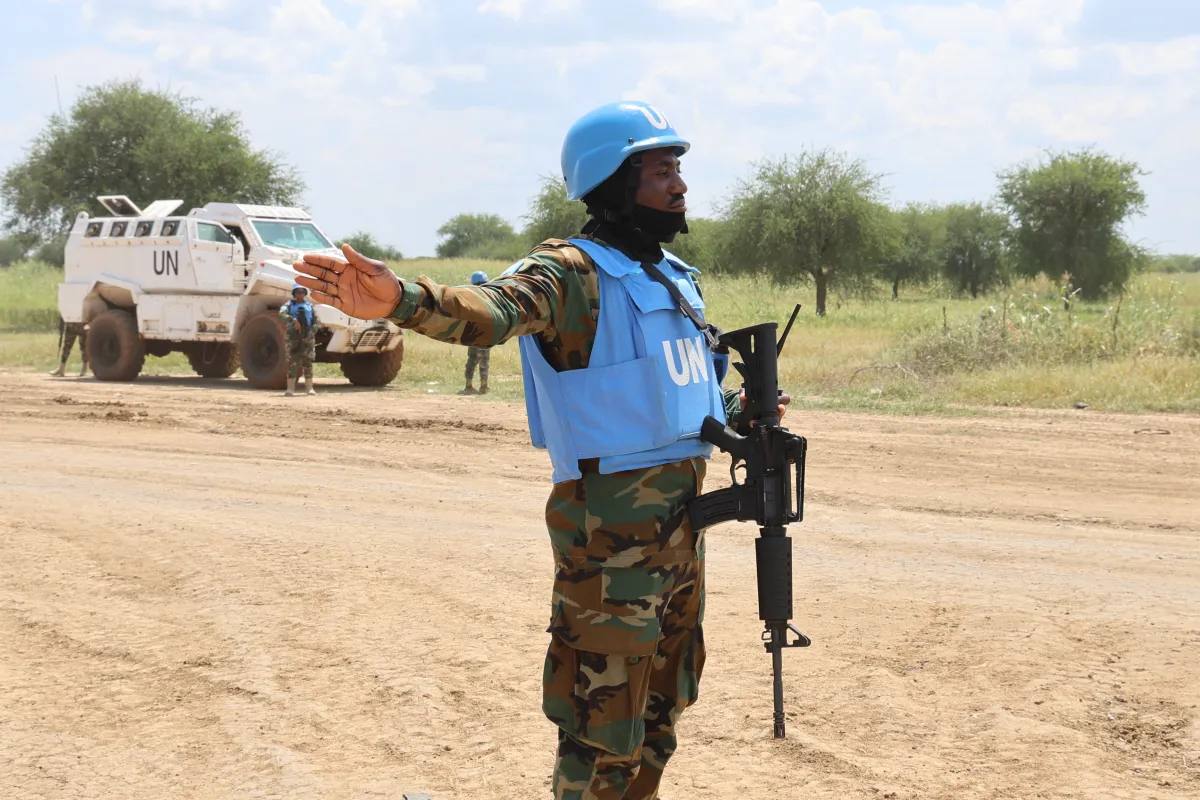
The UN Security Council voted in New York on Friday, November 13, to extend the authorisation of the United Nations Interim Security Force for Abyei (UNISFA), the peacekeeping force deployed in the disputed Abyei area between Sudan and South Sudan. The vote took place at the Council's 10272nd meeting, whose agenda was the Secretary-General's reports on the Sudan and South Sudan, including his latest report on the situation in Abyei, document S/2026/821.
Source: UN Web TV
The Council adopted the text as Resolution 2838 (2026) by 13 votes in favour to none against, with two abstentions — China and the Russian Federation. The draft was submitted by the United States, the Council's penholder on the Abyei file, and it renews the mandate of a mission whose previous authorisation was due to expire on November 15.
Source: Xinhua via Webull
China's Deputy Permanent Representative to the United Nations, Sun Lei, said in an explanation of vote that Beijing had constructively taken part in the negotiations but abstained because the draft “establishes a number of benchmarks around the Abyei political process” and links them to future extensions of UNISFA's mandate — an approach he said China has reservations about. He expressed concern that the author country, the United States, was pushing the draft in that direction.
Source: Xinhua via Webull
Sun Lei noted that China is a major troop contributor to UNISFA. He said the force had achieved “remarkable results” in protecting civilians, mitigating ethnic conflicts and improving people's livelihood and welfare, and warned that hastening talk of withdrawal while the Abyei issue remains unresolved would have “serious negative effects”. The Abyei question, he added, is the product of history, reality and internal and external factors, and should not be attributed entirely to a lack of will or action by the parties concerned.
A mandate that was days from expiry
Friday's vote came at the end of a renewal cycle set by Resolution 2802 (2025), which extended UNISFA until 15 November 2026 and — for the first time — tied the mission's future to demonstrable progress by Sudan and South Sudan. Those benchmarks include the withdrawal of all unauthorised armed forces from Abyei and its full demilitarisation, the resumption and documentation of meetings of the Joint Political and Security Mechanism (JPSM), the establishment of the Abyei Joint Security Police, and visas allowing UNISFA to deploy 640 police personnel.
The Council had been briefed on Abyei on November 5, when UN peacekeeping chief Jean-Pierre Lacroix warned that drone strikes in the area had added a “new and concerning” dimension to security there, after strikes the previous month killed at least 30 people. Britain's Deputy Permanent Representative Kate Foster told the same meeting that continued violations of Abyei's demilitarised status were unacceptable, citing drone attacks near Amiet Market and Todach on October 19 that killed and injured civilians and displaced thousands, and demanding that all unauthorised armed forces, including Sudan's Rapid Support Forces (RSF), withdraw from Abyei.
Source: UK Government (GOV.UK)
The Secretary-General's Special Envoy for the Horn of Africa, Guang Cong, told the Council on November 5 that the JPSM — the bilateral Sudan–South Sudan security body — had resumed meeting in Juba in August after a pause stretching back to 2023, though a follow-on meeting planned for October had been postponed to November 8–10. He also pointed to tensions over South Sudan's plans to include Abyei in its electoral map for the elections scheduled for December 22, and said resolving Abyei's final status remains the most significant unresolved issue between the two countries.
Source: ReliefWeb / UN
Abyei is an oil-rich area claimed by both Sudan and South Sudan, and its final status has been unresolved since South Sudan's independence in 2011. UNISFA was created by the Security Council in June 2011, under Resolution 1990, to protect civilians, support demilitarisation and monitor the border area. Its work has grown harder since Sudan's civil war erupted in April 2023, with fighting and armed actors spilling into and around the Abyei area.
UNISFA stays in place under the renewed authorisation, but the argument that split Friday's vote will return at the next renewal: the United States and its backers want the mission's future judged against the benchmarks Sudan and South Sudan were set in 2025, while China and Russia argue that progress on Abyei's political process cannot be made a condition for keeping peacekeepers who protect civilians. Both governments are now expected to show progress on demilitarisation, the joint police service and regular JPSM meetings.
Earlier this month the Council heard warnings that drone strikes were changing the security picture in Abyei: Read the November 5 Abyei briefing report