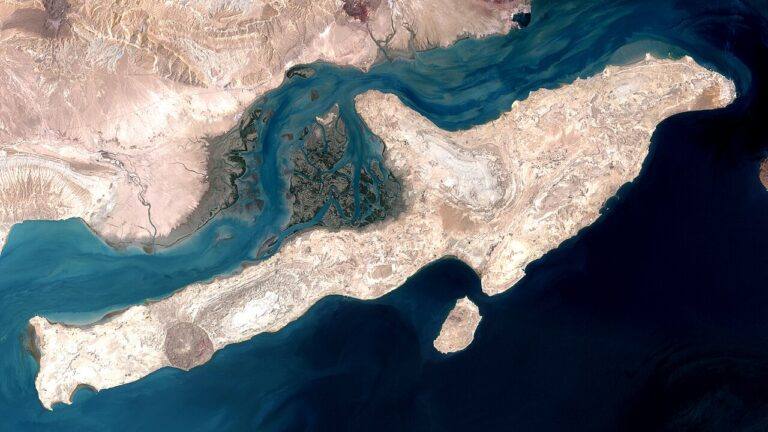
Hours before the Qeshm explosions, Iran's Revolutionary Guards said their combat drones had targeted a US-operated radar system at Bahrain's Sheikh Isa Air Base. Bahrain said the attack was intercepted, with no casualties or damage. Read the Bahrain drone-attack report
The United States carried out several strikes on Iran's Qeshm Island in the Strait of Hormuz on Tuesday evening, a senior Iranian provincial official said, in the latest exchange of fire in the nearly nine-month US-Iran war. Iran's official IRNA news agency said the sounds of five to six explosions were heard across the island.
Source: IRNA via AFP / Islamabad Post
"The American attack on locations on Qeshm island caused no damage to residential, commercial, or infrastructural areas," Ahmad Nafisi, deputy governor of Iran's southern Hormozgan province, was quoted as saying by IRNA. "The situation on Qeshm island is under control, and all relief, service, and executive agencies are on full alert," he added.
Reuters reported that Iranian media had reported an explosion on Qeshm and cited an Iranian official as saying the US had carried out an attack there without causing damage to infrastructure. Asked for comment, the US military's Central Command said it had no updates. Washington carried out limited strikes on Qeshm earlier this month.
Source: Reuters
Iranian media reports said several loud explosions were heard northwest of Qeshm city, and some reports said an air-defence site on the island was targeted. That detail has not been independently confirmed, and there was no immediate comment from the Pentagon on any specific target.
A day of strikes across the strait
Earlier on Tuesday, Iran's Islamic Revolutionary Guard Corps (IRGC) said its combat drones had carried out a precision operation against a radar system operated by US forces at Sheikh Isa Air Base in Bahrain, which hosts the headquarters of the US Fifth Fleet. The Guards' Sepah news website said the attack was in response to what it called repeated violations of Iranian airspace by US military drones. Bahrain said it intercepted the attack and reported no casualties or damage.
The IRGC also warned Bahrain over its alliance with the US. Guards spokesperson Hossein Mohebbi said Bahrain had made "three key mistakes" — cooperating in the invasion of Iran, remaining within the US security bubble, and encroaching on the sanctity of Shi'ite religious authority — and said these, if continued, would jeopardise Bahrain's survival in the region's new security order. Iran's foreign ministry separately condemned a Bahraini court's sentencing of 64 people, mostly Shi'ite clerics, to life in prison, calling the accusations baseless; Tehran has long denied interfering in Bahrain's internal affairs.
Attacks on shipping in the strait also rose on Tuesday. The United Kingdom Maritime Trade Operations agency said the crew of a tanker passing through the waterway was unaccounted for after being attacked north of the Omani port city of Khasab. Iran's Revolutionary Guards and navy said a ship carrying liquefied natural gas and two oil tankers had caught fire in the strait, and Iran's armed forces said three oil tankers struck naval mines while attempting to transit Hormuz. Reuters said it could not independently verify those reports. The US military has said it recently cleared all mines from the main routes through the waterway.
Strikes land in the middle of mediation talks
The strikes came on a day of active mediation. Qatari and Iranian officials were meeting on Tuesday as part of efforts to mediate an end to the war, with Qatari spokesperson Majed Al Ansari saying the talks aimed at "bridging perspectives and narrowing the gap between proposals presented on the ground." Iranian Foreign Minister Abbas Araqchi was visiting Oman, where he met Sultan Haitham bin Tariq and discussed safeguarding maritime corridors, ensuring the smooth flow of global shipping and trade, and preventing military escalation with Oman's foreign minister, Oman's Foreign Ministry said.
US President Donald Trump has said he might hold off from attacking Iran if the US does not face what he described as provocations from Tehran or the Iran-backed Houthi group in Yemen, and he has said he will maintain a US naval blockade on Iran because it has continued to disrupt shipping in the Strait of Hormuz — a sticking point in negotiations. On Tuesday Trump also said the US was taking seriously the possibility that Iran could be planning an attack involving a so-called dirty bomb in Washington, after being asked about a CNN report citing US intelligence assessments; Iran's foreign ministry spokesperson called the report part of a US campaign using "baseless allegations," according to Reuters.
Background: a war at stalemate, a strait partly blocked
The war began on February 28 with US and Israeli strikes on Iran and has ground to a stalemate after nearly nine months, destabilising the Middle East and pushing up global energy prices. The Strait of Hormuz, which lies between Oman and Iran, carried about one-fifth of global oil and liquefied natural gas supplies before the war but is now partly blocked by Iran, which insists vessels use only routes it authorises. The United States has imposed a naval blockade on Iranian ports and helped tankers travel the strait; Central Command said last month it had helped Gulf countries export 1.5 billion barrels of oil via Hormuz since the summer.
For the large Punjabi and Indian workforce living across the Gulf states, every escalation in the strait matters beyond the battlefield: Hormuz is the route for the region's oil and gas exports, and prolonged disruption typically means higher fuel and food prices and greater uncertainty for shipping, construction and service jobs across the Gulf. No specific impact on Indian or Punjabi workers from Tuesday's strikes has been reported.
What happens next will depend on whether Washington confirms or expands the Qeshm operation, whether Iran answers with further drone or missile fire at US bases in the Gulf, and whether the Qatar- and Oman-led mediation can narrow the gap over shipping through Hormuz. For now, the only confirmed account of Tuesday evening's explosions is Iran's own: an American attack, five to six blasts, and — on Tehran's account — no damage to homes, businesses or infrastructure.