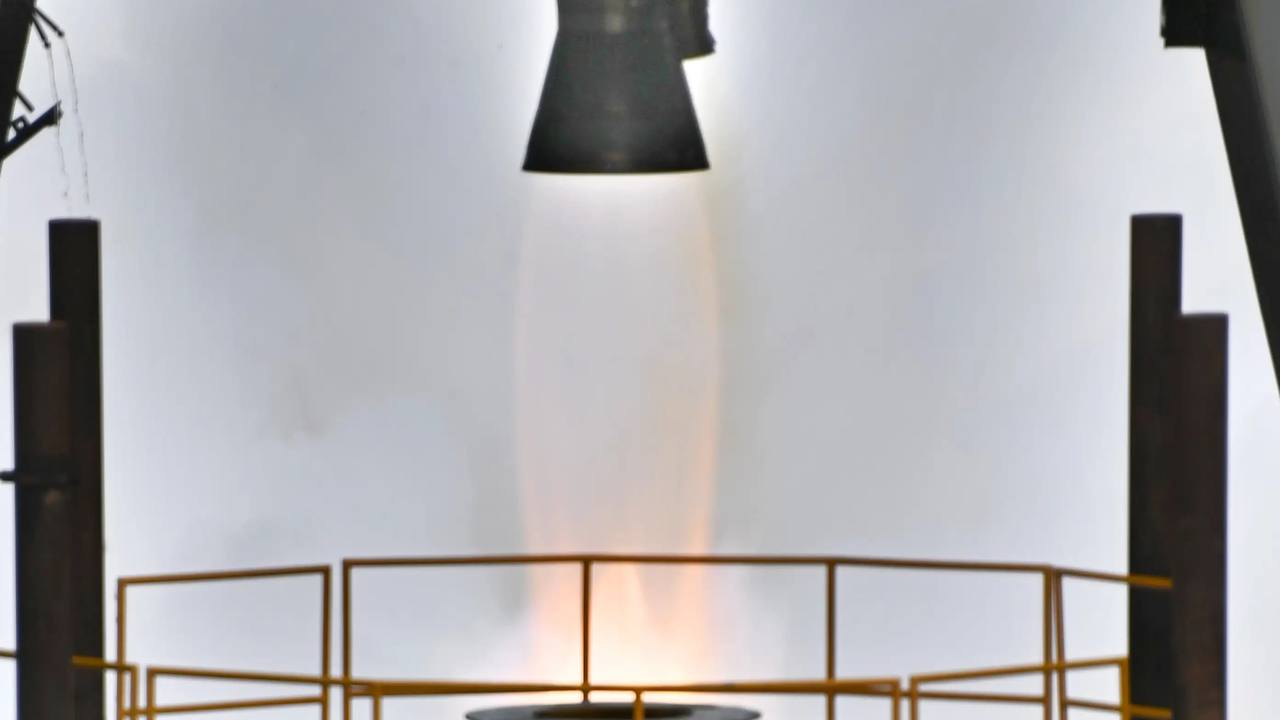
The Indian Space Research Organisation (ISRO) has completed a 200-second ignition test of the gas generator for its high-thrust liquid oxygen–methane (LOX-methane) rocket engine, the space agency said on November 27. The test was carried out on November 14 at the ISRO Propulsion Complex in Mahendragiri, Tamil Nadu, and the engine is being built for the Next Generation Launch Vehicle (NGLV).
Source: ISRO
In the test, the hardware held a steady chamber pressure of 31.5 bar, which ISRO said matches the engine running at about 60 per cent of its thrust. The agency reported smooth ignition and stable combustion throughout the 200 seconds, and said the result shows the design is adequate at that operating point. The same hardware will now be tested at other operating conditions.
Source: MapMyTimes
A gas generator is a small but critical part of a liquid rocket engine. It burns a small share of the propellants to produce hot, high-pressure gas, which spins a turbine that drives the pumps feeding propellant into the engine's main thrust chamber. ISRO describes a well-designed gas generator as one of the important milestones in developing any liquid rocket engine, because the pumps cannot run without it.
Two days earlier, on November 12, ISRO completed the first cold-flow test of the engine's liquid oxygen pump assembly. The test checked how the pump behaves both with and without cavitation — the formation of vapour bubbles that can damage pumps and reduce their output. ISRO said the pump had already been spin-tested up to its maximum operating speed, and its performance matched predictions for the integrated engine.
Source: Indian Defence News
ISRO also noted that the gas generator hardware was made by additive manufacturing, commonly known as 3D printing, by an Indian industry partner, underlining the growing role of Indian industry in building critical space hardware.
The agency has picked LOX-methane as the main propulsion for the NGLV and for a future heavy-lift rocket needed for India's crewed lunar landing mission, targeted for 2040. In an October 2026 overview of the programme, ISRO said rocket propulsion around the world is shifting to this propellant combination because methane burns cleanly, the engines need less maintenance — which makes reuse easier — and methane can in principle be produced on Mars from carbon dioxide and water ice.
The engine, called the LME1100, is a gas-generator-cycle engine of 1,100 kN thrust that has been under formal development since 2023 by ISRO's Liquid Propulsion Systems Centre, with participation from the Vikram Sarabhai Space Centre. With these tests, ISRO said the spark torch ignition system, the scaled thrust chamber, the full-scale gas generator and the LOX pump have all completed their development test campaigns. The integrated LME1100 engine is expected to be ready for hot testing by the middle of next year.
Source: Dharmakshethra
ISRO has not said when the complete engine will first be fired, and the announcement gives no new date for the NGLV's first flight. But because the agency has chosen LOX-methane as the main propulsion for the NGLV, progress on this engine largely sets the pace for that rocket.