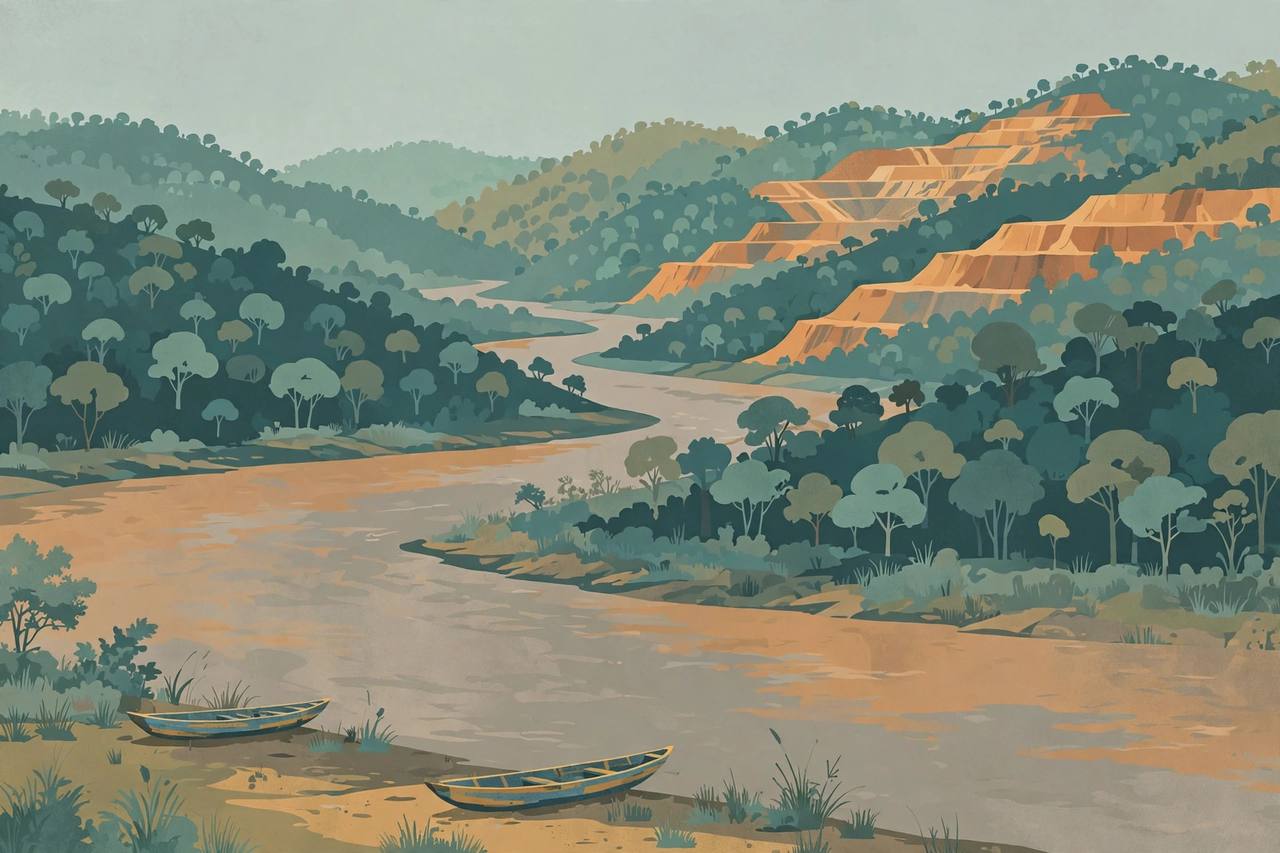
Thailand will ban exports of chemicals used in mining from Monday, Prime Minister Anutin Charnvirakul said on Saturday, in a direct strike at the unregulated rare-earth and gold mines across the border in Myanmar that Bangkok blames for poisoning its northern rivers. The Defence Ministry will issue the order, Anutin said on a weekly government television programme.
Source: Reuters
Ten days ago, arsenic from the same mines forced tap water to be cut to 20,000 homes in Mae Sai district, and the prime minister ordered a clean-water scramble. Saturday's announcement turns that emergency response into a crackdown on the chemical supply itself. Read the earlier story
Thailand said last week that it planned to block exports of chemicals used in rare-earth mining to Myanmar and other relevant countries. Bangkok is also planning to ban exports of two chemicals used specifically in rare-earth mining and to restrict imports of six minerals, including gold and rare earths, to cut off unauthorised mines from buyers, according to AFP reporting.
Source: AFP via MalaysiaNow
The pollution evidence
Tests in August found arsenic exceeding standard levels at multiple locations along the Kok, Sai and Ruak rivers, which rise in Myanmar's Shan State and flow into northern Thailand. Deputy Prime Minister Yodchanan Wongsawat told Reuters on Friday that existing data showed mines in Shan State were polluting the rivers flowing into northern Thailand, although Myanmar has asked for more evidence.
Source: Reuters
"Arsenic does not come from nature, it came from mining sites. The source was from (Myanmar's) Shan state, no-one disagrees," Yodchanan, who is also Thailand's science minister, said at joint talks this week.
Source: AFP via MalaysiaNow
Thailand's own role in the trade is now part of the story. Thai companies supply 70% to 80% of the industrial chemicals shipped into Myanmar for gold and rare-earth mines, according to Thailand's National Security Council. The council has forwarded a list of specific industrial reagents to the Defence Ministry to be classified as controlled goods, choking off cross-border shipments.
Source: Chiang Rai Times
Villages without clean water
Tap water supplies to 14 villages in Mae Sai district, near the Myanmar border, were suspended earlier this month after arsenic levels were found to be nearly 30 times government limits. Thai officials have also found dangerous levels of arsenic and lead in shellfish and other species in the contaminated rivers. From December 2, more than 150 kilometres of the Kok River will be designated a formal pollution control zone, and emergency clean water is being arranged for nearly 20,000 residents in Chiang Rai province. Anutin said authorities were also seeking alternative water sources for affected communities.
Source: AFP via MalaysiaNow
Diplomacy and what happens next
Bangkok hosted the first Thai-Myanmar working group on the issue this week, attended by the Chinese ambassador, where Thailand said tests proved the rare-earth and gold mines in Myanmar were causing the pollution downstream. The two sides agreed to joint water sampling on the Kok and Sai rivers, with 12 sampling locations and joint sampling expected to begin between December and January. Thailand is also looking to China — the main importer of rare-earth materials from Myanmar — to pressure private Chinese operators, and trilateral talks with Myanmar and China are planned this week.
Source: Reuters
The ban order lands on Monday, the Kok River pollution control zone takes effect on December 2, and the joint sampling programme is due to start in December or January. Whether the export ban bites will depend on enforcement at the border — traders have for years moved industrial acids, ammonium sulfate and cyanide compounds through weak customs checks and broad commercial classifications — and on whether Myanmar and China cooperate in reining in the mines.
Source: Chiang Rai Times
The stakes go beyond Thailand's northern provinces. Rising demand for rare earths — the elements used in electric-vehicle batteries, wind turbines and other new technologies — has driven an unregulated mining boom centred in war-torn Myanmar, and the toxic runoff now threatens the Mekong River system that around 70 million people across mainland Southeast Asia depend on for farms and fisheries.
Source: Associated Press