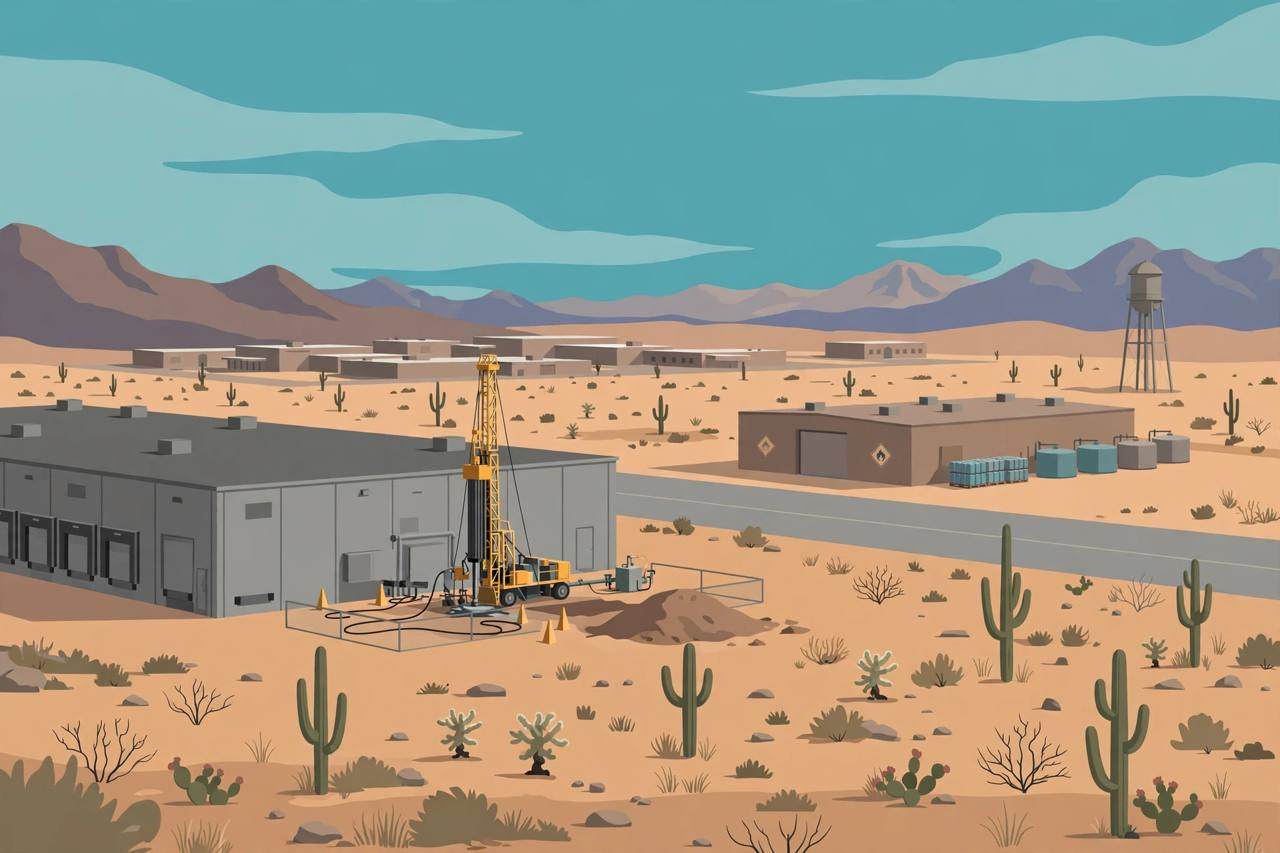
A draft environmental review released Monday by the U.S. Department of Homeland Security has found that converting a warehouse in Surprise, Arizona, into a 1,500-bed immigration detention center would cause no significant environmental harm — even though the facility would use about three times as much water as the building was designed for, and even though the review itself was managed by the company hired to convert and run the site.
Source: Project Salt Box
The facility is planned for a 400,000-square-foot warehouse at 13290 West Sweetwater Avenue, near Dysart Road, in Surprise, a fast-growing city on the northwestern edge of the Phoenix metropolitan area in Maricopa County. According to the draft assessment, the center would hold up to 1,500 detained people and operate around the clock with 676 staff members working across three shifts. U.S. Immigration and Customs Enforcement (ICE) owns the building and hired GardaWorld Federal Services under a $313 million contract to convert the warehouse and operate the facility, Project Salt Box reported after reviewing the documents, which the outlet posted in full.
Water is the one binding issue in the review
Water dominates the draft. The facility would use about 190,000 gallons on an average day and about 215,000 gallons at its peak, the draft says, while the city of Surprise is planning for a maximum of 380,000 gallons a day — three times what the building was originally designed to use, which was about 63,000 gallons a day. "Operation of the Proposed Action would substantially increase water demand above that anticipated for the existing industrial development," the report states. To meet the demand, Surprise would have to build a new municipal well about five years ahead of schedule and expand a planned treatment system that removes arsenic from groundwater. The detention center would pay for the infrastructure work.
Source: The Phoenix Focal
The money is itemized in a September 22 city memo to GardaWorld cited in the review: the facility would owe Surprise about $8.9 million before it could open, including $6.1 million for the new well, about $921,000 for expanded water treatment, about $840,000 for wastewater treatment and about $1.1 million for water rights, with development impact fees on top. Under a city ordinance for large water users — adopted by the Surprise City Council on January 20, just three days before ICE purchased the warehouse — the facility must also supply 15 years' worth of water rights, about 1,512 acre-feet, before it can receive service, and show access to roughly 490 million gallons of water. Surprise City Council member Chris Judd told ABC15 in October that the facility would use "two to three times more than our highest current water user." All five binding conditions in the draft finding of no significant impact come from that city memo, and they all concern water.
The draft assessment says consultants under contract to GardaWorld Federal Services prepared the review and its supporting documents, and GardaWorld's project manager is listed both as the review's project manager and as a technical reviewer. A project manager from a second firm, Rudiarius LLC, is also listed as a technical reviewer; only three government employees — two from DHS and one from ICE — are listed as reviewers. DHS's own environmental manual allows contractors to draft such documents but calls the underlying decision-making "an inherently governmental function," and only a DHS employee may sign the final documents.
A chemical warehouse sits directly across the street
The warehouse sits across West Sweetwater Avenue from Rinchem, a chemical company that stores hazardous materials for the semiconductor industry and files a risk management plan with the Environmental Protection Agency, as federal law requires of facilities handling the substances that pose the greatest risk in an accidental release. The draft reports no violations or releases at Rinchem and says detained people would likely shelter in place during a chemical emergency because of the facility's closed-loop air system, with an emergency response plan to be developed. Critics say that is not enough: in a November 10 statement, Northwest Valley Indivisible argued the review still has not studied the release scenario in Rinchem's own plan — a failure involving 20,000 pounds of anhydrous hydrogen chloride that the company estimates could send a toxic plume 2.7 miles and reach 73,642 people — and called on DHS to withdraw the draft finding and prepare a full environmental impact statement. That criticism is the group's allegation and position; DHS has not withdrawn the draft.
Source: Northwest Valley Indivisible
Traffic, schools and desert air
Beyond water, the draft says about 25 detainee transport vehicles would come and go each day, and that the facility's 3 p.m. shift change would overlap with dismissal at nearby Dysart High School and Dysart Middle School. It also concedes that a peak-hour traffic analysis "cannot be calculated from currently available information" because city traffic counts do not cover the route. On air quality, the draft notes that Maricopa County does not meet federal standards for ozone and airborne dust, analyzes the facility's 12 backup generators — which it calls the only stationary source of emissions — and finds the effect insignificant; it does not include a separate cumulative-effects analysis, citing the Supreme Court's 2025 ruling in Seven County Infrastructure Coalition v. Eagle County, though the draft finding itself says DHS considered cumulative impacts.
How the project got here
The review exists because Arizona sued. The state, through Attorney General Kris Mayes, sued DHS and ICE in April, arguing the agencies were converting the warehouse without the environmental review required under the National Environmental Policy Act. In late June the two sides asked a federal judge to pause the case while ICE completed an assessment, and under the order the judge entered in July, ICE may not hold anyone at the site or physically convert it until the assessment is final. Justice Department lawyers told the court on November 5 that ICE's contractor had prepared a draft and ICE was reviewing it, and that no final assessment or decision document had been issued. A spokesman for Attorney General Mayes told 12News on Monday that the office was still reviewing the assessment and had no comment.
What happens next
Public comments on the draft assessment and the draft finding are due December 9 and can be submitted by email through the DHS public comment page. Once ICE issues a final assessment, the court order gives Arizona 10 days to decide whether to renew its request to block the project; if it does, ICE must wait at least 21 more days before starting conversion work, unless a judge rules otherwise. The draft says renovation would take about 30 days once approved. For Surprise residents, the immediate questions are local — a new well drilled years early, arsenic treatment expanded, school-hour traffic on Sweetwater Avenue — but the decision also shapes how immigration detention expands across the Phoenix area, where immigrant families, including the region's Punjabi and South Asian communities, would feel any new 1,500-bed facility first. Nothing is final yet: until the comment period closes and a final assessment is signed, the warehouse stays a warehouse.