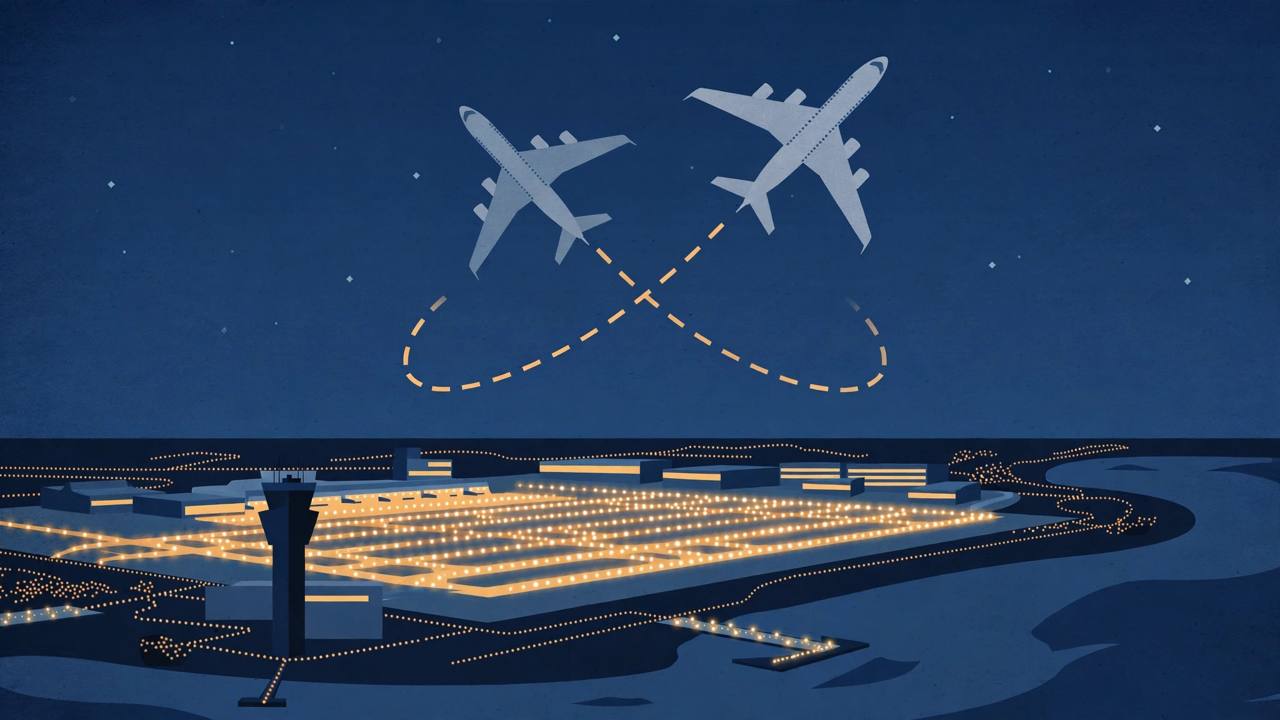
Two passenger jets that took off from Los Angeles International Airport (LAX) about a minute apart in the early hours of Saturday, November 7, came dangerously close to each other in the climb out of California's busiest airport, after the first aircraft turned left across the second aircraft's departure path, according to flight-tracking reconstructions and recorded air traffic control exchanges reported by Simple Flying and Aerospace Global News. Air traffic controllers spotted the conflict, ordered an immediate heading change for one jet and stopped the other jet's climb. Both flights then continued safely to their destinations and no injuries were reported.
Source: Simple Flying
The two flights, a minute apart
Air France flight AF28, an Airbus A350-900 registered F-HUVK, took off from runway 24L at about 12:15 a.m. local time, bound for Papeete in French Polynesia, Aerospace Global News reported. American Airlines flight AA1660, an Airbus A321-200 registered N191UW, departed runway 25R about a minute later, at about 12:16 a.m., for Dallas/Fort Worth International Airport in Texas. Runways 24L and 25R are the inner runways of LAX's northern and southern parallel runway pairs, and both aircraft initially departed west, out over the Pacific Ocean. Simple Flying noted the two aircraft together could have been carrying more than 500 passengers — a capacity-based estimate, not a confirmed passenger count, which neither airline has released.
Source: Aerospace Global News
What the departure procedure required — and the turn that broke it
AF28 had been assigned the FAA's SUMMR2 standard instrument departure. Under SUMMR2, aircraft departing runways 24L/R and 25L/R climb on a heading of 251 degrees to 640 feet before proceeding to their first assigned waypoints, Aerospace Global News reported, citing the FAA procedure; Simple Flying described the same procedure as requiring a straight initial climb before following the assigned route, and The Aviation Herald's account, cited by Simple Flying, said the A350 began turning left while climbing through about 1,800 feet, although its procedure called for a straight climb to 5,000 feet. Instead of continuing on that routing, the A350 turned left — toward the departure path of the American jet climbing behind and beside it — putting the two aircraft on conflicting flight paths as they climbed out.
The controller's intervention, in his own words
In the recorded exchanges reported by Aerospace Global News, the controller instructed the Air France crew to 'fly heading 270 immediately,' directing the A350 westward and away from the conflict. Seconds later, he warned the American Airlines pilots of traffic at their 12 o'clock position, less than one mile away, and told them to maintain 2,000 feet. The American crew acknowledged and said it would return to 2,000 feet; the controller later cleared AA1660 to climb to 17,000 feet with a 250-knot speed restriction. After the conflict had passed, the controller apologised to the American crew and explained that the other aircraft had turned in front of it. The American crew replied: 'Great job, thank you.'
Source: Aerospace Global News (recorded ATC exchanges)
The controller then questioned the Air France crew about the departure they had been cleared to fly. Asked why the aircraft had turned, the crew initially replied 'Standby,' and later confirmed it had been instructed to fly the SUMMR2 departure. The controller directed the A350 toward the DART waypoint, told the crew there was 'a possible pilot deviation' and gave them a telephone number to call — the standard first step in an FAA pilot-deviation follow-up. Simple Flying said it reached out to Air France for comment and an airline spokesperson could not immediately be reached; Aerospace Global News reported that neither Air France nor American Airlines had issued a statement on the incident at the time it published.
How close is 'close'? The numbers are preliminary
The most widely reported figure is about 400 feet (about 121 metres) of vertical separation. Flight-tracking company Wingbits, publishing its ADS-B data on X on November 8, estimated the aircraft were about 300 feet apart vertically when they were 1.6 nautical miles apart horizontally, with the closest pass at about 0.76 nautical miles (about 1.4 km). Both outlets stress that these are reconstructions from tracking data, not findings of an official investigation: they are preliminary, they differ between sources, and they do not establish whether either crew received a TCAS resolution advisory — the automated cockpit warning that orders pilots to climb or descend. So far, reports indicate neither crew received such an advisory, Simple Flying reported.
What is solid
- AF28 (Airbus A350-900, F-HUVK) departed runway 24L at about 12:15 a.m. on Nov. 7 for Papeete; AA1660 (Airbus A321-200, N191UW) departed runway 25R about a minute later for Dallas/Fort Worth
- AF28 had been assigned the SUMMR2 departure and turned left shortly after takeoff, across AA1660's climb path
- Controllers ordered AF28 onto heading 270 immediately and held AA1660 at 2,000 feet; both flights continued safely with no reported injuries
- The controller told the Air France crew there was 'a possible pilot deviation' and gave them a number to call
What is only claimed
- The exact closest separation — about 400 feet vertically in most reports, about 300 feet vertically at 1.6 nm horizontally in Wingbits ADS-B data, closest horizontal pass about 0.76 nm; all figures are preliminary tracking reconstructions, not official findings
- Why the A350 turned left — not explained in either report; the crew initially answered 'Standby' when asked
- Whether any TCAS resolution advisory was issued — reports so far indicate none, but this is not confirmed by an investigation
Background: not the first LAX departure deviation
Aerospace Global News reported this is the latest in a series of departure deviations from LAX's runway 24L. On October 20, 2026, a TAP Air Portugal A330-900 made an unexpected left turn shortly after departure from the same runway, it reported. On October 31, 2025, an ITA Airways A330-900 turned toward an American Airlines A321 that had departed parallel runway 25R — a pairing strikingly similar to Saturday's — and ADS-B data showed the two aircraft came within 0.6 nautical miles horizontally while at the same altitude. Simple Flying likewise noted a similar 2025 incident involving an American jet and an ITA Airways jet after a pilot deviation at LAX. The SUMMR2 procedure exists precisely to keep westbound departures separated as they climb out over the Pacific on routes toward Hawaii, Asia and the U.S. West Coast.
The close call also lands at a strained moment for U.S. air traffic control: the incident happened during the record federal government shutdown, when controllers have been working without pay and the FAA has ordered stepped flight reductions at 40 major airports — a story Awaaz Punjab is covering separately. No official or either report has linked the shutdown, staffing or the flight cuts to Saturday's deviation, and readers should not treat them as connected unless an investigation says so. What the reports do credit is the departure controller's own situational awareness: the conflict was caught by a person watching the scope, not by an automated cockpit alert, on the accounts published so far.
What happens next
A 'possible pilot deviation' report normally leads to an FAA review of the recorded radar and voice data and of the crew's clearance readback, and the airlines typically run their own internal safety reviews in parallel. The New York Post's account, carried by other outlets, said the FAA is expected to investigate whether a pilot violated controller instructions. Until the FAA or the airlines publish findings, the reason for the left turn — misheard clearance, wrong waypoint, cockpit programming or something else — remains unknown, and the separation figures in this story should be read as the best preliminary reconstructions, not verdicts. Awaaz Punjab will update this report if the FAA, Air France or American Airlines issues a statement.
LAX is one of the main gateways for Punjabi and other South Asian travellers in California, and the American flight's route — Los Angeles to Dallas/Fort Worth — is a corridor many diaspora families and truckers fly between California and Texas. A loss of separation a minute after takeoff, caught only by a controller's intervention, is the kind of near-miss that usually stays invisible unless tracking data and ATC audio surface, as they did here.