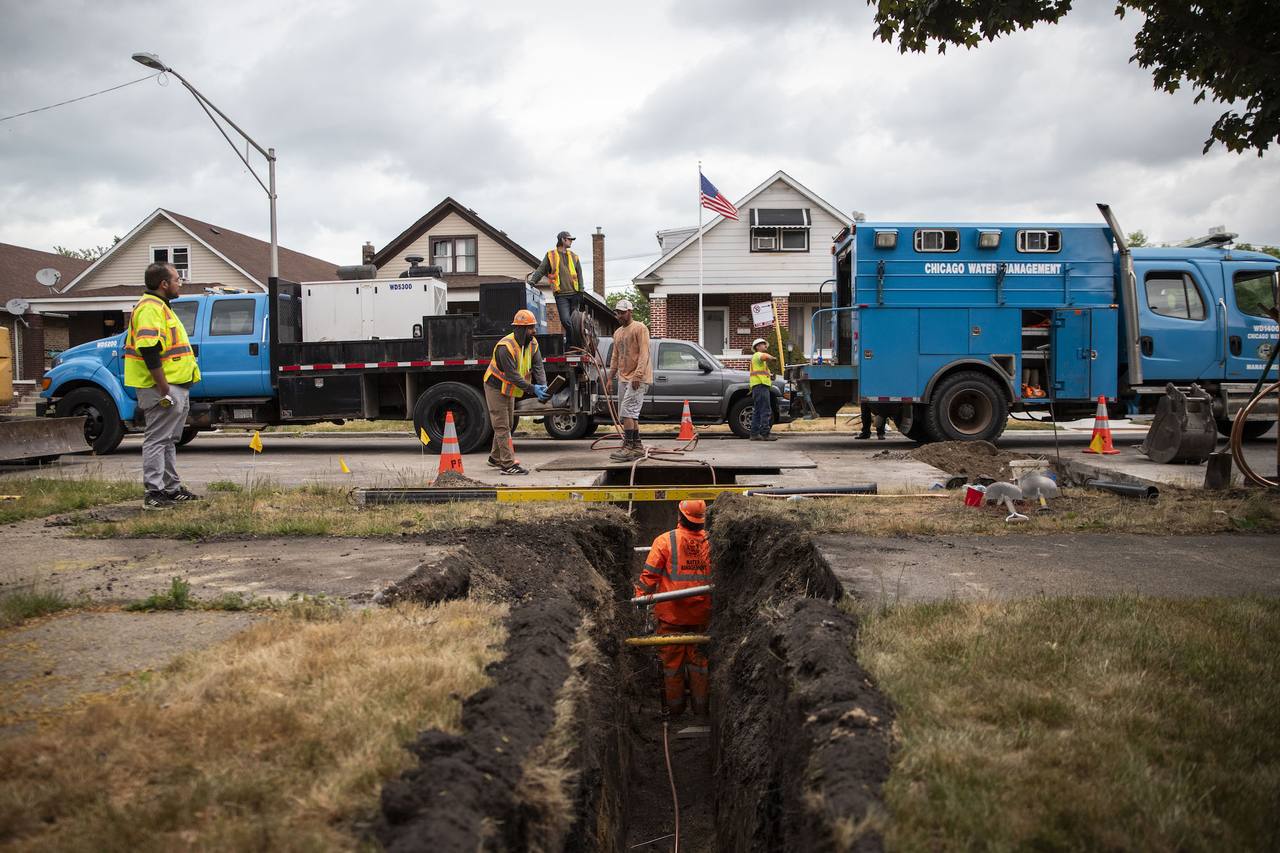
Chicago has replaced just 4 percent of its more than 400,000 lead service lines — the most of any city in the United States — and the federal money that has paid for the work is running out, according to a report released Wednesday by U.S. Senator Tammy Duckworth.
The city's own Department of Public Health puts the count at 18,000 lead lines replaced so far, about 6,000 of them this year. Roughly 400,000 lines remain in the ground, carrying drinking water into homes across the city — many of them built before 1986, when the federal government banned lead pipes and Chicago's own building code had required lead service lines for single-family homes and two-flats.
A funding cliff
The $15 billion Congress approved in the 2021 bipartisan infrastructure law to replace lead pipes nationwide is expiring. At the same time, the Trump administration has proposed cutting drinking-water revolving-fund assistance by about 90 percent, and Congress reduced the program by another $125 million, according to the Chicago Sun-Times' account of the report.
Illinois has received about $1.18 billion in federal lead-pipe money — more than any other state. But Duckworth's message, quoted across the coverage, was blunt: "Money alone doesn't remove pipes." Her report argues the money has not guaranteed progress without coordinated action by local, state and federal officials.
The deadline problem
Under the Environmental Protection Agency's rule, most water systems in the country must finish replacing their lead pipes by 2037. Chicago, because of the sheer size of its inventory, has until 2047, said Erik Olson, senior director of health at the Natural Resources Defense Council.
Even that extended deadline is at risk at the current pace. Duckworth's report estimates the country needs to replace more than 400,000 lead lines a year to meet the 2037 deadline — about four times the current pace — and more than 4 million lead service lines remain nationwide.
The most expensive pipes in America
Cost is a major obstacle, and Chicago pays far more than anywhere else. Each replacement costs the city about $31,000, compared with a national average of $4,700 — $10,000 a line in Denver and $2,500 in Detroit, according to Duckworth's report. A 2026 investigation by WBEZ, the Chicago Sun-Times, Grist and Inside Climate News found Chicago spends more per line than any other major U.S. city.
The city says it is pursuing new contractor deals, revised municipal-bond terms and block- or street-level projects to bring costs down. Duckworth is urging cities to adopt mandatory, block-by-block replacement programs, pointing to Newark, New Jersey, which replaced more than 23,000 lines in less than three years through an aggressive citywide programme.
Why it matters for health
Lead in drinking water is a health risk at any level of exposure, and children are the most vulnerable. A September 2026 study found children drinking water from lead pipes can have elevated blood lead levels even in cities that fall below the EPA's threshold — a finding that undercuts any comfort from passing a federal test.
For Chicago families, the practical question is what happens next: whether the city accelerates its replacement programme, whether Congress restores funding, and whether the cost per line can be brought down. Duckworth's report frames the moment as a choice — the pipes are in the ground, the deadline is written into federal rules, and the money that was supposed to pay for the work is nearly gone.