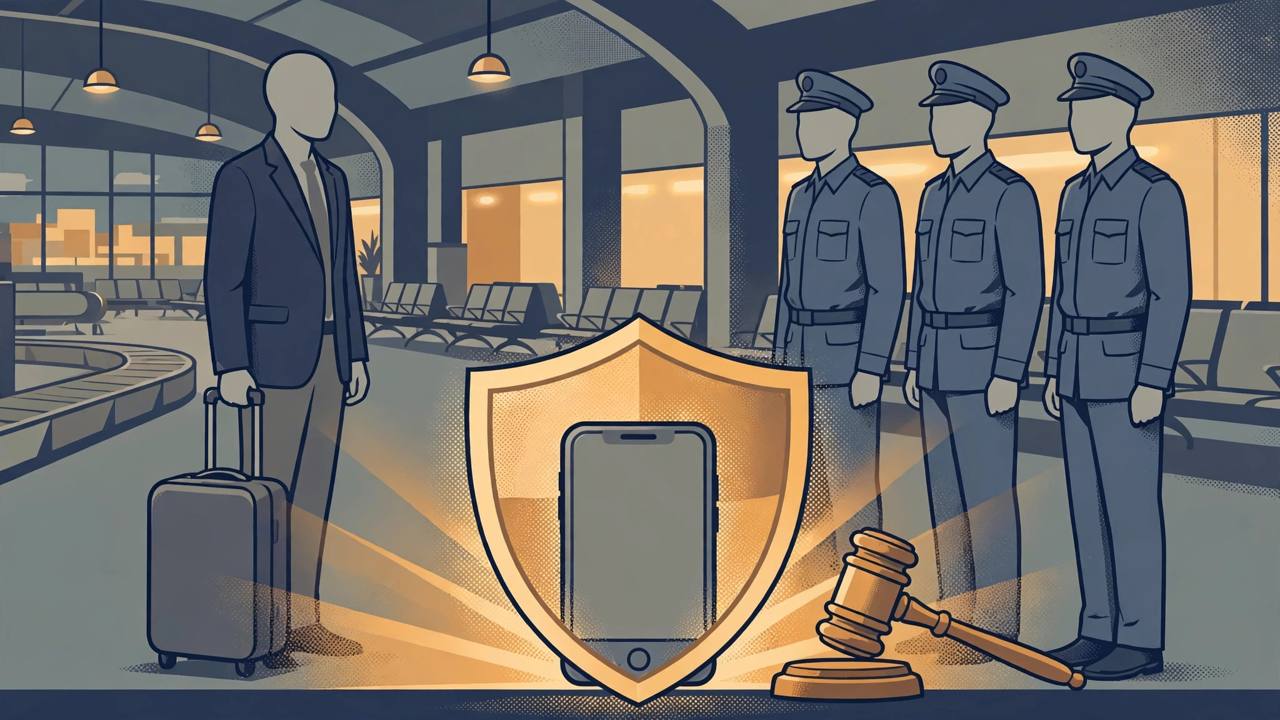
A federal judge in Boston has barred the United States government from accessing the data copied from an immigration lawyer's cell phone, holding that the lawyer is likely to prove the phone was seized and searched in retaliation for his public speech about immigration rights.
U.S. District Judge Allison Burroughs granted the preliminary injunction on Friday, November 13, in Lattarulo v. Mullin, enjoining the defendants from accessing the data obtained from the phone before the case is resolved. The order is not a final verdict, but it freezes the government's access while the lawsuit proceeds in the U.S. District Court for the District of Massachusetts.
A phone seized at Logan Airport
Andrew Lattarulo is an immigration lawyer and part owner of the law firm Georges Cote LLP, which, the court noted, represents "thousands of clients in active immigration proceedings." He also runs a popular Instagram account posting know-your-rights videos about U.S. immigration matters that regularly amass hundreds of thousands of views, according to the opinion.
On September 28, 2025, Lattarulo flew back to Boston from a weekend trip to Aruba, passing through customs preclearance in Aruba before boarding. When his flight arrived at Logan Airport, three U.S. Customs and Border Protection agents and one Homeland Security Investigations officer stopped him as he got off the plane. The agents seized his cell phone without a warrant and downloaded a complete copy of the data stored on it. The phone itself was returned eight days later by overnight delivery.
The copied data is currently in a format that is not readable or reviewable, but the government intends to convert it into an accessible format and search it if the court permits. The data includes confidential information, including privileged attorney-client communications relating to Lattarulo's clients. The government told the court that any search of the contents would use a taint team to protect privileged information.
An investigation that began with paperwork
The seizure came during an HSI investigation into whether Georges Cote employed individuals without a legal right to work in the United States — an allegation the firm has not been found liable for. Audai Cote, the firm's registered agent and the person in charge of I-9 compliance, was served with a Notice of Inspection on September 8, 2025. Cote is not an immigration attorney; he focuses on personal injury work. The firm responded on September 12, and the government sent a Notice of Suspect Documents on September 25, giving the firm ten days to try to verify the identity and work authorization of the employees named.
Three days after that notice — and a full day after Audai Cote had made the same return journey from Aruba without any issue — agents took Lattarulo's phone at the airport.
Why the judge saw likely retaliation
The court wrote that the law is settled that the First Amendment prohibits government officials from subjecting an individual to retaliatory actions for speaking out, and that the case turns on causation: whether the seizure would have happened but for Lattarulo's protected speech. The government provided no evidence that cell phone searches are frequently conducted during this kind of employment investigation, the judge found, while Lattarulo's evidence suggested that criminal charges against employers for employing unauthorized immigrants are exceedingly rare. Adopting a highly unusual investigative method that inflicted a maximal burden, shortly after he spoke out publicly, lent substantial support to an inference that the action was pretextual, the court said.
Timing strengthened that inference. Under HSI's own policies, employers who act within ten business days of a Notice of Suspect Documents are presumed to have demonstrated reasonable care. The search happened only three days after the notice arrived, while that presumption was still running — an aggressive deviation from the agency's orderly procedures, in the court's words. The judge also pointed to Audai Cote: a similarly situated person with the same or greater access to the firm's employment records who did not speak publicly about immigrant rights, who returned a day earlier, and who was not searched at all.
The government told the court it has additional evidence that would show the search would have been initiated without regard to retaliation, but said it has not provided that evidence because doing so would prejudice an ongoing investigation. It also said any search of the phone's contents would use a taint team to protect privileged material. The court granted the injunction on the record before it.
The border-search question the court left open
Judge Burroughs did not resolve Lattarulo's Fourth Amendment claim, because the First Amendment ruling was enough to grant the injunction. But the opinion discussed the border search exception, which under the First Circuit's 2021 decision in Alasaad v. Mayorkas allows routine border searches of electronic devices without suspicion, and non-routine searches without a warrant where the government has reasonable suspicion. The suspected violation here — employing unauthorized workers under 8 U.S.C. § 1324a — is a law enforced by ICE, but, the court noted, there appears to be no connection between Lattarulo's border crossing and the suspected offence, which was already under investigation at home. Calling the questions novel, the court refrained from reaching a firm conclusion on them for now.
The case has been closely watched since it was filed. Earlier in the litigation, Judge Burroughs issued a temporary restraining order blocking government access to the phone and any mirrored data, after Lattarulo argued that the seizure violated his First and Fourth Amendment rights and risked exposing privileged client communications, legal strategy and sensitive client information — the kind of material on which removal defence, bond motions and protection claims depend.
Source: VisaVerge, 2025 — background on the seizure, lawsuit and earlier restraining order
For immigrant communities — including the Punjabi diaspora families across the United States who rely on immigration lawyers for work permits, asylum claims, family sponsorships and deportation defence — the ruling goes to a practical fear: that speaking publicly about your rights, or representing people who assert theirs, could itself invite a search of the phone that holds a law practice's confidences. The injunction means that, at least for now, the government cannot look at what it copied.
What happens next
The preliminary injunction stays in place until the case is resolved, unless it is overturned on appeal. The government can still try to persuade the court, with evidence, that the search would have happened anyway, and the open Fourth Amendment question — how far the border search exception reaches into a domestic investigation — remains for later stages of the case. Lattarulo is represented by Mary Lemay and Patrick M. Hanley of Butters Brazilian LLP. The underlying HSI employment investigation is separate from this ruling, and the allegations in it remain allegations, not findings.