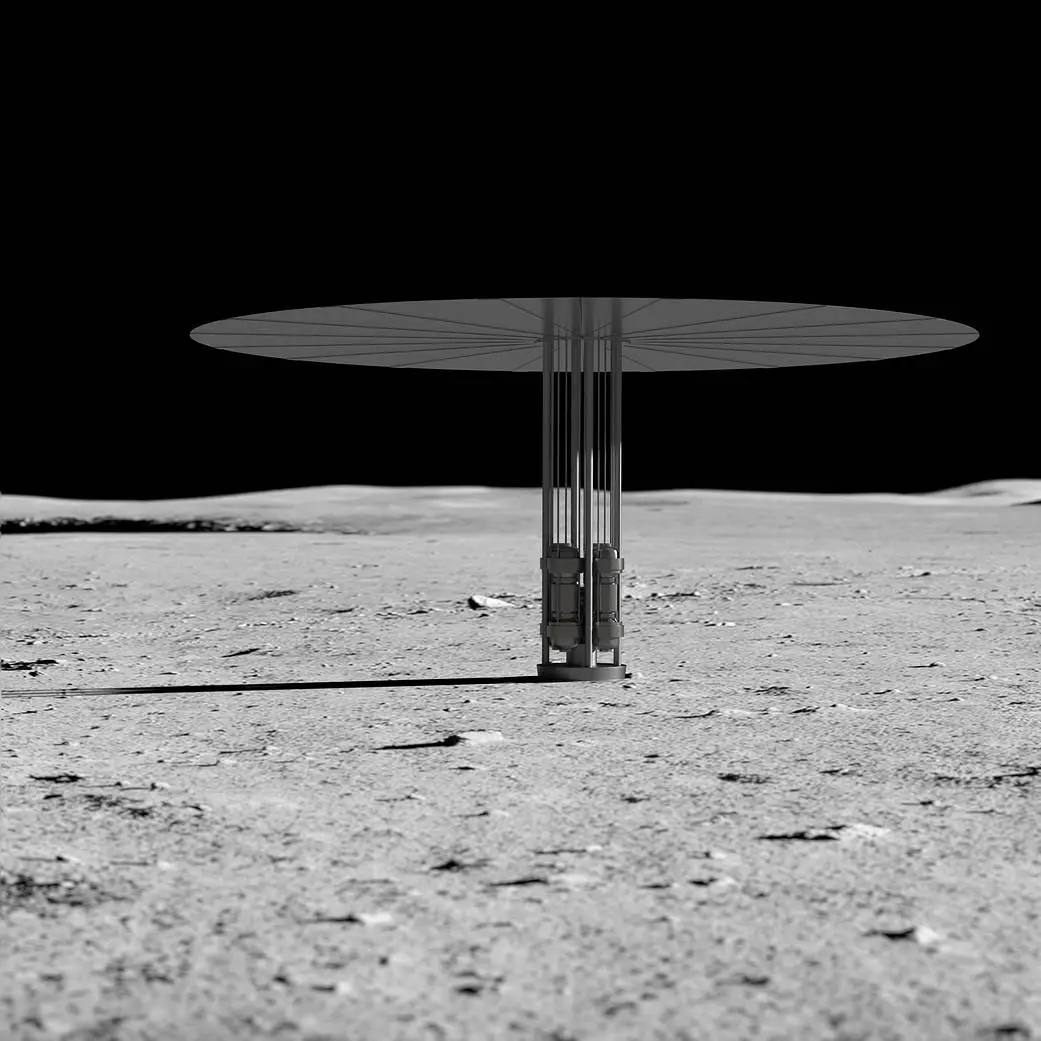
NASA has asked American industry to design and test the first nuclear reactor built to generate electricity on the Moon, opening bidding on Monday, November 23, 2026, for a system it calls Lunar Reactor-1. The agency wants a launch-ready reactor by 2030 — a power plant for a place where the Sun sets for two weeks at a time.
Source: NASA
Lunar Reactor-1, or LR-1, is a small fission power system designed to generate 20 kilowatts of electricity — roughly enough to meet the annual electricity needs of about 16 average American households. Once deployed, NASA aims to operate it on the lunar surface for at least five years, providing steady, solar-independent power to whatever is built around it.
Why the Moon needs nuclear power
The case for a reactor is written into the Moon itself. A lunar day lasts about 29 Earth days, which means a lunar night lasts roughly 14 Earth days of unbroken darkness — far too long for solar panels and batteries alone to keep a habitat, rovers and science instruments alive. Near the lunar south pole, where NASA plans its sustained presence, some craters sit in permanent shadow and never see sunlight at all.
A fission system runs continuously, in darkness and in terrain sunlight rarely reaches. NASA says that is what makes it the backbone of a lasting presence: power that does not depend on where the Sun is, so crews can live and work through the long night and in the shadowed craters where water ice — a potential source of drinking water, oxygen and rocket fuel — is believed to lie.
What NASA is actually buying
The solicitation, issued under NASA's Space Power and Reactor Capabilities request for proposals, asks companies to advance the reactor's technology, testing and flight design. The first task order covers hardware-driven preliminary design work to be completed within 18 months of award, including non-nuclear hardware demonstrations and component-level radiation exposure testing. NASA says it may issue additional task orders to support other space nuclear power systems.
“This request for proposals represents an important step forward as NASA partners with industry to establish an enduring human presence on the lunar surface,” said Brian Giblin, NASA's Lunar Reactor-1 program manager. “A reliable source of safe and abundant energy will be vital to future exploration of the lunar and Martian surface,” he added.
What is decided — and what is not
The announcement sets a target, not hardware. NASA has not named a design, a contractor or a contract value, and no reactor has been built or ground-tested under this programme yet. The 2030 date is for a launch-ready system; the five-year operating life starts only after a landing that the announcement does not schedule, and no landing site has been named.
The solicitation builds on months of preparation. NASA released a draft proposal in August 2026 and hosted an industry day in September at the Ohio Aerospace Institute in Cleveland, folding the feedback it received into the final request. The programme is managed by NASA's Space Reactors Division in partnership with the US Department of Energy, and the reactor must meet the department's safety standards for nuclear operations.
LR-1 is designed as a fission system using closed-Brayton power conversion — the same approach as Space Reactor-1 Freedom, a separate NASA system targeting a late-2028 launch. The programme is an initiative in response to Executive Order 14369 and National Space Technology Memorandum-3, the White House directives that pushed NASA to move faster on space nuclear power.
Not the first attempt
NASA has sought a lunar reactor before. A 2021 request for proposals asked for a 40-kilowatt unit and hoped to deploy it by 2030. The target date has not moved, but the planned output has halved to 20 kilowatts — a smaller, more focused system that the agency now wants to prove through hardware before committing to a flight unit.
A reactor that works on the Moon is the difference between visiting and staying. It would power a Moon base through the two-week night, run rovers and drills in shadowed craters, and prove the technology NASA would need for Mars, where sunlight is weaker and dust storms can blot out the Sun for months.
What happens next
Industry proposals are due by December 21, 2026. NASA has not said when awards will be made or how much money is involved. After the first design phase, the programme moves toward hardware demonstrations and, eventually, a flight design — the long road from a paper reactor to a power plant standing on grey lunar dust.
NASA announced the solicitation on November 23, 2026, and published the full request for proposals the same day; the agency's own pages describe LR-1 as intended to power a Moon base near the lunar south pole. Coverage of the announcement was carried by the Innovation News Network, The Fair Report and other outlets.
Source: Innovation News Network