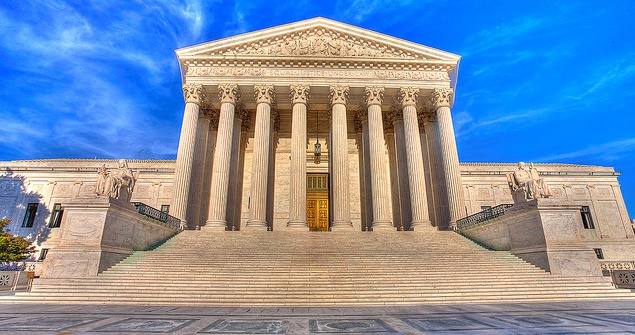
The U.S. Supreme Court will hear arguments on Monday, November 30, in Wassily v. Blanche, a case that could decide whether noncitizens whose asylum was later terminated because of criminal convictions can still become lawful permanent residents — green card holders — under federal immigration law.
Source: The Center Square
The case centres on two men who were granted asylum in the United States decades ago. Tamer S. Wassily, an Egyptian Coptic Christian, entered the country on a visitor visa in 1993 and was granted asylum in 2000 after raising fears of religious persecution in Egypt. Byron E. Velasquez Arreaga, from Guatemala, came to the United States in 1995 and was granted asylum the following year.
Source: Immigration Analytics
Both men later lost that protection. Wassily was convicted in New York in 2004 of third-degree stalking and child endangerment, crimes an immigration judge deemed particularly serious, and the government moved to terminate his asylum. Velasquez Arreaga was convicted of driving while intoxicated in 2015 and of aggravated driving while intoxicated in 2018, and his asylum was terminated as well. Each man then applied to adjust his status to lawful permanent resident — and each was told he was no longer eligible.
Source: Immigration Analytics
The question before the court
The dispute turns on a single phrase in 8 U.S.C. § 1159(b), the provision that lets a person adjust to permanent resident status after a year in the United States. The statute covers “any alien granted asylum.” The two men argue that “granted” describes a completed event in the past: anyone who was ever granted asylum qualifies, and the word “any” is a word of breadth. The government answers that adjustment concerns a person’s “status,” a present condition — and that the benefits of asylum, including adjustment, end when asylum is terminated.
Source: Immigration Analytics
The federal appeals courts are split. The Second and Fourth Circuits have held that a person whose asylum has been terminated is categorically barred from adjusting to permanent resident status. The Fifth Circuit has ruled the other way, allowing former asylees to apply for green cards. In this case, a divided Second Circuit panel ruled 2-1 against the two men, holding that Section 1159(b) “allows only noncitizens with current asylum status to adjust.” The Supreme Court agreed in late June to hear the case, docketed as No. 25-842.
Source: Legal Tech Digest
Why the ruling reaches beyond the two men
The decision will also reach the families of former asylees. Under federal regulation 8 CFR 1208.24(d), terminating a principal applicant’s asylum automatically terminates the derivative status of a spouse or child. Lawyers for Wassily and Velasquez Arreaga told the justices that if the lower court’s decision stands, “these innocent spouses and children — through no fault of their own — will be precluded from adjusting to [lawful permanent resident] status and will face removal themselves.” Nearly 5,000 people received derivative asylum in the United States in 2023, according to court records cited in the case.
Source: The Center Square
A second argument in the case concerns the rule of lenity, the criminal-law principle that an unclear statute should be read in the way most favourable to the defendant. The two men say that if Section 1159(b) is ambiguous, lenity resolves it in their favour. The government and its supporters say the rule has no place in a civil immigration case. Matthew O’Brien, deputy director of the Federation for American Immigration Reform, said he expects the justices to focus on that point, and Heritage Foundation senior legal fellow Zack Smith called the petitioners’ reliance on lenity “odd,” because the rule “has applied whenever someone is facing criminal consequences” — which, he said, “is not the case here.”
Source: The Center Square
Arguments in Wassily v. Blanche are second on the Court’s Monday calendar, after Crowther v. Board of Regents. Briefing closed on November 2, and a decision is expected by mid-2027. The ruling will settle the split between the federal appeals courts and set the rule for every former asylee who seeks a green card after losing asylum status.
The case is separate from the Court’s consideration of the administration’s border asylum ban in the RAICES case, which the justices have also taken up this term. But for immigrant communities — including many Punjabi families who came to the United States through asylum — Wassily is the case that decides whether a later criminal conviction permanently closes the path to a green card, or whether the statute still leaves the door open. Immigration lawyers on both sides say the decision will shape how immigration judges and U.S. Citizenship and Immigration Services handle adjustment applications for years to come.
Source: America's Best Advocates
In the end, the justices must decide what Congress meant when it wrote “any alien granted asylum” — whether it meant anyone who holds asylum today, or anyone to whom asylum was ever granted. The petitioners’ brief puts it in the terms the Court will test on Monday: “Text, context, structure, history, and purpose provide a clear answer: any noncitizen previously granted asylum is eligible to adjust to [lawful permanent resident] status if the conditions in paragraphs (1)-(5) are satisfied.”
Source: Liberty First