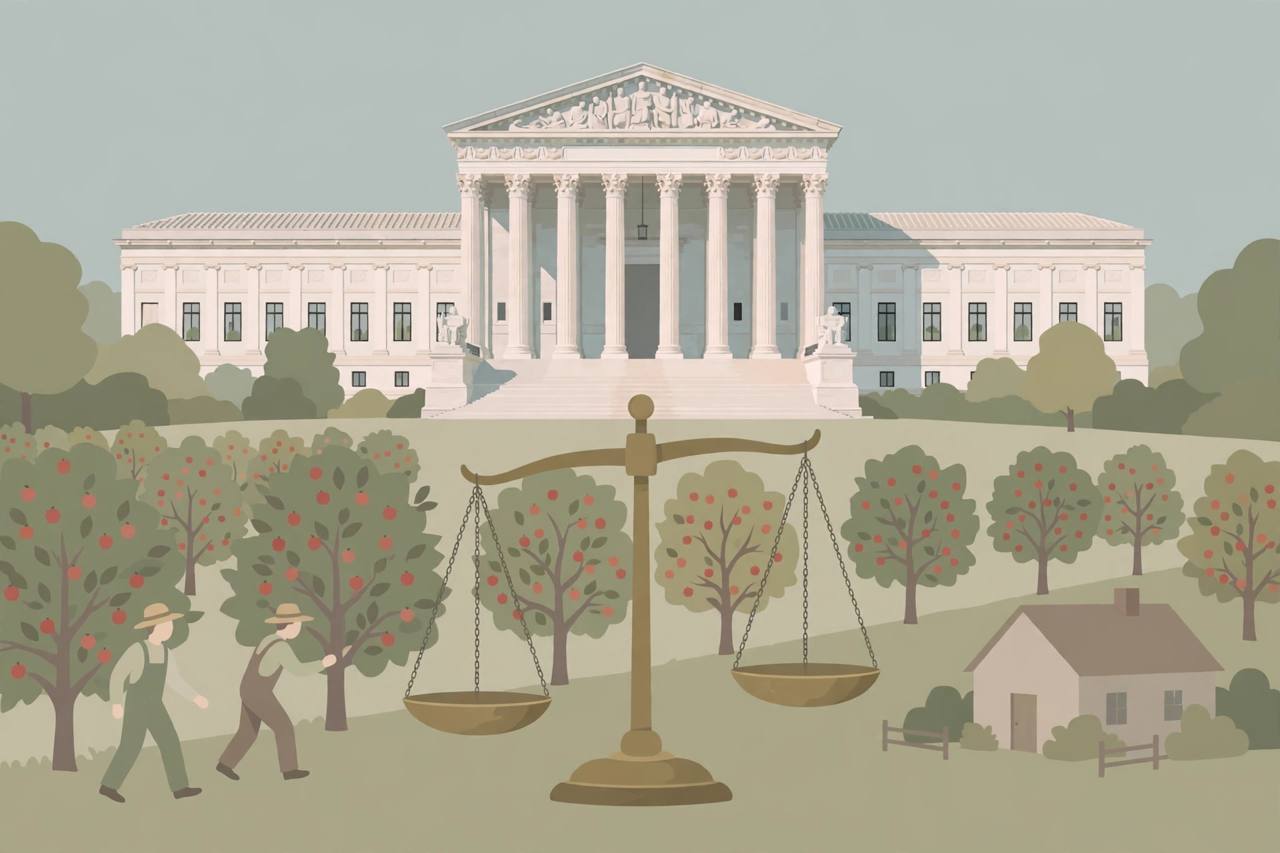
The U.S. Supreme Court heard arguments on Tuesday, November 10, in Department of Labor v. Sun Valley Orchards, LLC, No. 25-966 — a New Jersey farm case that could decide whether federal agencies may keep imposing money penalties through their own administrative judges, or must instead take employers to a federal court and jury. The justices seemed divided, NPR reported, with Chief Justice John Roberts suggesting the executive branch has stretched its authority, and the government's lawyer warning that a broad ruling against the agencies would be, in her words, the nuclear option.
Source: NPR
At stake in the immediate case is $556,745.80: $211,800 in civil penalties plus $344,945.80 in back wages that a Department of Labor administrative law judge ordered Sun Valley Orchards to pay after investigators found violations in the farm's use of the H-2A temporary migrant worker program. The department's Administrative Review Board affirmed the order. Sun Valley disputes the findings and the process itself.
What investigators said they found at the New Jersey farm
Sun Valley brought in 96 foreign workers and hired 51 U.S. workers in 2015 to pick crops, according to the opinion of the U.S. Court of Appeals for the Third Circuit. Labour Department investigators cited unsafe drinking water, overcrowded housing with 20-bunk rooms and broken sinks, housing with missing window screens, an insect infestation throughout the camp, and mattresses on the floor. The farm had promised free kitchen access so workers could cook; instead, investigators found, it charged them for meals without notice, and a supervisor sold them drinks at a profit. Vehicles that carried workers had worn tires and unlicensed drivers, and the department found the farm constructively forced some workers to go home early, then had them sign forms saying they left for personal reasons. NPR's account summarised the cited infractions as providing unsafe drinking water, overcrowded housing, broken facilities, and failure to pay promised wages.
Source: Workers Rights News / Supreme Court docket 25-966
The H-2A program, established under the Immigration and Nationality Act, lets U.S. agricultural employers bring foreign workers for temporary farm jobs when they cannot find enough U.S. workers. Employers must promise wages, housing, transport and conditions that do not undercut U.S. workers — promises the Labour Department polices.
The two questions before the court
The court agreed to decide two questions, according to its docket: first, whether the Constitution — Article III and the Seventh Amendment jury-trial right — bars the Labour Department from deciding these cases itself through administrative proceedings; and second, whether the H-2A statute itself, 8 U.S.C. § 1188(g)(2), actually authorises the department to do so. Sun Valley's lawyer, Robert Johnson of the Institute for Justice, argued that the statute contemplates penalties but says nothing about where those penalties should be adjudicated, and that penalties should be imposed by federal courts, not by the administrative agencies that do most of that work under current law.
In 2025, the Third Circuit sided with the farm. Relying on the Supreme Court's 2024 decision in SEC v. Jarkesy — which held that the Securities and Exchange Commission cannot impose fraud penalties through in-house hearings without a jury — Judge Hardiman wrote that Sun Valley was entitled to have its case decided by an Article III court, meaning a federal court with life-tenured judges. The district court had earlier ruled for the Labour Department, concluding the dispute involved public rights that could be adjudicated by an administrative judge.
What the justices said on Tuesday
Chief Justice Roberts told Principal Deputy Solicitor General Sarah Harris, who argued for the Labour Department, that it seems to me you're still trying to extend that broad authority beyond the justification for its application, according to the argument transcript cited in the reporting. Justice Sonia Sotomayor asked how disruptive it would be for federal courts to handle enforcement instead of the designated agency. Justice Elena Kagan asked why the government should not just go to court always; Harris answered that doing so would raise massive concerns about under-enforcement of the law given resource constraints, and closed by saying it would be a big deal for the government to lose, but an even bigger deal would be to have a mess.
Harris argued the dispute involves public rights — a category the government can decide in-house — because the government is exercising its plenary immigration power on the employer's behalf, and the farm agreed to the program's conditions in exchange for taking part. She warned that if the court were to say civil penalties always have to be in Article III courts, that is kind of the nuclear option, with catastrophic effects on enforcement across programs including Medicare, Medicaid and federal student loans, as the government's argument was summarised in the reports. Justice Ketanji Brown Jackson pushed back on the farm, telling Johnson it seems like you're just sort of fighting the reality of the nature of this program — a program meant to ensure farm workers do not undercut domestic workers. Justice Brett Kavanaugh said the farm's proposed line is really at war with clarity.
Why this reaches far beyond one orchard
Since Jarkesy in 2024, businesses have used its jury-trial reasoning to challenge agency enforcement across the government, with mixed results. The Congressional Research Service notes that some agencies — including the Occupational Safety and Health Review Commission and the Federal Mine Safety and Health Review Commission — can pursue penalties only in agency proceedings; a broad ruling for Sun Valley could leave those enforcers stuck unless Congress acts. In June 2026, by contrast, the Supreme Court ruled 8–1 for the FCC in FCC v. AT&T, rejecting jury-trial challenges to fines of about $57 million against AT&T and $47 million against Verizon, on the basis that a carrier that refuses to pay gets a fresh trial in federal court before it can be made to pay. Jarkesy itself left standing Atlas Roofing, a decision that allowed in-house penalties under the federal workplace safety law.
For Punjabi and other immigrant farmworkers and for the farms across California's Central Valley, New Jersey and other agricultural states that rely on H-2A labour, the ruling will decide who hears a wage, housing or transport complaint's money case: an agency judge who knows the program, or a federal jury. Worker advocates argue agency proceedings are faster and cheaper for low-wage workers to benefit from; employer groups argue a business should not be fined by the same government that accused it, without a jury.
What happens next
The court has not ruled. No decision was announced at the argument, and none is expected for months: the court's term usually runs until late June or early July, and a decision in No. 25-966 is expected by then — June or July 2027 on the current term's calendar. Until then, the Labour Department's $556,745.80 order against Sun Valley remains contested, the Third Circuit's ruling for the farm stands as the judgment under review, and H-2A employers and workers alike wait to learn which forum will decide the next housing, wage or transport penalty case.