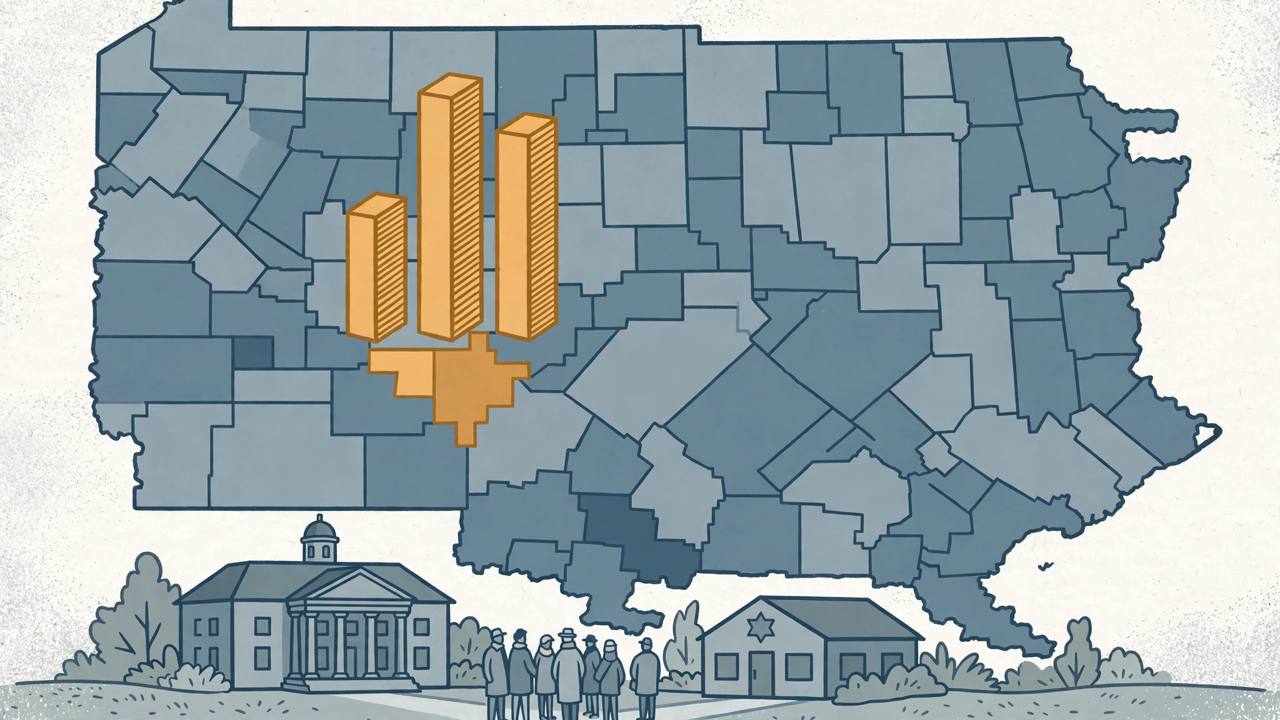
People from Beaver County account for a sizable majority of the immigration detentions recorded in U.S. Rep. Chris Deluzio's western Pennsylvania district — despite Beaver containing a much smaller share of the district's population, and even though most of those detained have committed no criminal offense — according to a new study of federal immigration enforcement data released on Tuesday, November 10, 2026. The report also contends that agreements between local police, including the Beaver County sheriff, and U.S. Immigration and Customs Enforcement are driving the trend.
Source: 90.5 WESA
The report identified 209 total detentions that took place within Deluzio's 17th Congressional District between January 1 and August 6 of this year, just over 64 percent of which were in Beaver County. The district straddles Beaver County and a broad swath of Allegheny County suburbs. In a call with reporters on Tuesday afternoon, Deluzio linked the findings to the politics of the moment, noting that President Donald Trump's Republican allies had suffered bruising losses in last week's midterm elections: “One of the many things that the American people are angry about,” he said, “is Donald Trump's mass-deportation regime and ICE agents abusing American liberties at the president's direction.”
A smaller county producing most of the detentions
The imbalance is stark when set against population. According to Census data cited in the reporting, the Allegheny County portion of the district contains more than three times the population of Beaver County, and 10 times as many foreign-born residents — yet it produced barely a third of the detentions. The vast majority of those detained had no prior criminal convictions or pending criminal charges against them, the report contends: nearly seven in 10 people detained in the 10-county region had no criminal charges or convictions, and nearly nine in 10 were not identified as posing any safety threat at all, according to a matrix ICE itself uses. In a statement accompanying the report, Deluzio said the data shows enforcement is “primarily targeting people who have committed no crimes, face no allegations of violence, and are lawfully pursuing their shot at the American Dream.”
The 287(g) agreements at the centre of the argument
At the heart of the report are concerns about so-called 287(g) agreements, which ICE enters into with local law-enforcement agencies willing to assist with immigration enforcement. That assistance can range from help transferring detainees already incarcerated for other offenses to a full “task-force” model in which local police actively enforce immigration law; in return, local agencies can get access to federal training, equipment and other incentives. The report says detentions in Beaver County were far more likely to have been carried out under the 287(g) program: just under 69 percent came about as a result of the program, while only 26.6 percent of detentions in Allegheny County did. Such agreements have become increasingly common nationwide. Some communities in Beaver and Allegheny counties have entered the agreements, though most of the communities where the report says most detentions took place — including Aliquippa, Beaver Falls and Freedom — do not have agreements of their own.
Source: Office of Rep. Chris Deluzio
Deluzio's statement said the findings “show that 287(g) agreements are increasing ICE detention rates in our communities — all while redirecting local law enforcement time and resources into federal immigration enforcement that is overwhelmingly targeting people who pose no risk to our communities. I think local law enforcement should be focused on local public safety.” Immigrants “are our neighbors, and the consequences of immigration enforcement extend far beyond the immediate moment of detention,” said Jaime Martinez, executive director of immigrant advocacy group Frontline Dignity, which compiled the data cited in the report. The trauma of detention “follows families into their homes,” Martinez said. “It creates fear and uncertainty that don't simply disappear when someone's released.”
The sheriff's answer: “I don't have a single deputy engaged in it”
The data does not identify which law-enforcement agencies were involved in any given detention, though Deluzio's report flags that the Beaver County sheriff's office is a party to a 287(g) agreement. Sheriff Tony Guy — who ran unsuccessfully against Deluzio in last week's midterm election — said his office's role in enforcement has been minimal. “I don't have a single deputy engaged in it or trained in it,” he said. The sheriff's office oversees the county jail, and it does turn over prisoners ICE says have violated immigration laws, under so-called detainer requests. “But we've always done that,” Guy said. His department's only other real engagement, he said, took place during a sweep in Ambridge in the summer of 2025. Guy said he could not speak to other local departments' activities, or why the numbers would be larger in Beaver than Allegheny; federal agents, he suggested, might be following a “path of least resistance” by spending more time in Beaver, which skews more conservative. “I think ICE is doing a pretty good job of singling out the people who need to be picked up,” Guy said. “I know that talking with ICE officials, they've said they are looking for the bad guys.” A spokesman for ICE did not immediately respond to a request for comment on Tuesday afternoon.
Gaps in the data itself
Tuesday's report was compiled from information obtained through public-records requests by the California-based Deportation Data Project; Frontline Dignity brought an “initial analysis” of the data to Deluzio's office this fall. ICE data has notable gaps, the reporting notes. The Allegheny County borough of Springdale, whose 287(g) agreement has been one of the region's most controversial, is identified as the site of just three detentions — while neighbouring Cheswick, which lacks a 287(g) agreement, is identified as the site of six detentions under the program. Media reports have identified Springdale police making immigration-related arrests in nearby communities. In a separate letter to ICE, Deluzio and three Pennsylvania colleagues wrote that of 1,227 Pennsylvania 287(g) arrest records published between January 1 and August 6, 2026, only 12 included the task-force agency involved in the arrest — ICE withheld that information more than 1,000 times, they said. “We should know which local law enforcement is engaged in this,” Deluzio said. “Are they patrolling and being pulled away from their municipality where they have responsibilities?”
The 17th District race itself was fought partly over this issue: Guy hailed the Trump administration's immigration policy in the pair's lone debate, while Deluzio argued there is “no defense for ripping apart those families.” The new report turns that campaign argument into a data dispute — over who is being detained, by whom, and under which local agreements.
Background: Moshannon, the midterms and Washington's shifting tone
The report dovetails with Deluzio's earlier criticism of detention conditions and oversight. This past spring he and fellow western Pennsylvania Democrat Summer Lee made an unannounced oversight visit to the Moshannon Valley Processing Center in Clearfield County, the region's largest immigrant-detention facility, and said the overwhelming majority of people held inside were considered low-security — people not accused of serious, violent crimes. Nationally, Deluzio's report lands after a midterm election in which Republicans took a drubbing, in his district and across the country. Trump himself has suggested immigration policy might be one reason: in a “60 Minutes” interview days after the election, he said his approach might have been “too tough,” because alongside “getting the bad ones out,” his administration “also took people that had good jobs” who were otherwise law-abiding. But by the time the interview aired, Trump had named Stephen Miller, the immigration hardliner and architect of the administration's policies, as his chief of staff. Asked how much faith he had in Trump's willingness to work on a new approach with Democrats given Miller's promotion, Deluzio said: “Not much. But I think we owe it to our constituents and the residents of Pennsylvania to try.”
What is solid
- The report counted 209 detentions in the 17th District between Jan. 1 and Aug. 6, with just over 64 percent in Beaver County
- Beaver County detentions were far more likely to be recorded under the 287(g) program (just under 69 percent) than Allegheny County detentions (26.6 percent)
- Sheriff Tony Guy says no deputy of his is trained for or engaged in 287(g) task-force work, and that his jail has always honoured ICE detainer requests
What is only claimed
- Whether 287(g) agreements themselves are causing the higher Beaver County numbers, as Deluzio contends, or whether federal agents are simply concentrating there, as Guy suggests
- Which local agencies took part in individual detentions — ICE records frequently omit the agency involved, and ICE did not immediately comment
What this means for immigrant and Punjabi families
Pennsylvania's immigrant communities — including Punjabi families in the Pittsburgh suburbs and along the state's trucking and warehouse corridors — live inside the system this report describes: enforcement that can begin with a jail transfer, a traffic stop or a local officer working under a federal agreement, rather than with a federal agent at the door. The report's central claim matters practically, not just politically: if most detentions involve people with no criminal charges and no safety-threat finding, families deciding what documents to carry, whether to report a crime, or whether a detained relative will be transferred to a facility like Moshannon are making those decisions in exactly the gap between the two sides' versions of the program.
What happens next
ICE had not responded to the report by Tuesday afternoon, and its answer — or continued silence — will shape the next round of the dispute. Deluzio and his Pennsylvania colleagues are separately pressing ICE for stronger data transparency, including training, complaint and oversight records for 287(g) programs in the state, and for the agency-field information missing from more than 1,000 Pennsylvania arrest records to be made public. The underlying data, drawn from the Deportation Data Project's records requests, covers January 1 to August 6; whether detention patterns in Beaver and Allegheny counties have shifted since the midterm election is a question the next release of federal data will have to answer.