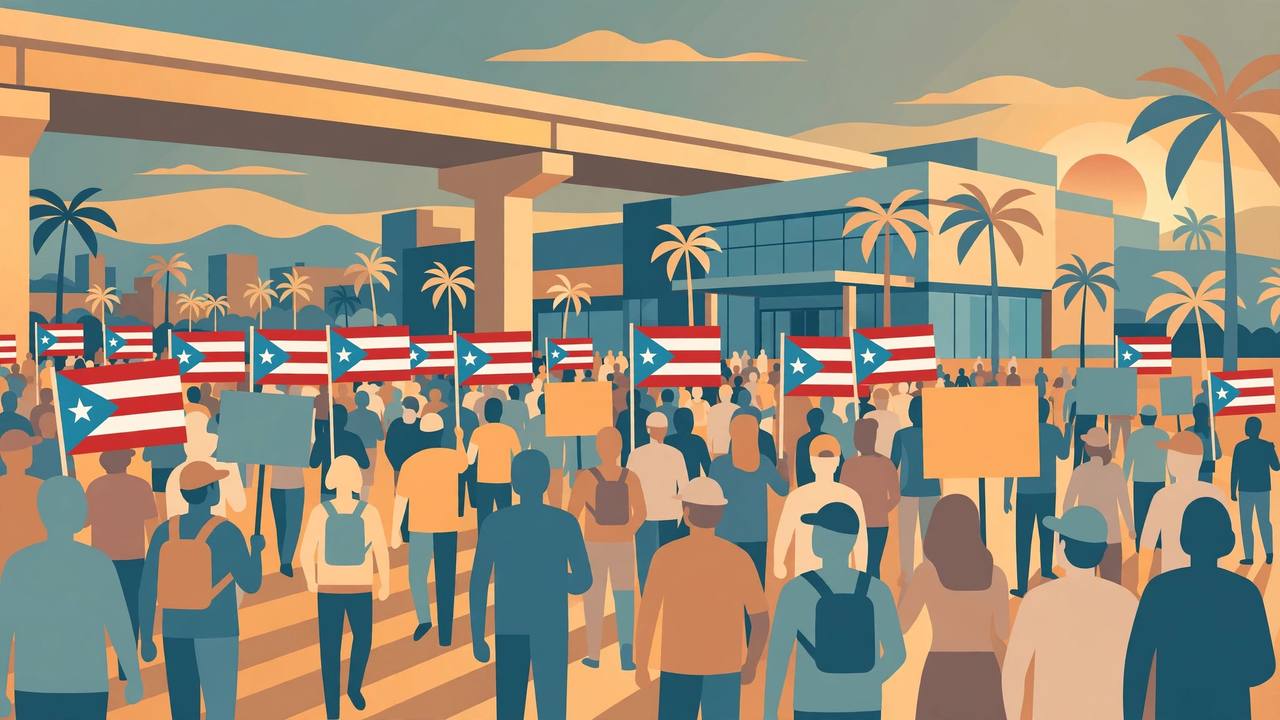
Thousands of people marched through San Juan on Friday, November 27, in a 'Day of National Outrage' over record electricity bills, the rising cost of living and deteriorating public services, in one of the largest demonstrations in Puerto Rico since Governor Jenniffer González took office in January 2025.
Source: Associated Press
Retirees, university students, bus drivers and other workers joined the march, organised by about 30 groups ranging from unions to religious organisations. The crowds gathered outside Plaza Las Américas in the Hato Rey district — the largest shopping mall in the Caribbean — on Black Friday, the busiest shopping day of the year, and grew through the day until demonstrators took over one of the island's main highways, forcing it to close.
Hundreds of demonstrators arrived by bus from dozens of cities and towns across the island, and organisers estimated that about 8,000 people took part, according to local media reports.
Source: The Insight International
Why power bills are the flashpoint
Electricity is the sharpest edge of the protest. Monthly bills for some residential customers recently rose about 18 percent, from $229 to $271, and the new residential rate of 33.86 cents per kilowatt-hour far surpasses the 18.3-cent average for residential customers on the US mainland, according to the US Energy Information Administration.
The price is only half the complaint — the lights keep going out. Veronica Ishtar, a visual arts student, told reporters the power in her neighbourhood went out 12 times this week alone. Protesters said unreliable water and power services have become a fact of daily life, with some neighbourhoods going dark at least once a week for hours at a time.
Much of the anger is aimed at Luma Energy, the private company that has run Puerto Rico's power transmission and distribution system since June 2021. The island's grid was wrecked by Hurricane Maria in 2017, and outages have remained routine ever since, even as rates climbed.
The march came two days after Puerto Rico's Supreme Court narrowly approved cancelling the government's contract with Luma Energy. Our earlier report covers that ruling and what it means for the grid. Read our earlier report on the Luma ruling
On Wednesday, November 25, the court ruled 5–4 that the extension of the government's contract with Luma did not meet the legal requirements, and ordered an orderly handover of the power system within a year of the ruling taking effect. Governor González praised the ruling, while the island's Association of Industries warned that cancelling the contract could discourage private investment — leaving residents unsure who will run the grid next, or whether the service will improve.
What the protesters are demanding
The demands went beyond electricity. Protesters called for higher wages, better pensions, respect for collective bargaining agreements, cheaper electricity and food, and an end to the privatisation of public services. They also demanded payment of the Christmas bonus, the resumption of work by the commission that reviews the minimum wage, and the repeal of measures changing working hours in the private sector.
The protest also speaks to Puerto Ricans living on the US mainland, millions of whom have family on the island and follow its power crisis closely. For families split between the island and states such as Florida and New York, the rising bills and failing services are not distant news — they are the reason relatives send money home, and the reason some decide whether to stay or leave.
What happens next
The government must now set out how and when the Luma contract will end and who will operate the grid in its place, within the one-year transition the court ordered. Organisers have signalled more protests through the Christmas season if relief does not come, and the immediate political question is whether the government answers the call for cheaper power and living wages — or whether the island's most crowded streets fill again.
For residents, the question is no longer only who runs the grid. It is whether the lights stay on, the water keeps flowing — and the bill at the end of the month can still be paid.