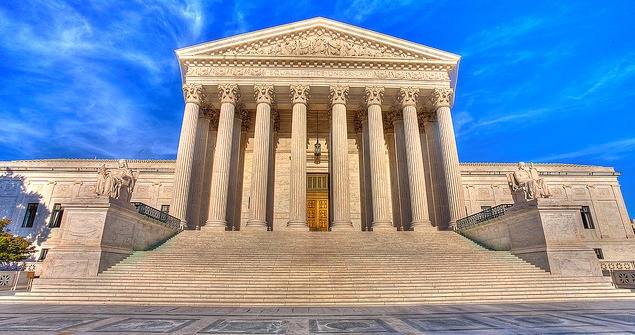
On Wednesday, December 2, the U.S. Supreme Court will hear oral arguments in two consolidated cases asking whether the Second and Fourteenth Amendments guarantee the right to possess AR-15-platform and similar semiautomatic rifles — the first time the court has agreed to rule on the availability of such a high-profile firearm, according to legal scholars following the cases.
The cases are Grant v. Higgins, a challenge to Connecticut's ban on AR-15-style rifles adopted soon after the 2012 Sandy Hook school shooting, and Khaya v. Cook County, which challenges a 1993 Cook County, Illinois, ordinance banning the rifles in the county that includes Chicago. The court has allotted one hour of argument for both cases combined, and the court convenes at 10 a.m. Eastern. The U.S. solicitor general will take part in the argument as a friend of the court supporting the challengers.
A renamed case and a mootness question
The Cook County case reaches the argument in an unusual posture. On November 23, the court agreed to dismiss the original lead plaintiff, Cutberto Viramontes, at his own request, and the case now proceeds under the name of the remaining petitioner, Christopher Khaya. A day later, on November 24, the court said it would consider Cook County's request to dismiss the case as moot at oral argument, rather than deciding it in advance. Cook County argues that Khaya lacks standing because he has said he wants to own an IMI Galil rifle modelled on the AK-47, rather than an AR-15. The challengers respond that the Galil is covered by the question before the court and that Khaya also wants an AR-15. The deferral decides nothing about the merits, and it does not affect the Connecticut case, which presents the same question.
The stakes extend well beyond the two jurisdictions. Besides Connecticut and Illinois, 11 other states prohibit AR-15-style weapons, so the ruling could decide the fate of bans in 13 states. The Trump administration, which supports the challengers, told the court that at least 16 million Americans own AR-15s and that about 28 million such rifles are in circulation. The challengers cite figures suggesting as many as 26 million Americans own AR-15s or similar rifles.
The arguments on each side
The challengers argue that the Supreme Court's decisions in District of Columbia v. Heller in 2008 and New York State Rifle & Pistol Association v. Bruen in 2022 require a finding that AR-15-platform rifles are protected arms that cannot be banned. They say the rifles are in "common use" by law-abiding citizens and that no valid historical principle justifies the bans. "If the Second Amendment is to have any teeth at all, at bare minimum, it must include protecting the most common arms in the country," said Bill Sack, senior director of legal operations for the Second Amendment Foundation, which organised the challenges. Erin Murphy, who wrote a brief for the National Shooting Sports Foundation supporting the challengers, said semiautomatic rifles and handguns have been around for well over a century and that history will matter to the court.
Connecticut and Cook County argue the bans are lawful because the rifles are unusually dangerous. Connecticut Attorney General William Tong and former U.S. Solicitor General Elizabeth Prelogar, who will argue for both Connecticut and Cook County, told the court that "from Sandy Hook to Las Vegas to Parkland to Uvalde, shooters have used the AR-15 or similar weapons in the vast majority of mass-casualty shootings this century." They argue that governments have banned unusually dangerous weapons for centuries, from English crossbows to 19th-century Bowie knives. Cook County State's Attorney Eileen O'Neill Burke said the bans matter most in densely populated urban areas, adding that bullets fired from an AR-15 have "a significantly greater lethal capability" and are much more likely to prove lethal.
How the cases reached the court
The court agreed to hear the cases on June 30, 2026, consolidating them for one hour of argument. The 2nd U.S. Circuit Court of Appeals at New York upheld Connecticut's law in 2025, saying governments may restrict weapons that are "unusually dangerous." The 7th Circuit at Chicago upheld the Illinois restrictions in 2025, applying its own 2023 decision that had preliminarily upheld the state statute. In practical terms, the Cook County ordinance has been superseded by the Illinois statute, which followed the July 4, 2022, mass shooting at a parade in Highland Park, in which seven people were killed and 50 wounded. In June 2025, the court declined to take up a challenge to Maryland's AR-15 ban, with three justices dissenting and Justice Brett Kavanaugh writing that the court should address the issue "soon, in the next term or two."
What happens next — and why it matters beyond the courtroom
After the December 2 argument, the court will consider the cases behind closed doors, with a decision usually expected by late June or early July 2027. The argument opens the court's December sitting, which runs from November 30 to December 9 and includes seven arguments, among them Arizona's proof-of-citizenship voting rule. For readers in the Punjabi diaspora, the outcome matters directly: the bans cover states with large Punjabi and South Asian communities, including California, New York, New Jersey, Washington and Illinois. Adam Winkler, a professor at the UCLA School of Law, said the case carries big symbolic stakes and "whatever the Supreme Court does here will necessarily get far more public attention than other recent decisions by the court on the Second Amendment."
Awaaz Punjab reported on October 23, 2026, when Cook County and Connecticut filed their Supreme Court briefs defending the bans on AR-15-platform rifles. Read the earlier report
This report is based on coverage by the ABA Journal and Attorneys.org, and on the Supreme Court's public dockets for the two cases.
Source: ABA Journal