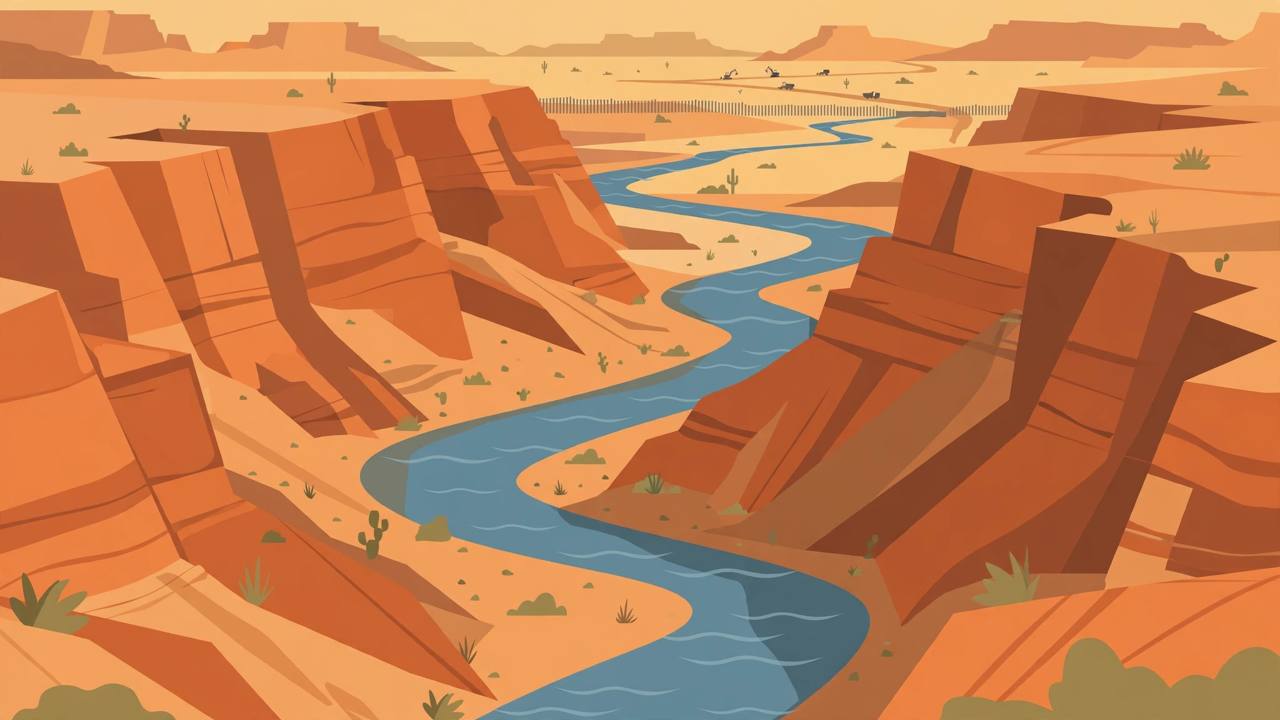
The Supreme Court on Monday, November 9, let the Trump administration resume building border barriers and roads in the Big Bend region of West Texas while a legal challenge to the project continues, granting the government's emergency application in Mullin v. Friends of the Ruidosa Church, No. 26A560.
Source: Supreme Court of the United States, per curiam opinion in No. 26A560
The unsigned per curiam order stays the preliminary injunction issued on October 2 by U.S. District Judge Kathleen Cardone of the Western District of Texas, in El Paso. Justice Ketanji Brown Jackson was the only justice who noted that she would have denied the government's request, and she did not write a separate opinion.
What the Texas judge had blocked
Judge Cardone had barred the Department of Homeland Security from continuing construction until it complied with environmental and other applicable laws. The halt covered work under three waivers issued between February and July 2026 — one by former Secretary Kristi Noem and two by her successor, Secretary Markwayne Mullin — according to Reuters reporting on the case.
The challengers are the Center for Biological Diversity, a Big Bend river guide, and Friends of the Ruidosa Church, a group formed to preserve a historic church in Ruidosa, Texas. Their lawsuit, filed in April, argues the waivers go beyond what Congress authorized and threaten desert, river and historic sites in one of the most remote stretches of the U.S.–Mexico border.
The 1996 law at the centre of the case
The power at issue comes from Section 102 of the Illegal Immigration Reform and Immigrant Responsibility Act of 1996, expanded in 2005. It lets the secretary of homeland security build barriers and roads 'to deter illegal crossings in areas of high illegal entry' and 'waive all legal requirements' the secretary deems necessary to build them quickly. The same law allows only constitutional claims against those waivers, filed within 60 days, and routes appeals straight to the Supreme Court — the Fifth Circuit has no jurisdiction, which is why the government went directly to the justices on October 21.
Cardone accepted a newer theory: that the challengers' major-questions claim was constitutional in nature, and that the waivers lacked the clear congressional authorization that doctrine demands. Reuters reported her finding that Big Bend has the fewest migrant apprehensions of any southwest border sector, and quoted her reasoning: 'Therefore, if the Big Bend Sector is an area of high illegal entry, so is every other sector, and the waiver authority would apply to the entire US-Mexico border.'
What the Supreme Court said
The justices rejected that framing directly. 'There is no such thing as a “constitutional” major-questions claim,' the opinion says, describing the challengers' case instead as an allegation 'that the Secretary exceeded his statutory authority' — a type of claim the 1996 law does not allow. On that basis the court said the government is 'exceedingly likely to prevail' because the lower court lacked jurisdiction.
Source: The Digital Free Press — reading of the per curiam opinion and government application
The court also weighed money and harms. It cited a declaration from a Customs and Border Protection official putting the cost of the injunction at more than $460,000 a day in land leases, offices and security while contractors wait — money the opinion says cannot be recouped. By allowing the waivers, the court said, Congress showed 'a clear preference for expeditious border construction over the very harms respondents assert,' and the government's interest 'outweighs any aesthetic, recreational, and environmental harm.'
A stay is not a decision on the merits. The order does not hold that the three waivers are lawful. It keeps the injunction on hold while the government asks the Supreme Court to take up the case; if the court declines, the pause ends automatically.
What it means on the ground
Most of the planned construction is on private land, Reuters reported, citing the administration. Inside Big Bend National Park itself, the plan calls for a 17-mile noncontiguous vehicle barrier system rather than the 30-foot pedestrian wall planned elsewhere. The Center for Biological Diversity says construction began near Santa Elena Canyon on August 6 and that CBP paused work on August 17, after protests and criticism from members of both parties.
The Center for Biological Diversity called the decision 'horrific,' saying it 'clears the way for contractors to bulldoze pristine desert and dynamite canyon walls before the courts have even decided whether this destruction is legal.' That is the challengers' characterization, and it is contested by the government, which says delay — not construction — is the harm the court should weigh.
A separate lawsuit filed September 14 in Washington, D.C., by six landowners and Conserve Big Bend, which says it represents about 230 more people, argues the waivers were improperly issued and that owners' Fifth Amendment due process rights are being violated. That case is not decided by Monday's order.
What happens next
Construction may resume while the El Paso case continues on a full record, and because the waiver statute routes appeals directly to the justices, the Supreme Court will be the next stop for whichever side loses the final judgment. For landowners, river guides, park visitors and border communities in West Texas, the practical question now is pace: how quickly DHS and its contractors move back into the canyon country, and whether work inside the national park — paused in August by choice, not by court order — restarts as well.