This story follows our November 6 report on Mayor John Whitmire's executive order limiting Houston police cooperation with ICE. The new development is the City Council move to turn that order into permanent city law. Read the November 6 report
HOUSTON, Texas — Three members of Houston City Council introduced a proposed ordinance on Monday, November 9, 2026, that would write Mayor John Whitmire's new limits on police cooperation with U.S. Immigration and Customs Enforcement (ICE) into the city code, making the protections permanent law rather than a mayoral order that a future mayor could reverse alone. Council Members Alejandra Salinas (At-Large Position 4), Edward Pollard (District J) and Tiffany Thomas (District F) are the authors of the measure, which they are calling their “Prop A immigration ordinance.”
The proposal builds directly on the executive order Whitmire announced at a November 6 news conference, three days after the November 3 elections changed Texas's statewide leadership. That order, already in effect, ended the Houston Police Department's practice of alerting ICE simply because a person encountered by an officer held a civil administrative immigration warrant. The council ordinance would align the city code with the order — with one decisive difference: an ordinance can only be changed by a council vote, not by the next mayor's signature.
What the ordinance would do on the street
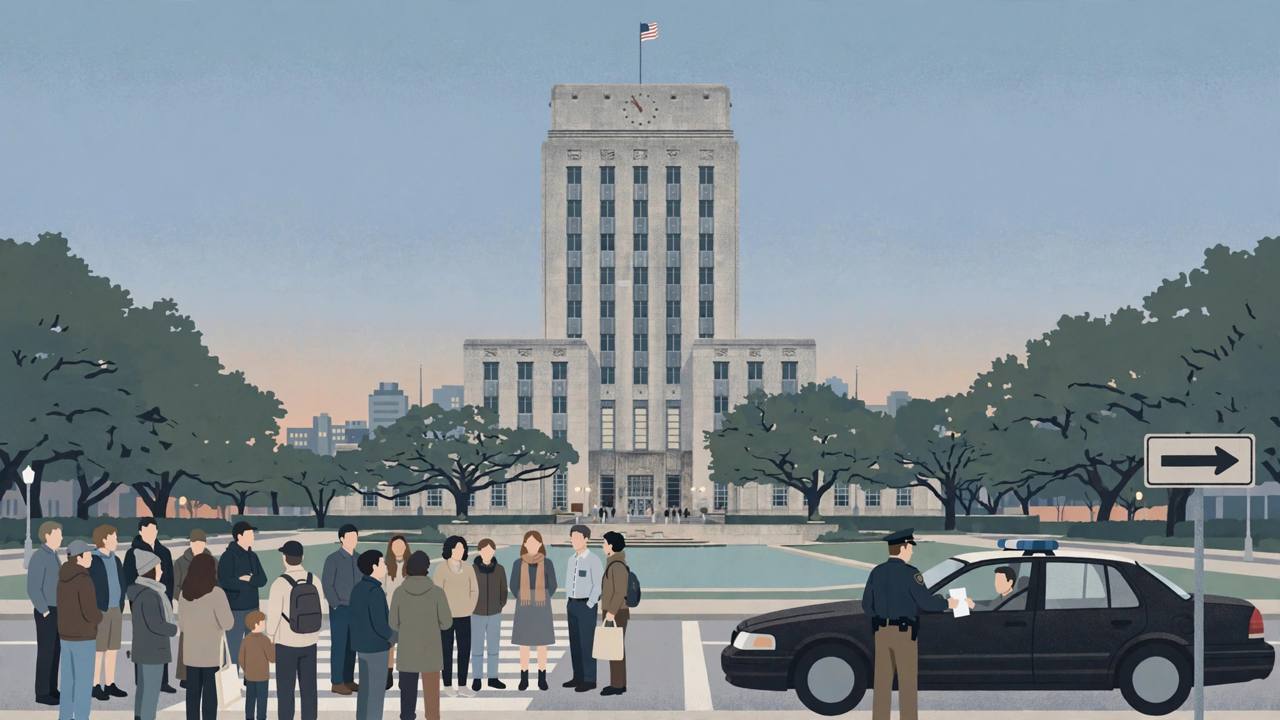
Under the proposed ordinance, HPD officers could no longer prolong a traffic stop, detain someone, or contact ICE solely because of a civil administrative immigration warrant — unless that person is also being arrested for a jailable criminal offence. A minor traffic infraction on its own would no longer trigger a call to federal immigration agents. Administrative immigration warrants are civil documents issued by federal immigration authorities, not by judges, and are separate from criminal arrest warrants signed by a court — a distinction the council members put at the centre of their case.
The measure would also strengthen the city's existing quarterly HPD–ICE transparency reports. Departments would have to record additional detail about each encounter, including the reason for a jail booking and whether ICE was contacted in connection with a victim, a suspect or a witness — closing a gap highlighted earlier this year when reporting documented a case in which an officer contacted ICE after discovering that a woman who had reported domestic violence held an administrative warrant; federal agents did not respond to that scene, according to the reporting.
A year-long fight over $110 million and a 30-minute rule
The ordinance is the latest chapter in a dispute that has run for more than a year. In April 2026, City Council approved an earlier ordinance limiting when HPD officers could contact ICE. That measure prohibited prolonged detention during traffic stops, ended the department's previous practice of waiting up to 30 minutes for ICE to arrive when an administrative warrant appeared, and established the quarterly public reporting of HPD–ICE interactions. State officials then threatened to withhold more than $110 million in public-safety funding if Houston did not change course, and Whitmire pushed to amend the measure, arguing the city could not afford to lose essential state and federal grants.
Whitmire reversed himself on November 6, after the November 3 elections in which Democrats won several major Texas races, including the governor's and attorney general's offices, according to the council members' statement and local reporting. “I do this to begin a healing process to reduce fear and anxiety across our community,” Whitmire said at the November 6 news conference. “I also do this knowing that elections matter. I've been in contact with the new statewide elected officials, and SB 4 is not a priority.” SB 4 is the Texas state law that prohibits so-called sanctuary-city policies and requires local agencies and jails to comply with ICE detainer requests — the legal backdrop against which any Houston ordinance will be tested.
“For more than a year, Houston families, workers, and advocates have demanded that City Hall limit HPD's cooperation with ICE. Our new Prop A immigration ordinance builds on the measure we successfully fought to pass earlier this year. It would codify the protections in the mayor's executive order into city law to ensure they endure far beyond any one administration, uphold constitutional rights, and keep HPD focused on solving serious crimes.” — Joint statement by Council Members Alejandra Salinas, Edward Pollard and Tiffany Thomas, November 9, 2026. They added: “On election night, Texans stood up to the bullies in Austin. Houstonians have shown that same resolve for more than a year. It's time for City Hall to put these protections into law.”
In their statement, the three council members pointed to two recent Houston-area incidents involving ICE as evidence of the need for urgency. On July 7, ICE agents fatally shot Lorenzo Salgado Araujo, 52, a father of three U.S. citizens, during an immigration-enforcement operation in Houston's Magnolia Park neighbourhood; federal officials later acknowledged he apparently was not the person agents had been seeking, and his family disputes the government's account of the shooting. On October 10, an ICE agent driving an unmarked SUV struck Miguel Parra-Hernandez, 48, as he fled through a parking lot in northwest Harris County, leaving him with severe injuries requiring surgery; Harris County District Attorney Sean Teare has said surveillance evidence suggested the agent deliberately drove toward Parra-Hernandez — an allegation ICE denies. Neither incident has been shown to have resulted from Houston police notifying ICE during a routine encounter, and Whitmire's order does not directly regulate federal agents; both cases are cited by the council members as the stakes of the wider debate, not as consequences of the city's notification practice.
Reaction beyond the council chamber was split along familiar lines. FIEL Houston, an immigrant advocacy organisation, welcomed the executive order the ordinance would codify. “Today Houston won. Today our community can breathe easier,” FIEL Executive Director Cesar Espinosa said in a statement, adding: “As a collective we still demand ICE out of Houston.” Houston Controller Chris Hollins welcomed the mayor's reversal but questioned why the administration had not acted sooner, especially after incidents involving immigration agents that ended in death and serious injury. The restrictions do not prevent federal immigration agents from operating in Houston, and they do not remove the city's obligations under Texas law.
On the ground, the executive order is already the working rule. HPD Chief J. Noe Diaz said the directive was distributed to officers the day it was announced and would be read at every police roll call for five consecutive days, with officers reminded of the procedures during shift briefings. For Houston's large immigrant communities — including the Punjabi and wider South Asian families who live and work across the metro area, many of them in trucking and small business — the practical change is that a routine traffic stop is no longer supposed to become an immigration referral unless a jailable arrest follows.
What happens next
The proposed ordinance has not yet been scheduled for a City Council vote. The council will not officially discuss it at the November 10 council meeting; officials from Salinas's office said the changes would likely reach the agenda in mid-November or early December, and the city's legal department must review the measure first. If the ordinance passes, officials said it would take effect immediately. Until then, Whitmire's executive order remains the operative policy — and the open question the council vote will decide is whether that policy outlives his administration, and whether it survives the legal and funding challenges Texas state law still makes possible.