A Houston man's 76-minute traffic stop on Interstate 35 ended with a federal jury awarding him $76 — one dollar for every minute deputies held him on the side of the highway — and a new KPRC 2 investigation is now asking who was tracking his truck before the stop ever happened.
Source: KPRC 2 / Click2Houston — ENOUGH
The stop on I-35
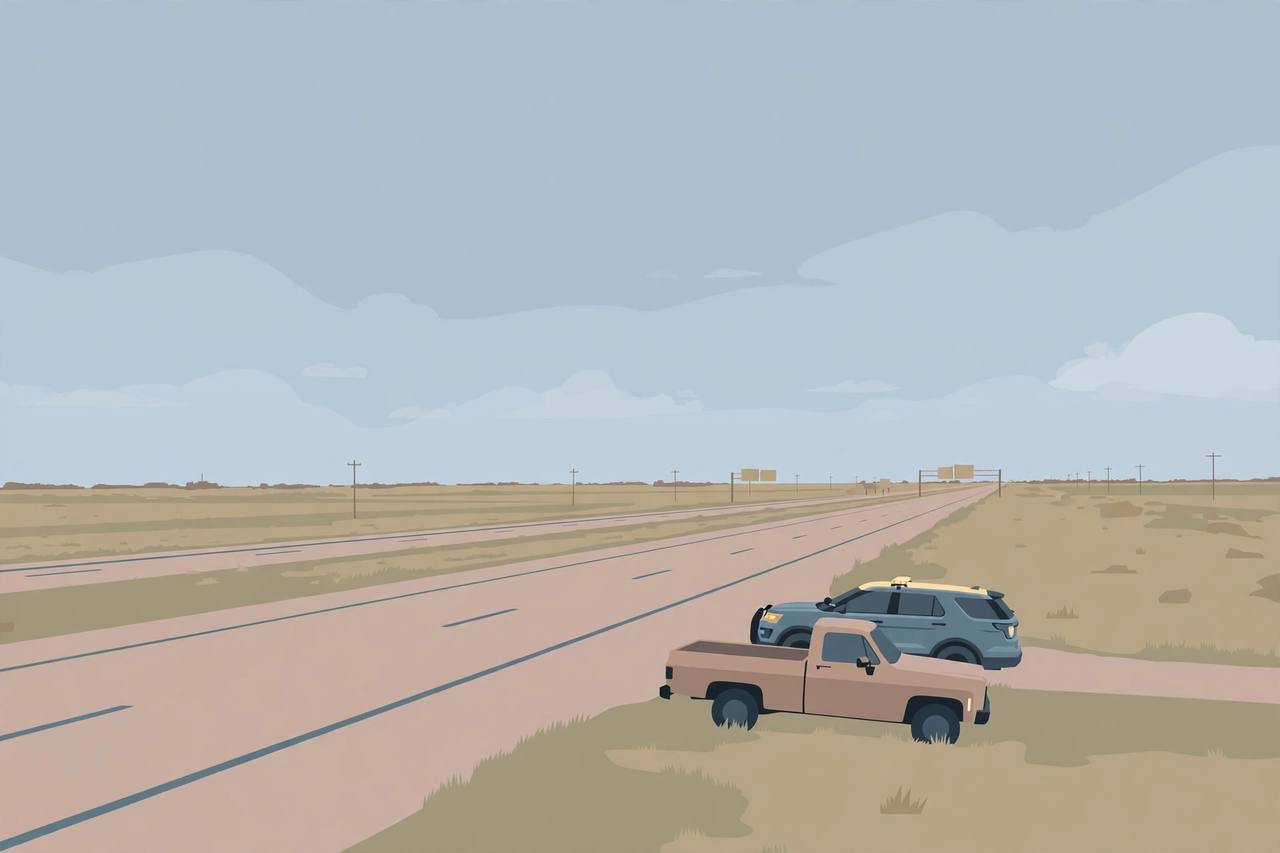
On March 16, 2022, just after 11 a.m., Alek Schott was driving north on Interstate 35 just south of San Antonio, on his way back from work trips in South Texas. Schott, a Houston man, works as director of operations and business development for his father's company, RMS Controls, which makes products for upstream and midstream pipeline companies. He told KPRC 2 he travelled to South Texas several times a week for oilfield customers. As he passed a parked patrol vehicle, Bexar County Sheriff's Deputy Joel Babb pulled onto the highway behind him.
Source: KPRC 2 / Click2Houston — ENOUGH
According to the lawsuit, Babb ran Schott's license plate twice in about two minutes, then stopped him, saying Schott had drifted over the fog line. Schott's own dash camera showed he had stayed in his lane and never touched the lines on either side. Babb's patrol vehicle had no forward-facing dash camera at the time, so the sheriff's office had no video of its own showing how Schott was driving before the stop.
Source: KPRC 2 / Click2Houston — ENOUGH
Babb told Schott he would get a warning, not a ticket — then asked him to get out of his truck and sit in the front seat of the patrol car. Inside, Babb explained his job, in words captured on body-camera footage obtained by KPRC 2's ENOUGH team: "So, what I do, what I am is what's called a criminal interdiction unit. So, I don't give tickets. I give warnings. The main reasons, I sit on the side of the highway looking for, because it's bad out here, human smuggling, drug smuggling and all those things like that."
Seventy-six minutes on the shoulder
According to the lawsuit, Babb questioned Schott about his identity, his trip, his job, his family, where he lived, and whether he had drugs or money in the truck. "It wasn't like a normal traffic stop," Schott said. "I thought that's really strange, but I'm getting a warning, no big deal. We'll be out of here shortly. And it just kept escalating."
Schott said he did not want his truck searched. Babb called for a K-9 unit. When the dog arrived, it alerted near the truck, and Babb told Schott he was being detained because of the alert. Babb and Deputy Martin Molina then searched the truck without Schott's consent and without a warrant, pulling items out of bags and compartments and putting them on the floor, according to the lawsuit. Schott was moved to the back seat of the patrol car. He had a six-week-old baby at home. Deputies found nothing illegal. The stop lasted about 76 minutes.
Source: KPRC 2 / Click2Houston — ENOUGH
"As they kept searching, more officers eventually showed up to search further, and they had me in the back of the cop car, and you're just thinking, what are they planting? Who do they think I am?" Schott said.
Who was tracking his truck?
About 34 minutes into the body-camera recording, Molina arrived with the K-9. That is when Babb can be heard telling him: "It's the one I was looking for. They've been tracking it." Court filings from the sheriff's office cite "prior intelligence" about Schott from the "Laredo Fusion Law Enforcement Center" — but no agency can say what that center is. The Texas Department of Public Safety said it is not aware of a Texas fusion center in Laredo. U.S. Customs and Border Protection also said there is no fusion center in Laredo. The Laredo Police Department said it was unaware of one, and the San Antonio Police Department said Laredo was not part of its Southwest Texas Fusion Center.
Source: KPRC 2 / Click2Houston — ENOUGH
Howard Henderson, a professor of justice administration at Texas Southern University and founding director of its Center for Justice Research, reviewed the body-camera footage with ENOUGH. "It seems as if everything that he said before is all based upon this being tracked already," Henderson said. "So, I don't know how valid anything else he said is." He also noted that Babb never told Schott his truck had been flagged — a detail that matters, he said, because it raises questions about what information deputies were relying on when they decided which drivers to stop.
The WhatsApp allegation
Christie Hebert, Schott's attorney with the Institute for Justice, alleges the stop was part of a larger practice. She alleges deputies used an unofficial WhatsApp group to share license-plate-reader information and flag drivers based on where they travelled. "They wouldn't have actual traffic violations to pull people over," Hebert said. "Instead, what was happening was license plate readers were flagging people for their travel, whether they went down to a border town or whether they took a quick trip." She alleges officers in the group then used that information to stop those drivers and claimed traffic violations that did not really exist. The allegation has not been established by the verdict, and the sheriff's office has not answered it publicly.
Source: KPRC 2 / Click2Houston — ENOUGH
The verdict
Schott sued Bexar County, arguing the stop was part of a broader pattern of unconstitutional searches and seizures. After a five-day federal trial, a jury in San Antonio returned its verdict on September 28, 2026. It found for Schott on all three of his Fourth Amendment claims — that there was no reasonable suspicion for the stop, no lawful basis to extend the detention, and no probable cause for the search — and it found the county liable at the level of policy, not just for one deputy's mistake. The award was $76, the amount his legal team had asked for.
Source: Talk With Tech
"We asked for $76, $1 for every minute of the traffic stop because this case was really about holding Bexar County responsible and accountable for the Constitution," Hebert said. Schott added: "This isn't about money. This isn't a $10 million settlement. This is about protecting people's rights."
The Institute for Justice plans to ask U.S. District Judge Orlando Garcia for a court order to stop similar stops and warrantless vehicle searches, and the county may appeal. The Institute says the practice ran for about four years and affected thousands of drivers — those are the plaintiff's claims, not findings in the verdict.
Source: Talk With Tech
What are automated license plate readers?
Automated license plate readers, or ALPRs, use cameras and software to capture vehicle license plates. Depending on the system, the technology can also record the time and location a vehicle passed a camera, letting officers search past records or get alerts when a vehicle shows up on a camera network. Police use the technology to find stolen cars, investigate crimes and track vehicles connected to specific cases. Privacy advocates have raised concerns about how much information the systems collect and who it is shared with.
Source: KPRC 2 / Click2Houston — ENOUGH
Henderson said researchers are still trying to answer whether the cameras deliver the results police promise. "The jury is still out," he said. "The research is still asking that question about whether or not there is a relationship between the use of these cameras and the outcomes that we desire, so catching individuals who are violating the law." What concerns him is oversight: "In this case, these ALPRs create an opportunity for abuse, and without adequate safeguards in place, you're going to encounter this." He also questioned the use of unofficial messaging apps, saying back-channel conversations make it harder to establish what information deputies received, who shared it, and how it shaped an investigation.
What happens next
Hebert says more drivers have come forward since the verdict, and she hopes the precedent reaches beyond one stop on I-35. "We're hoping that the precedent here will create opportunities for lots of drivers who experience these kinds of things and put different agencies across the state on notice that these kinds of practices violate the Constitution," she said.
Texas has no statewide law on how police use license plate readers — each agency writes its own rules. That could change when the Texas Legislature meets in January: lawmakers have already filed at least four bills to regulate the cameras, with proposals ranging from a ban to requiring warrants or a 48-hour limit on keeping the data. KPRC 2 has also filed an open-records request with the Bexar County Sheriff's Office asking what policies govern who can access plate-reader information, how it is shared with other agencies, and what safeguards exist to prevent misuse. The office had not responded by the time the investigation was published, and it declined to comment on cases involving past or current litigation.
Source: KPRC 2 / Click2Houston — ENOUGH
Interstate 35 is one of the busiest trucking and travel corridors in Texas, used daily by thousands of drivers — including Punjabi truckers running loads between San Antonio, Austin, Dallas and the border. The Schott verdict does not outlaw license plate readers, but it puts every agency that uses their alerts to make stops on notice: a surveillance flag alone is not a lawful reason to pull a driver over, hold them for over an hour and search their vehicle.
What is solid
- A federal jury in San Antonio found Bexar County liable on all three Fourth Amendment claims and awarded $76, on September 28, 2026.
- The stop lasted about 76 minutes; deputies searched the truck and found nothing illegal.
- Schott's dash camera showed he did not cross the fog line; the patrol car had no forward-facing camera.
- The verdict followed a five-day federal trial; the Institute for Justice plans to seek an injunction.
What is only claimed
- Whether a license-plate-reader flag triggered the stop — Schott's lawyers allege it did; the sheriff's office has not explained what information deputies had before the stop.
- Whether deputies shared plate-reader data in an unofficial WhatsApp group — alleged by Schott's attorney, not established by the verdict.
- What the 'Laredo Fusion Law Enforcement Center' cited in court filings is — the Texas Department of Public Safety, Customs and Border Protection and San Antonio police all say no such center exists.