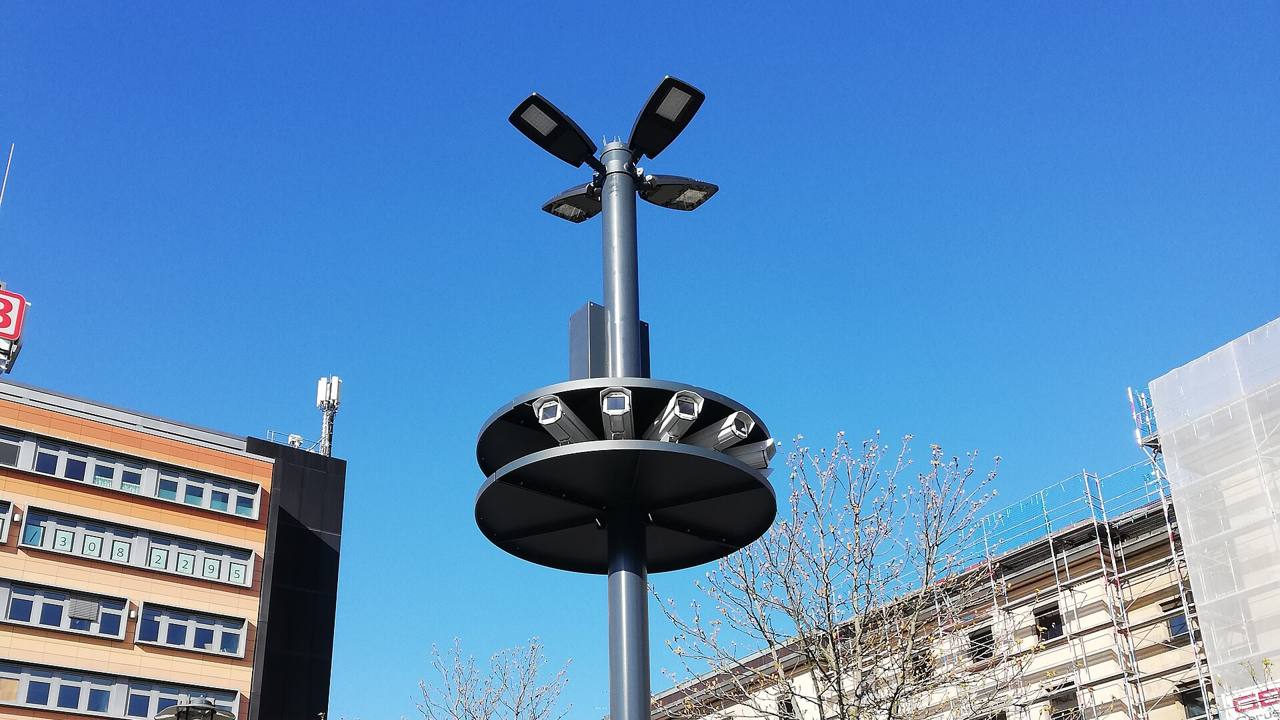
Seattle's police surveillance system should operate under far tighter rules — including a warrant before officers search camera footage to track someone after a crime — according to a long-awaited civil-liberties audit of the Seattle Police Department's Real Time Crime Center (RTCC) released on Monday, November 9, by the Policing Project at New York University School of Law. The audit makes 19 recommendations and lands one day before Mayor Katie Wilson is due to announce whether the city will expand the camera network that feeds the center.
Source: Policing Project at NYU School of Law
The Policing Project stressed that it was not asked to decide whether the RTCC should exist or grow. “We think that there is a solid foundation for governance of the RTCC in Seattle… but that there are also significant gaps in policy that the city and SPD can fill,” the project's chief of staff, Katie Kinsey, said on Monday. “If the RTCC is going to continue to operate, it should do so subject to implementing these additional policy recommendations.” Mayor Wilson commissioned the audit in March, after pausing a planned camera expansion, and is scheduled to hold a press conference on Tuesday morning with interim police chief Andre Sayles.
Source: PubliCola
What the Real Time Crime Center is
The RTCC began operations in 2025 and gives Seattle police real-time and recorded access to a network of more than 500 individual cameras — run by SPD, the Seattle Department of Transportation (SDOT) and private businesses that volunteer their feeds — with about 900 more private cameras at 159 locations available on request. Analysts work in the center using Axon's Fusus platform, layering camera views with law-enforcement databases and object-detection software to guide officers in the field and to investigate crimes afterwards. SPD is barred from using facial recognition, but its object-identification system is meant to pick out vehicles, purses and clothing colours — and, the audit found, it often misidentifies objects and people. In one case cited by the auditors from last year, police swarmed and handcuffed a 16-year-old student after a school camera system mistook the bag of Doritos he was holding for a gun.
The headline recommendation: a warrant for looking back
Most RTCC work supports officers answering 911 calls in real time. But analysts also search recorded footage to track people's movements after a crime — what the report calls retrospective surveillance. The auditors recommend that police be required to obtain a warrant for any such after-the-fact search, treating it as a search in law, with warrantless tracking allowed only while officers are responding to a live situation to prevent physical harm, stop evidence being destroyed, or prevent a suspect escaping. Max Isaacs, the Policing Project's director of technology law and policy, conceded it was “a hard pill for [SPD] to swallow,” but added: “It is not the case that [a warrant requirement] would impede investigations. If the investigation is warranted, then they can always go to a judge and get sign off.” The requirement would not apply in emergencies such as an active shooter, and officers could still check cameras at a fresh crime scene.
Five days on paper, not just in practice
The audit found that several of SPD's key safeguards exist only as informal practice, not written policy — including the practice of keeping CCTV footage no longer than five days unless it is needed for an investigation. Because that limit is unwritten, the department could stretch it to 30 days tomorrow without changing any policy, the report noted; the auditors recommend making five days binding policy. They also recommend deleting footage kept as evidence once it is no longer needed: keeping it indefinitely, Isaacs said, raises the risk that outside actors — he named ICE and outside law enforcement among “bad actors” in this context — could obtain SPD footage through a public-records request or a subpoena. For immigrant communities in Seattle, including the region's Punjabi families, that data-sharing question is the most concrete one in the report: it decides whether local camera footage can end up in federal immigration hands.
“Mission creep” and thin evidence
The report also found that the written rule limiting the RTCC to “serious and violent” crimes is interpreted by SPD in practice to cover “misdemeanors of all kinds.” “When there are no clear guardrails around how a police department can use surveillance, there is this tendency to have mission creep,” Kinsey said. The auditors further noted that the evidence the cameras actually solve crime is “thin”: SPD says officers are three times more likely to arrest a suspect with RTCC support and that the center assisted in 17 homicide cases in 2025, helping close 10 — but SPD counts any analyst action, even a camera check that produced nothing, as “support,” which the report says confuses correlation with causation.
Background: how Seattle got here
Seattle built its camera system quickly. The City Council voted 7–2 in September 2025 to expand cameras and fold SDOT traffic cameras into the center; SPD's cameras currently cover the downtown Third Avenue core, Aurora Avenue North and the Chinatown-International District. Earlier this autumn, two city watchdog reports — from the Seattle City Auditor and the Office of Inspector General — found that unauthorised SDOT cameras had been streaming into the RTCC and that federal agencies had accessed SDOT camera data. Mayor Wilson paused new cameras on Capitol Hill and in the Central District earlier this year while allowing stadium-area cameras that were switched on only during the World Cup, and critics on both sides have attacked her approach: law-and-order councilmembers say she is risking public safety, while privacy groups such as Community Not Cameras say the system endangers residents and visitors.
The cameras cover neighbourhoods where many of Seattle's immigrant communities live and work, including the Chinatown-International District. The audit's rules on retention and data sharing decide how long footage of ordinary residents exists — and who can get hold of it.
What happens next
Mayor Wilson announces her plans for the RTCC on Tuesday morning, November 10. She has signalled for months that the audit's release was the final step before she decides whether to keep the center and preserve or expand its camera footprint — the open questions are which of the 19 recommendations she adopts, and whether she makes the center's future conditional on meeting them. Any change to the center's authorisation also goes before the City Council, which the auditors urged to consider tighter limits when the authorisation is next reviewed. Kinsey said she was “relatively optimistic” about adoption, noting the mayor's office itself requested the audit and that the Policing Project spent eight months working with stakeholders inside and outside city government.