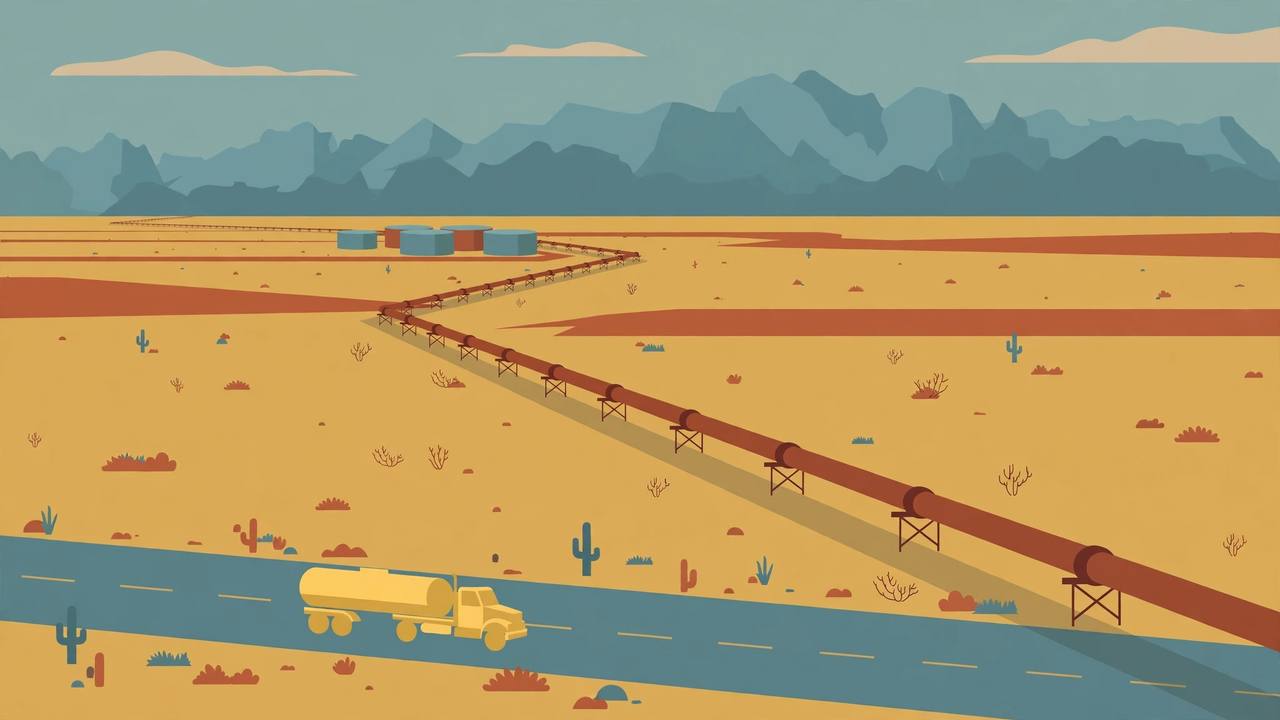
The U.S. Bureau of Land Management (BLM) has begun work on a full environmental impact statement for the proposed Western Gateway Pipeline, an 887-mile new fuel pipeline that would run from Texas to Arizona and carry gasoline, diesel and jet fuel from Mid-Continent and Gulf Coast refineries toward western markets, the agency announced in Phoenix.
Source: Bureau of Land Management
The project is being developed by three energy companies — Phillips 66, Kinder Morgan and HF Sinclair — and would combine two brand-new pipeline segments with existing lines to move refined products as far west as California. The BLM said a notice will publish in the Federal Register on November 17, opening a 30-day public scoping period, with comments accepted until December 17, 2026.
What would be built, and where
According to the BLM, the project involves building and maintaining two new segments: a 20-inch-diameter pipeline running from Borger, Texas, to El Paso, Texas, and a 24-inch-diameter pipeline running from El Paso to Buckeye, Arizona, west of Phoenix. The line would cross public lands in Arizona and New Mexico and tie into existing pipeline networks that transport refined petroleum products from refineries in Illinois to California.
The new stretch is part of a roughly 1,300-mile system. Reporting on the project says the plan also reverses an existing pipeline between Arizona and California so fuel can flow west into California, and that Phillips 66 is seeking a 30-year right-of-way grant for the portion crossing BLM-managed land. The three partners announced a final investment decision in August 2026; Phillips 66 holds a 49.9 percent share, Kinder Morgan 35.1 percent and HF Sinclair 15 percent, according to project reporting.
Source: WiseVoter / TruckDriverNews project reporting
Why the West is short of fuel
Arizona has no crude-oil refineries of its own and receives gasoline and other petroleum products through pipelines from California and Texas, leaving its supply tied to those two corridors. California's own refining capacity has also shrunk: the U.S. Energy Information Administration (EIA) notes that a Los Angeles-area refinery with capacity of 139,000 barrels per day closed in late 2025. Arizona's average price for regular gasoline was about $4.05 a gallon on November 16, compared with roughly $3.36 a year earlier.
For truckers, the number that matters most is diesel. The EIA's latest weekly benchmark, for the week of November 9, put the U.S. on-highway diesel average at $6.127 a gallon, down from $6.292 the week before — while California's average stood at $7.897 a gallon, the highest in the country. Punjabi and other long-haul drivers running Interstate 10 and Interstate 40 between Texas, Arizona and California pay those western prices every day, which is why a new supply line into Arizona and California is being watched closely across the trucking industry. The companies have not confirmed how much, if at all, the pipeline would change prices at truck stops, and no specific trucking contracts or hiring plans have been announced in the federal notice.
What the review will examine
An environmental impact statement is the most detailed level of federal environmental review. The BLM will study the project's possible effects on land, water, wildlife, public safety and transportation before deciding whether to grant the right-of-way. The agency said the project aligns with Executive Order 14154 and Secretary's Order 3418, which direct federal agencies to prioritise domestic energy development and cut what the administration calls unnecessary regulatory barriers. The start of the review does not mean construction has been approved.
Public scoping opens November 17 and comments are accepted until December 17, 2026, through the BLM National NEPA Register's 'Participate Now' option, or by mail to: BLM Arizona State Office, Attention 'Western Gateway Project,' One North Central Avenue, Suite 800, Phoenix, AZ 85004. The BLM will hold virtual public meetings on December 1 (9–10 a.m.) and December 2 (6–7 p.m.), Mountain Standard Time.
What happens next
After scoping closes on December 17, the BLM will prepare a draft environmental impact statement, followed by further public comment. Project reporting puts the final environmental impact statement in February 2028 and a federal decision in May 2028, with the companies targeting completion in 2029 if permits are granted. Until then, western diesel supply — and the prices drivers pay on the I-10 and I-40 corridors — will keep depending on the existing refineries and pipelines the new line is meant to back up.