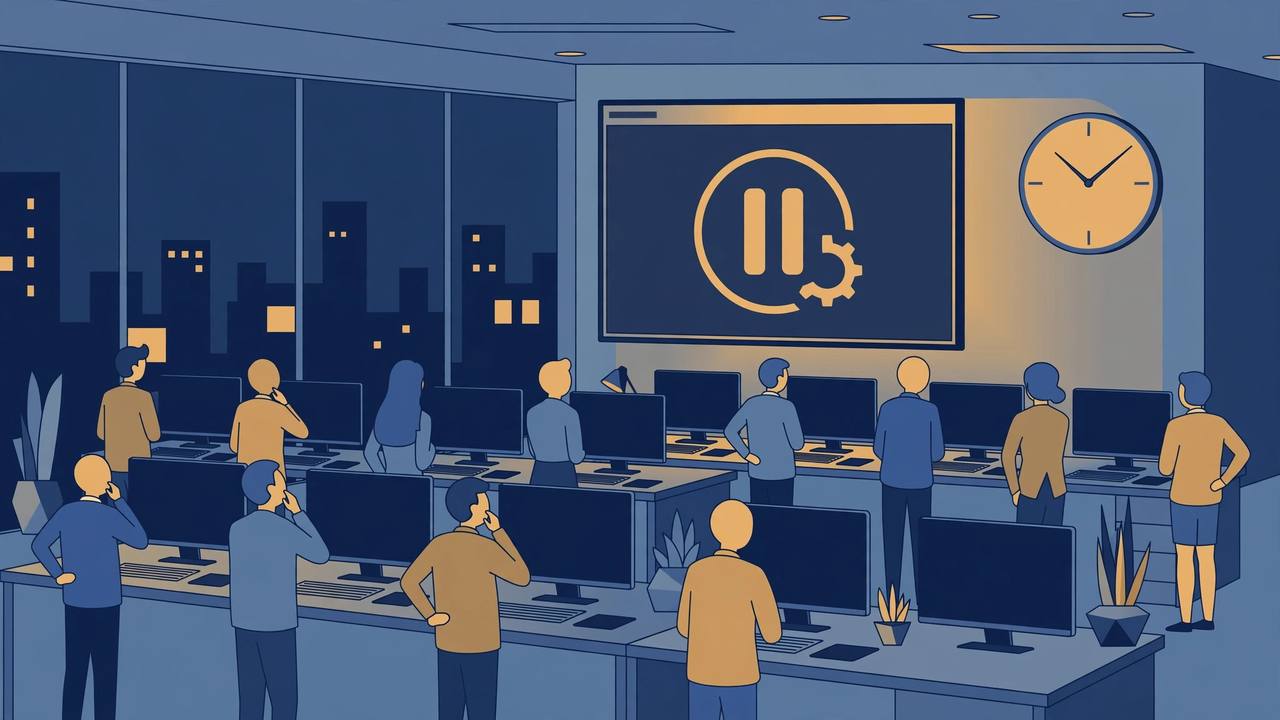
Workday, the human-resources and payroll platform used by more than 11,500 organizations worldwide, suffered a major outage on Friday night, November 13, 2026, that left employees at affected companies unable to clock in, check their pay, request time off or finish benefits enrollment — before the company restored service on Saturday morning. In a statement on Saturday, a Workday spokesperson confirmed the disruption affected two of the company's data centers and said service was fully restored by 11 a.m. EST on Saturday.
Source: Techstrong IT
"Customers are coming back online," the spokesperson said. "We recognize the critical services we provide to our customers and their workforces, and we sincerely apologize for this outage." Users who tried to log in during the outage were met with an error message saying Workday was experiencing a service interruption and advising them to contact their organization's administrator or check back later.
Source: Techstrong IT
The trouble began shortly after 5 p.m. EST on Friday, when the outage-tracking site Downdetector recorded a spike of nearly 3,000 user reports. By early Saturday, staff at affected organizations still could not log in, clock in, check pay, request time off or complete open-enrollment steps for health benefits, UC Today reported.
Source: UC Today
How a backup test took the live system down
According to the San Francisco Chronicle, the disruption began after a problem was discovered while Workday was testing its backup systems, and the glitch left some information in an inconsistent state. A notice on Workday's own Community Status Page, quoted by Washington University's IT department early Saturday, explained it more bluntly: while the company was validating its weekly maintenance window for disaster-recovery tenants, services inside the disaster-recovery site unexpectedly connected to the live production databases.
Source: UC Today
"As a result, this has left data in an inconsistent state that can cause errors accessing tenants or jobs/integrations/tasks to fail with missing transaction error messages," the status notice said. In plain terms, a test designed to prove the company could survive a failure helped cause one: because the backup environment touched real payroll and HR data, Workday could not simply switch the system back on — it first had to check and repair the data so that pay and time records would not be wrong when workers logged back in.
Source: UC Today
Workday said it was placing all of its WD1 production tenants into maintenance mode and would provide updates every 30 minutes. A company spokesperson told KRON4 and LiveNOW from FOX on Friday: "Some of our customers are experiencing a service disruption and we're working urgently to investigate and resolve the issue. We sincerely apologize for the challenges this is causing impacted customers." Nothing in the company's statements or the reporting so far indicates a cyberattack; Workday has tied the failure to its own backup testing.
Source: UC Today
Who felt it: from Walmart and Target to city governments
Workday's customer list reaches deep into everyday American working life. Its major corporate clients include retail giants Walmart and Target, alongside Netflix, Southwest Airlines, General Electric, Morgan Stanley, Charles Schwab and Nasdaq. The platform is also heavily used in the public sector — by municipal governments in Seattle, Dallas, Philadelphia, Charlotte and Denver, and by federal bodies including the U.S. Department of Energy and NASA's Jet Propulsion Laboratory. For hourly workers at such employers, Workday is often the only way to record a shift, confirm a schedule or see a pay stub.
Source: Techstrong IT
Workday has not said exactly how many of its 11,500-plus client organizations were actually affected — it has only said "some of our customers." The 11,500 figure is the company's total customer base, not a confirmed impact count, and no list of affected employers has been published. Workers should rely on their own employer's IT or HR notice for whether their workplace was hit.
On the ground, universities and employers improvised through Friday night and Saturday morning. Emerson College said Workday took its system offline at about 10:15 p.m. GMT on Friday for unplanned maintenance affecting multiple customers, and extended its open-enrollment deadline to Monday, November 16. Washington University said on Saturday morning that Workday was still performing data-validation activities, and in a customer message later that morning Workday said reindexing and tenant release were expected to complete for the majority of customers by 11 a.m. EST, with any customers delayed past that point to be notified through a proactive case.
Source: UC Today
The second big workplace outage in two days
The Workday failure was the second major enterprise-software outage in as many days. On Thursday, a global Microsoft 365 outage affected millions of users across Outlook, Teams and Copilot, with lingering connection issues extending into early Friday morning; Microsoft executive Charles Lamanna confirmed on social media that it was caused by technical challenges rather than a cybersecurity incident. Together, the two failures underlined how much of the modern workplace — email, meetings, payroll and timekeeping — now depends on a small number of cloud platforms.
Source: Techstrong IT
What happens next: service is restored, but employers and workers should verify that hours clocked around the outage, pending time-off requests and benefits-enrollment choices were recorded correctly, because the company's own notice warned the inconsistent data could cause errors in jobs, integrations and tasks. Workday has not yet published a full post-incident report explaining how a disaster-recovery test gained a path into production data, or what it will change to prevent a repeat — the question every large customer will now be asking.