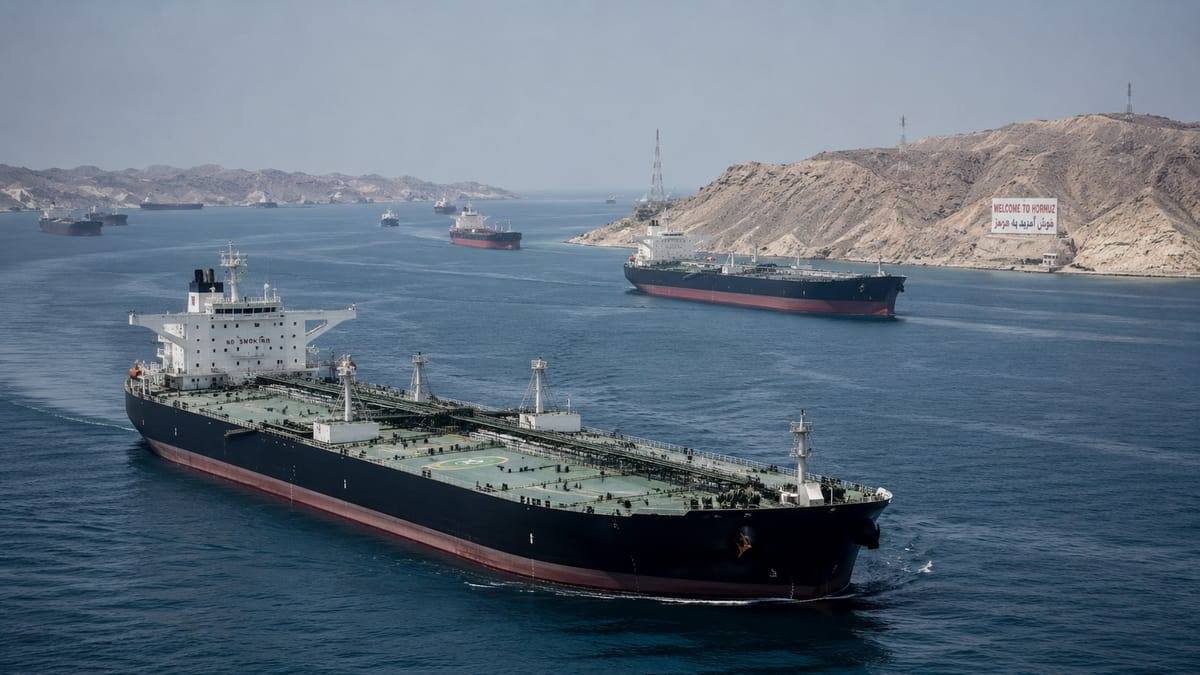
DUBAI — The United Arab Emirates' state oil company has quietly become the driving force keeping crude oil moving through the Strait of Hormuz, running a risky wartime shuttle of tankers through the world's most dangerous shipping lane under American military protection, The Wall Street Journal reported on Saturday.
Source: The Wall Street Journal (via US News Pulse)
Under the operation run by Abu Dhabi National Oil Company, known as ADNOC, company tankers load Emirati or Iraqi crude inside the Persian Gulf, cross the strait at night in convoys coordinated with US and Emirati military authorities, and then transfer their cargo to other tankers outside the strait for onward delivery, the Journal reported.
The scale of the operation is large. More than 70 percent of the crude that passed through Hormuz in August was later transferred offshore near hubs off the UAE and Oman used by ADNOC's shuttle, according to the report. The UAE pumped around 3.4 million barrels of crude a day in 2025 — yaani about 34 lakh barrels every day. ADNOC also buys Iraqi crude at a discount and resells it to buyers outside the strait.
The danger to ADNOC's own fleet is not theoretical. More than 20 of its vessels have been hit since April, and the most recent strike came on Tuesday, November 17, when a vessel operated by ADNOC was hit, leaving 11 crew members injured and one still missing. Read the earlier story on the November 17 attack
Why the strait matters
The Strait of Hormuz, the narrow waterway between Iran and Oman, normally carries roughly a fifth of the world's seaborne oil. It has been a battleground for months in the war that began with American and Israeli strikes on Iran in February 2026, with tankers hit by missiles, drones and mines. One analysis counted 35 vessels struck in October 2026 alone, the worst month of the war.
Source: Princeton Policy Advisors
Despite the attacks, flows have partly recovered. The International Energy Agency said crude oil and fuels through the strait rose 7 percent quarter-on-quarter in the third quarter to 9.1 million barrels a day — still well below the 21.4 million barrels a day of the year-earlier period. Brent crude, the international benchmark, settled at $92.57 a barrel on Friday, its third straight weekly fall, as recovering Middle East supply outweighed strike fears.
Source: Seeking Alpha
What it means for Gulf workers
Lakhs of Indian and Punjabi workers live and work in the Gulf, and Indian seafarers sail these same waters. In two recent tanker attacks in the strait, Indian crew members were reported safe — three aboard the tanker Navig8 Messi and six aboard the LNG carrier Al Mayeda. But every crossing still carries risk for the crews, and families back home in Punjab watch each new attack on the shipping lanes with worry.
Al Jazeera has separately described Iran as targeting a so-called “US-UAE” oil shuttle operating outside the strait, according to summaries of its reporting. That targeting claim has not been independently confirmed, and the Journal's account of the shuttle itself rests on its own reporting.
What happens next: traders will watch whether the night convoys keep running without a major new attack, and OPEC+ ministers meet on November 29. As long as the war continues, the strait will remain a militarily managed corridor for state energy companies rather than a normal commercial shipping lane — and the shuttle is the operation keeping Gulf crude moving through it.