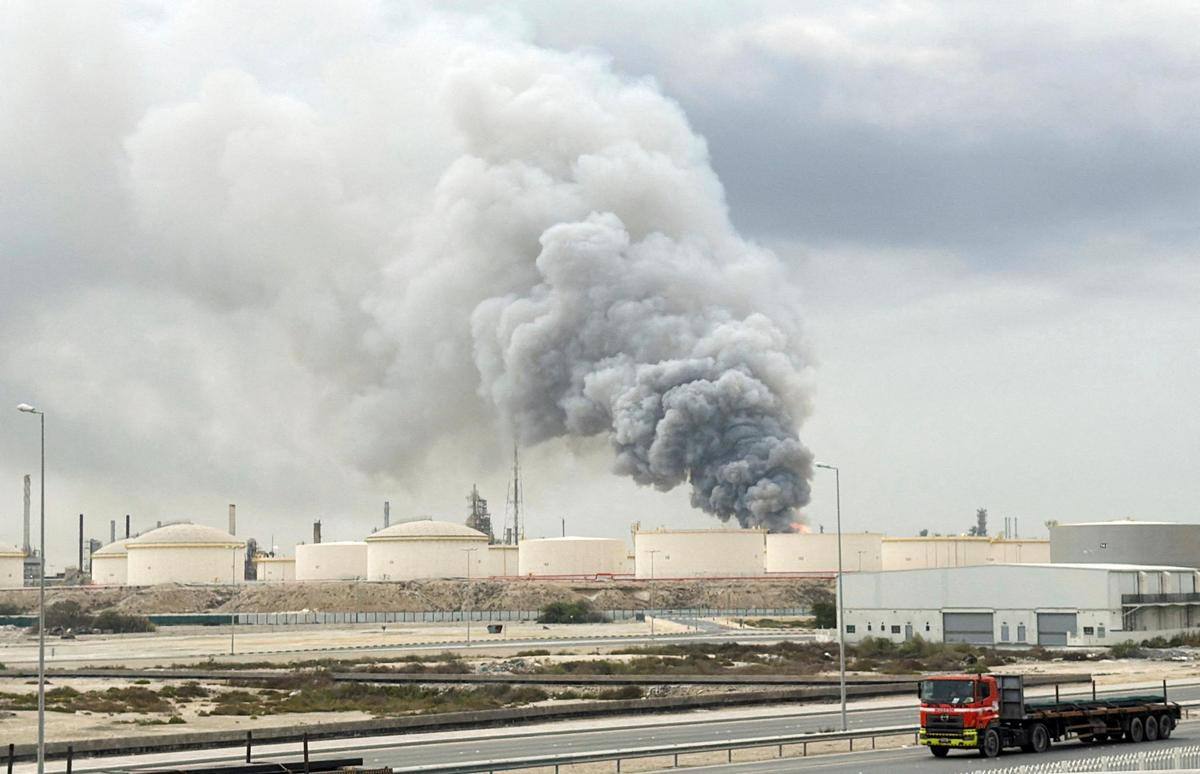
Bahrain urged the United Nations Security Council on Sunday to act against Iran after an Iranian strike set fire to a civilian industrial facility in the kingdom and caused property damage, its foreign ministry said. Manama also demanded that Tehran pay full compensation for the damage.
Source: Iran International
The ministry rejected the Revolutionary Guards' claim that they had targeted American military radars, saying the facility was used solely for civilian purposes. It accused Tehran of using its disputes with third parties to justify strikes on Bahraini territory.
Bahrain said it reserved the right to defend itself, alone or with its allies, at a time and place of its choosing, citing the United Nations Charter and the Gulf Cooperation Council's joint defence agreement.
What Bahrain is asking the Council to do
The ministry called on the Security Council to enforce Resolution 2817 and press Iran to halt attacks on civilians and infrastructure, end threats to shipping through the Strait of Hormuz and the Bab el-Mandeb Strait, and stop supporting armed proxy groups. Bahrain has pressed the Council before during this war — on November 17 it urged 'firm, deterrent measures' and compensation over earlier attacks — but Sunday's demand follows a fresh strike on a civilian site.
Source: Middle East Monitor via Anadolu
Bahrain said on Saturday night that an Iranian attack had struck a civilian industrial facility and started a fire. The Interior Ministry reported material damage but no injuries, and residents reported smoke over Sitra Island, an industrial area on Bahrain's east coast. The ministry did not name the facility. Read the earlier report
A week of attacks on the kingdom
The Saturday-night fire was the fourth Iranian attack on Bahrain in just over a week. The Guards have said the strikes were aimed at American radar systems at the Sheikh Isa Air Base and the Riffa helicopter base. On November 13 the US military said it shot down two Iranian drones headed for Bahrain, and on November 15 the Guards claimed six drones targeted a radar at Riffa. On Tuesday, Bahrain said it had thwarted a third drone attack in five days.
Iran's semi-official Fars news agency, which is close to the Revolutionary Guards, said the Guards had attacked the Sheikh Isa Air Base and the American base in Juffair, home of the Fifth Fleet headquarters. Channels linked to the Guards claimed three ballistic missiles and several drones were used, and also claimed two American Patriot radars were destroyed — a claim that could not be verified, and on which the US military has not commented.
Why it matters for Gulf workers
Bahrain hosts the headquarters of the US Navy's Fifth Fleet, which was struck in an Iranian missile and drone attack on February 28, the day the United States and Israel began their war on Iran. The island kingdom sits across the Gulf from Iran, and its waters and airspace have become one of the main front lines of a war that has repeatedly spilled into Gulf shipping.
Bahrain is also home to a large Indian expatriate community, including many Punjabis working across the Gulf, and every escalation raises fresh questions about worker safety, flights and remittances for families back home. The shipping threat is not abstract: on the same Saturday, British maritime monitors reported two tankers struck by unidentified projectiles near the Strait of Hormuz, with no casualties.
Two tankers were hit near the Strait of Hormuz on the same day as the Bahrain strike. Read about the tanker strikes
Diplomacy still running alongside the fighting
Earlier on Saturday, Bahrain's mission to the United Nations had already written to Secretary-General Antonio Guterres and the Security Council about what it called continuing Iranian attacks. A Qatari delegation held talks in Tehran on Friday night as mediators try to end the war, and Iran's deputy foreign minister, Kazem Gharibabadi, said on Saturday that Tehran regards the American naval blockade of its ports as an act of war and will do whatever is needed to break it.
What happens next
No date has been set for the Security Council to take up Bahrain's demand, and it is not clear whether Washington will answer the latest attack with further strikes. With Qatar's mediation still under way and Iran warning it will act to break the blockade, the next days will show whether diplomacy or another round of strikes decides what happens in the Gulf.
What is solid
- Bahrain's Foreign Ministry urged the UN Security Council on Sunday to act against Iran and demanded full compensation for the damage.
- Bahrain's Interior Ministry confirmed the Saturday-night attack hit a civilian industrial facility and started a fire, with material damage but no injuries.
- Bahrain said it reserved the right to defend itself, citing the UN Charter and the GCC joint defence agreement.
- Bahrain's UN mission wrote to the Secretary-General and the Security Council on Saturday about continuing Iranian attacks.
What is only claimed
- The Revolutionary Guards claim they targeted American military radars; Bahrain says the facility was solely civilian.
- Fars and IRGC-linked channels claim the Guards struck the Sheikh Isa air base and the US base in Juffair with missiles and drones.
- IRGC-linked channels claim two US Patriot radars were destroyed; the claim is unverified and the US military has not commented.