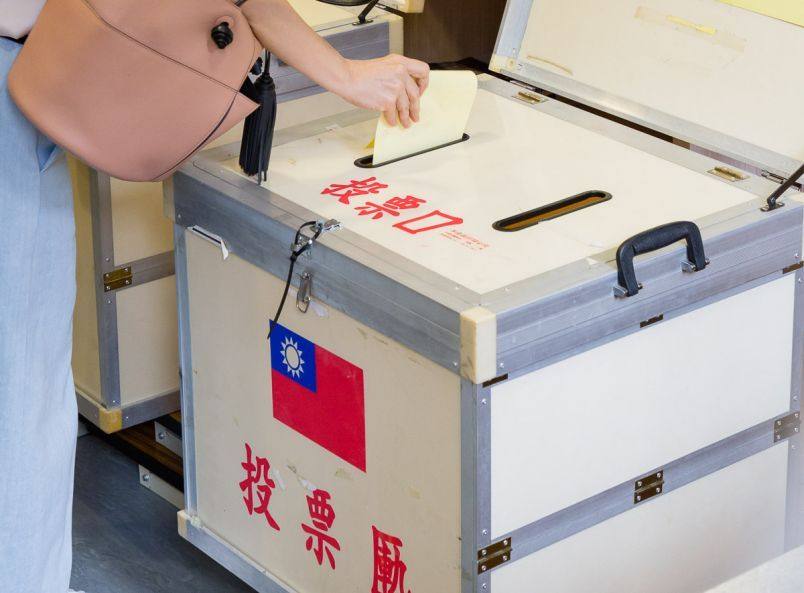
China warned on Sunday that “reunification” with Taiwan cannot be stopped, delivering its first formal response to Taiwan’s local elections, in which the ruling Democratic Progressive Party (DPP) doubled the number of cities and counties it controls but the opposition Kuomintang (KMT) held on to the capital, Taipei.
Source: Reuters
Taiwan voted on Saturday in local elections across all 22 cities and counties. The KMT’s Chiang Wan-an won re-election as Taipei mayor, while the DPP captured Taichung and doubled its tally. Read the full results story
China’s Taiwan Affairs Office said in a statement that it had “noted” the election result, adding that “mainstream public opinion” in Taiwan wanted peace, development, exchanges and cooperation. “No matter how Taiwan’s political landscape changes, it cannot alter the direction and trend of cross-Strait relations moving forward, and it cannot stop the historical trend that the motherland must and will inevitably be reunified,” the statement said.
Beijing also said it would continue to “firmly crack down on Taiwan independence separatist forces and oppose external interference” and “advance the great cause of national reunification.” China views democratically governed Taiwan as its own territory and has never renounced the use of force to bring the island under its control. Taiwan’s government rejects Beijing’s territorial claims.
Taiwan’s government answered back, saying China should respect its democratic system and the choices of its people and face the election result pragmatically. Beijing should talk with Taiwan’s democratically elected, legitimate government on the principles of “no preconditions and equal dignity”, the China-policy making Mainland Affairs Council said in a statement.
Source: Reuters
The results: DPP doubles its tally, KMT keeps Taipei
Final counts gave the KMT 11 of Taiwan’s 22 top local posts, the DPP 10, and one to an independent. The DPP’s tally doubled from the five cities and counties it won four years ago — its best local showing since 2014 — but it still fell short of the KMT overall. The DPP’s biggest prize of the night was Taichung, the island’s second-most-populous city, in central Taiwan.
In Taipei, the most watched race of the night, KMT incumbent Chiang Wan-an won a second term with about 53.8% of the vote against DPP challenger Puma Shen, who took about 45.6%, with almost 90% of polling stations counted. Shen, an academic-turned-lawmaker and expert on Chinese disinformation whom Beijing has sanctioned and labelled a “separatist”, conceded and called Chiang to congratulate him. The DPP has won the Taipei mayorship only once, in 1994.
Source: Associated Press
Shen said the result was real and Taiwan’s democracy could be trusted. “No matter who wins in the end, it will be a victory for Taipei and a victory for democracy,” he said. Chiang thanked Shen, saying: “Together, we have completed a celebration of democracy.”
Beijing’s pressure before the vote
The China issue did not feature prominently during the campaign, which focused on domestic issues such as water safety, school meals, transport and the environment. But in the run-up to the vote, China relentlessly attacked Shen, and sent about 33 warplanes and eight warships into the skies and waters around Taiwan on Friday, according to Taiwan’s defence ministry. Chinese state media also launched a fresh attack on Shen the same day, saying the United States had backed him and “deeply interfered” in the vote.
Taiwan also voted to bring back nuclear power in a landmark referendum held on the same day, overturning the island’s nuclear-free policy. Read: Taiwan votes to bring back nuclear power
What happens next: all eyes on 2028
Attention now turns to Taiwan’s next presidential election in early 2028. President Lai Ching-te, who is also the DPP chairman, will almost certainly seek a second and constitutionally limited final four-year term. The KMT has not confirmed its candidate. Its chairwoman, Cheng Li-wun, who met Chinese President Xi Jinping in Beijing in April, said there was a lot of work ahead, including for the 2028 vote.
Chiang, widely considered a possible future presidential contender after his convincing re-election, gave no indication he was interested in standing in two years’ time. “For the next four years, I am the mayor of Taipei,” he told reporters on Sunday, adding that as a KMT member he would of course offer a supporting role for 2028.
China refuses to speak with Lai, saying he is a “separatist”. Lai says only Taiwan’s people can decide their future. With Beijing’s military pressure continuing — dozens of warplanes flew near the island on the eve of the vote — the coming weeks will show whether the post-election calm holds or the pressure campaign resumes.
What is solid
- Final results: KMT 11, DPP 10, one independent of 22 top local posts
- China’s Taiwan Affairs Office issued the reunification statement on Sunday
- Taiwan’s Mainland Affairs Council replied, urging talks with no preconditions
- About 33 Chinese warplanes and eight warships operated around Taiwan on Friday, Taiwan’s defence ministry said
What is only claimed
- Whether the DPP’s gains signal a shift in views on China — Beijing frames the DPP as separatist, while Taipei says local issues decided the vote